Why Kona Coffee & Tea matters.
Kona Coffee & Tea is a family-owned coffeehouse where Kailua Village's historic commercial character meets single-estate Kona coffee cultivation, multigenerational entrepreneurship, and Hawaiʻi Island's specialty coffee culture.
Positioned along Palani Road at the entrance to Kona Coast Shopping Center, Kona Coffee & Tea occupies a Central Kailua-Kona location between the town's inland commercial districts and the waterfront streets surrounding Kailua Bay. The freestanding café features a broad lanai wrapping around three sides of the building, connecting its bright interior with shaded outdoor seating and the warm coastal air. Visitors encounter the coffeehouse through a spacious ordering counter and retail area where freshly prepared espresso drinks, brewed coffee, and packaged Kona beans bring the company's agricultural production into a single setting. Indoor tables accommodate extended conversations and working sessions, with the surrounding lanai providing a quieter setting for breakfast, coffee tastings, and the movement of neighborhood customers throughout the day. The result is a distinctive community coffeehouse whose approachable physical setting introduces a family enterprise built around direct control of Kona coffee from cultivation through roasting and service.
What defines Kona Coffee & Tea.
Kona Coffee & Tea is best known for the Bolton family's transformation of a former cattle ranch on Hualālai into an award-winning, vertically integrated coffee enterprise that grows, processes, roasts, and serves its own 100% Kona coffee. Daniel and Janet Bolton acquired 154 acres of ranchland called Waiono Meadows in 1996, establishing the foundation for an agricultural undertaking that would eventually involve three generations of their family. Daniel operated Bolton Construction, a Hawaiʻi Island building company, and approached coffee cultivation as an opportunity to preserve the agricultural character of land overlooking the Kona coast. In spring 1998, the couple enlisted their children Malia, Danny, and Kirstina, alongside extended family members, to plant the first twenty acres of Arabica Typica coffee. The project demanded a substantial commitment before its first commercial harvest, with young coffee trees requiring several growing seasons to reach productive maturity. An adjoining 99 acres joined the property in 1999, expanding the family's agricultural holdings as the original plantings developed. The first ripe coffee cherries arrived in 2000, allowing the Boltons to begin harvesting and roasting the crop they had established two years earlier. Their early production achieved a major distinction in 2002 when Kona Coffee & Tea won first place in the Kona Coffee Cultural Festival Cupping Competition, a blind evaluation of coffees produced within the region. The recognition strengthened the family's position within an established agricultural community whose producers had cultivated Kona coffee for generations. The Boltons opened their first retail location near Honokōhau Harbor in 2003, introducing their coffee directly to customers through a small shop initially dedicated to drip brewing. Malia Bolton returned to Hawaiʻi after attending college in California and on Oʻahu, eventually assuming an important role in developing the family enterprise. A consequential production expansion followed in 2006 when the company established its own wet and dry milling facilities, bringing another major stage of coffee processing under direct family control. That investment allowed the Boltons to manage the transformation of harvested cherries into export-ready green beans, strengthening consistency across cultivation, processing, and roasting. Another competitive achievement arrived in 2009 when Kona Coffee & Tea placed first in the Gevalia Crown Cupping Competition, prevailing against ten other large Kona coffee farms in a blind tasting conducted by professional judges. The company's coffee subsequently entered the national specialty coffee spotlight through Pete Licata, who used Kona Coffee & Tea beans during his victorious performance at the 2011 United States Barista Championship. Licata later won the 2013 World Barista Championship, extending the international prominence of a competitor whose earlier national title had involved the Bolton family's coffee. The family secured a former Starbucks location in Kona Coast Shopping Center in 2013, undertaking a yearlong renovation before opening its flagship Kailua-Kona café in 2014. The move established a larger public destination for a business whose original ambitions had centered on cultivating a productive agricultural property. Malia directed the growing farm-to-cup operation, and Danny became closely involved in milling, extending the founding generation's work through specialized responsibilities within the family. The County of Hawaiʻi recognized Kona Coffee & Tea's twentieth anniversary in 2018, acknowledging an enterprise that had developed from a small family planting into a prominent regional coffee producer. The company's expansion also brought increasing attention to agricultural sustainability, with the Boltons introducing agroforestry practices that integrate coffee trees with fruit-bearing plants and native Hawaiian vegetation. This approach diversifies the cultivated landscape and strengthens the ecological relationships supporting long-term agricultural production. Kona Coffee & Tea has continued expanding its estate and direct-to-consumer business, distributing roasted coffee beyond Hawaiʻi through an online retail operation. Its historical significance rests on the unusual continuity between the family's original agricultural investment, its competitive achievements, and the development of a coffeehouse that serves beans grown and processed by the same enterprise.
How Kona Coffee & Tea fits.
Kona Coffee & Tea works as the starting point for an exploration of Kailua-Kona's royal political history, the arrival of Christianity in the Hawaiian Islands, and the surviving architecture of the Hawaiian Kingdom.
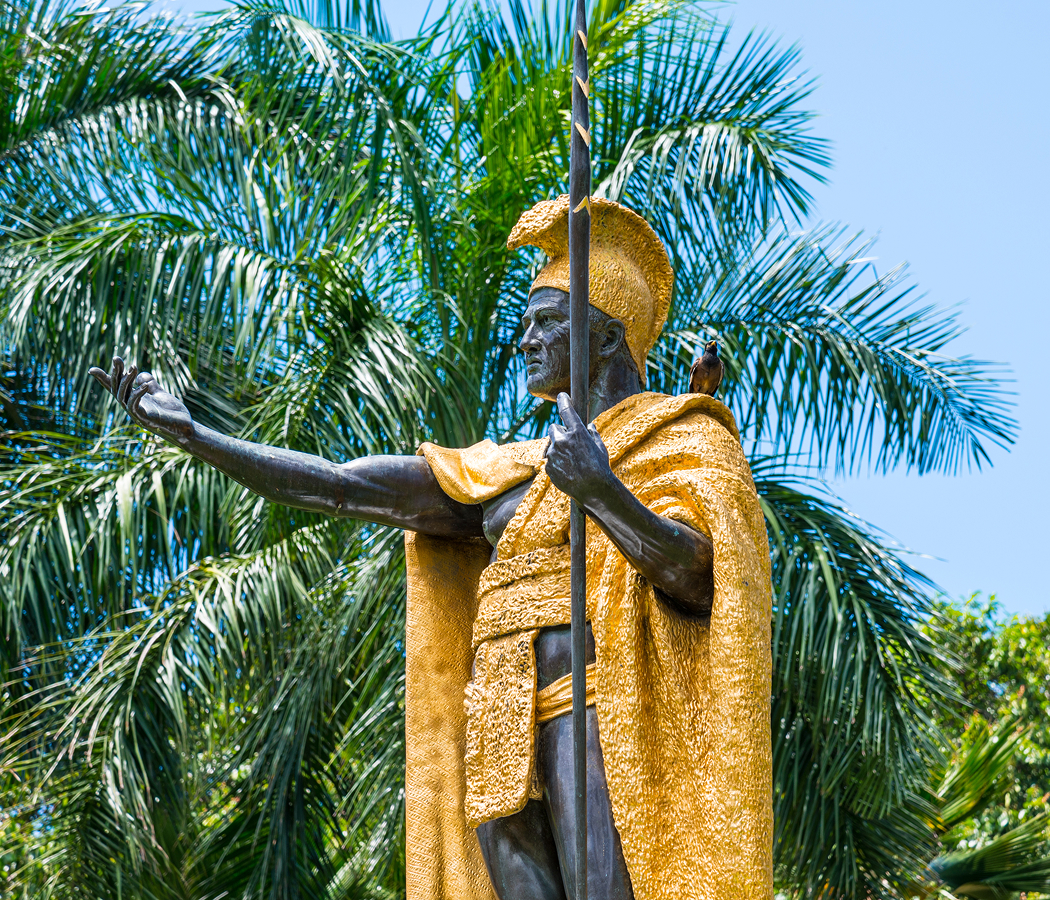
Begin at Kamakahonu National Historic Landmark, the coastal royal compound where Kamehameha I established his principal residence during the final years of his reign. The king returned to Hawaiʻi Island in 1812 and developed the shoreline property into an important center of government following his unification of the Hawaiian Islands. Its principal ceremonial structure, Ahuʻena Heiau, served as a place of religious observance and private consultation with leading advisers. Kamehameha died at Kamakahonu on May 8, 1819, initiating the succession of his son Liholiho, who became Kamehameha II. The subsequent abandonment of the traditional kapu system transformed Hawaiian religious and political life, and the arrival of the first American Protestant missionaries in April 1820 introduced another consequential historical transition. Continue to Mokuʻaikaua Church, the oldest established Christian congregation in the Hawaiian Islands and a surviving architectural expression of the kingdom's early nineteenth-century religious transformation. Asa and Lucy Thurston arrived aboard the brig Thaddeus in 1820, joining the first company of American Protestant missionaries sent by the American Board of Commissioners for Foreign Missions. Governor John Adams Kuakini supported the development of a permanent congregation, and an earlier wooden church eventually gave way to the substantial stone sanctuary completed in 1837. Its construction incorporated lava rock and lime mortar, with interior timber obtained from the upland forests of Hualālai. A commemorative stone arch was erected in 1910 during the ninetieth anniversary of the missionaries' arrival, extending the building's architectural history into the territorial period. Conclude at Huliheʻe Palace, the historic royal residence constructed in 1838 by Governor John Adams Kuakini along the waterfront of Kailua Bay. Its two-story lava-rock structure combined Hawaiian construction traditions with architectural influences introduced through the kingdom's expanding relationships with Western merchants and missionaries. The property passed through successive members of the Hawaiian royal family, including William Pitt Leleiohoku I, Princess Ruth Keʻelikōlani, and Princess Bernice Pauahi Bishop. King Kalākaua and Queen Kapiʻolani subsequently used the residence as a retreat, connecting its domestic spaces with the monarchy's final decades. The Daughters of Hawaiʻi preserve the palace as a museum containing koa furnishings, royal portraits, featherwork, Hawaiian quilts, and other artifacts associated with nineteenth-century chiefly life. The progression moves from Kamakahonu National Historic Landmark's royal political authority through Mokuʻaikaua Church's religious transformation and culminates at Huliheʻe Palace, where the surviving domestic architecture and collections preserve the cultural world of Hawaiʻi's nineteenth-century monarchy.
Where your story begins.
Foresyte Travel reveals places that feel extraordinary long before you arrive.
Enjoy editorial crafted for luxury travelers.