Why LaSalle Street matters.
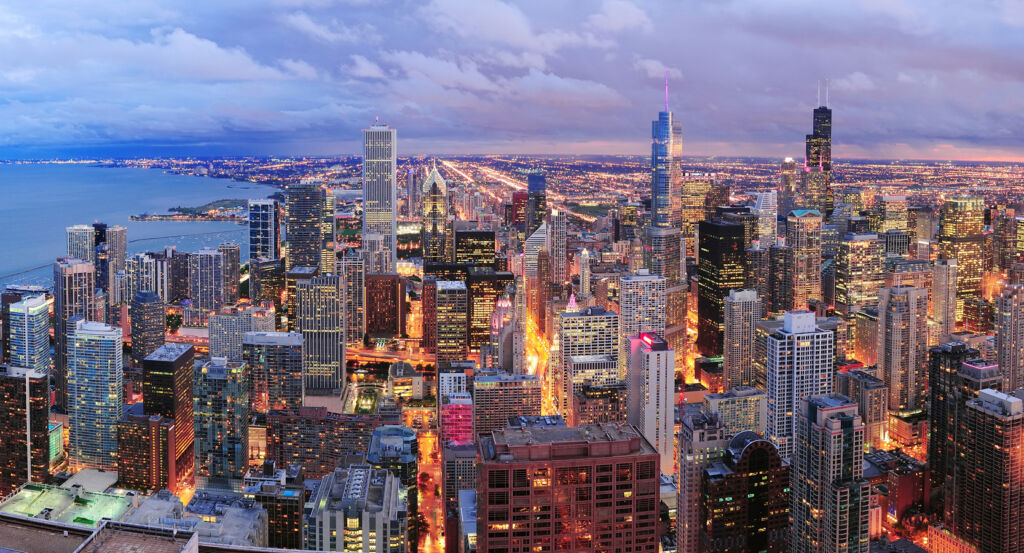
LaSalle Street is an enterprising corridor where the Loop's financial influence, architectural ambition, civic authority, and Chicago's emergence as a global commercial center have defined one of the nation's most consequential urban streets.
Running through the Loop between River North and Printer's Row, LaSalle Street connects expansive office towers, government institutions, historic skyscrapers, financial headquarters, and public plazas that collectively chronicle more than 175 years of downtown development. The corridor reveals how banking, law, commerce, and civic leadership established an urban landscape whose influence extends far beyond Chicago. Successive generations of landmark architecture continue standing beside contemporary investment, preserving the corridor's historic character while accommodating the evolving needs of a modern financial district. The result is a corridor distinguished by institutional prominence, architectural excellence, and an enduring place at the heart of Chicago.
What defines LaSalle Street.
LaSalle Street is best known for serving as the historic center of Chicago's financial district, where reconstruction following the Great Chicago Fire of 1871 accelerated the development of banks, commodity exchanges, insurance companies, and corporate headquarters that established the city as one of North America's principal commercial capitals. Completion of steel-frame office buildings between the 1880s and the early twentieth century introduced pioneering skyscraper engineering through the work of architects including William Le Baron Jenney, Burnham & Root, Holabird & Roche, and D. H. Burnham & Company. Construction of the LaSalle Street Station terminal in 1903, expansion of elevated railway service, and continued investment in nearby government institutions reinforced the corridor's role as one of Chicago's foremost centers of finance, transportation, and civic administration. Ongoing adaptive reuse and preservation have retained LaSalle Street's extraordinary concentration of historic commercial architecture while supporting continued investment in office, residential, and institutional development.
Creation of the LaSalle Reimagined initiative established a coordinated strategy for converting underused commercial towers into residential and mixed-purpose buildings while strengthening the long-term vitality of Chicago's central business district. Designation of the Loop Retail Historic District on the National Register of Historic Places recognized an exceptional concentration of late nineteenth- and early twentieth-century commercial architecture documenting the broader evolution of Downtown without relying upon the corridor's principal visitor destinations. Engineer William Le Baron Jenney advanced steel-frame construction methods that fundamentally reshaped commercial architecture throughout the district, influencing generations of office buildings surrounding LaSalle Street. Together, LaSalle Reimagined, the Loop Retail Historic District, the National Register of Historic Places, and William Le Baron Jenney demonstrate how strategic reinvestment, historic preservation, and engineering innovation have collectively reinforced LaSalle Street's enduring significance.
How LaSalle Street fits.
LaSalle Street works as an exploration of Chicago's financial history, architectural achievement, and civic identity.
Begin at Chicago Board of Trade Building, where expansive Art Deco architecture and the historic center of American commodities trading establish the economic foundations that shaped both LaSalle Street and Chicago's rise as an international commercial powerhouse. Continue to Federal Reserve Bank of Chicago Money Museum, where interactive exhibits and the history of American monetary policy deepen the story from private enterprise into the broader institutions that sustain the national financial system before leading naturally toward the civic core. Conclude at Chicago City Hall, where more than a century of municipal leadership, landmark Beaux-Arts architecture, and the enduring relationship between government and commerce provide the historical and civic payoff, demonstrating how public institutions helped shape the financial district's continuing evolution. The complete sequence reveals how markets, monetary stewardship, and civic governance collectively explain why LaSalle Street remains one of the defining corridors in the economic history of both Chicago and the United States.
Where your story begins.
Foresyte Travel reveals places that feel extraordinary long before you arrive.
Enjoy editorial crafted for luxury travelers.
Foresyte may earn a commission when you book.