Why Bibliothèque-musée de l'Opéra matters.
Bibliothèque-musée de l'Opéra is a scholarly theatrical archive where Chaussée-d'Antin's grand boulevard character meets three centuries of operatic history, Charles Garnier's imperial architecture and an exceptional collection devoted to performance, dance and stage design.
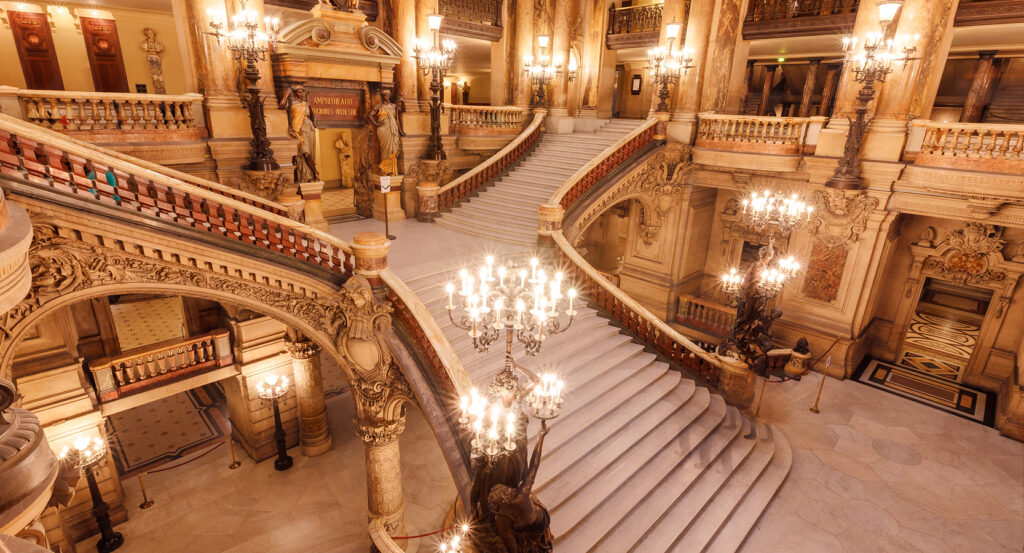
Set within Palais Garnier near Rue Scribe and just steps from Rue Auber, the museum occupies the western pavilion where arcaded stone elevations, the projecting imperial rotunda and the theater's richly sculpted exterior rise above the dense commercial streets surrounding Place de l'Opéra. The library extends through rooms originally connected with Napoleon III's intended ceremonial entrance, embedding collections and reading spaces inside architecture conceived for the imperial court. Galleries retain Garnier's nineteenth-century proportions as paintings, drawings and three-dimensional stage models introduce a smaller sequence of rooms within the immense theatrical complex. The unfinished masonry visible near the temporary exhibition area preserves another physical layer, exposing construction interrupted after the fall of the Second Empire in 1870. The result is an unusually intimate interior within Palais Garnier where theatrical scholarship, exhibition design and unfinished imperial architecture occupy the same historic structure.
What defines Bibliothèque-musée de l'Opéra.
Bibliothèque-musée de l'Opéra is best known for preserving the artistic and archival inheritance of the Paris Opera through an institution formally established in 1866 under archivist Charles Nuitter. Its holdings originated much earlier in the Académie Royale de Musique, founded under Louis XIV, where performance scores and orchestral parts accumulated through the copyists' office before a formal library existed. Administrative archives expanded after the City of Paris assumed responsibility for the Opera in 1749, adding financial and personnel documentation to the growing musical holdings. Fires that destroyed Opera theaters in 1763, 1781 and 1873 spared major portions of these collections through their storage apart from the auditoriums or prior transfer to the new Palais Garnier. The 1866 ministerial decree placed the library and archives under Nuitter, who began imposing institutional order on material inherited from successive Opera administrations. Composer Ernest Reyer became librarian in 1869, and the archives-library entered Palais Garnier when the new theater opened in 1875. Nuitter then conceived a theatrical exhibition for the 1878 Exposition Universelle, using the project to enlarge the institution's iconographic holdings and establish the basis for a permanent museum. That museum opened on October 24, 1881 during an intermission of Ambroise Thomas's Hamlet and received formal status through the decree of December 10, which divided the institution into archives and museum, musical library and dramatic library. The library moved into the western pavilion in 1882, joining archival preservation, musical scholarship and theatrical collecting within the palace whose performances generated much of its holdings.
Charles Nuitter developed the museum through a collecting program that transformed objects associated with individual performers into a substantial visual history of European theater. Study missions to Italy between 1881 and 1892 secured acquisitions including two Francesco Battaglioli paintings created for Farinelli, and the new gallery encouraged gifts of drawings, paintings and sculpture. Charles Garnier strengthened the architectural holdings in 1883 by offering the state his drawings, studies and sketches for construction of the new Opera, selecting the library and archives of the Académie nationale de musique as their destination. Charles Malherbe expanded the museum after Nuitter's death, organizing an autograph-music exhibition during the 1900 Exposition Universelle and reopening improved galleries to a broader public in 1903. Nuitter's own bequest entered the institution during this period, adding another body of material assembled by the archivist who had shaped its modern form. The Archives Internationales de la Danse entered in 1952, deepening holdings devoted to choreography and performance. A major reconfiguration in 1992 separated research areas from museum circulation and introduced a permanent gallery designed by Richard Peduzzi alongside temporary exhibition rooms in Garnier's lower rotunda. The museum now draws from 2,500 stage models, 3,000 objects including 500 paintings and 3,000 pieces of stage jewelry, with the broader library preserving scores, costume and set designs, photographs, programs and architectural archives tied to the Opéra de Paris and Opéra-Comique.
How Bibliothèque-musée de l'Opéra fits.
Bibliothèque-musée de l'Opéra works as the anchor for a daytime exploration through the theater district using three nearby sites that move from the architectural machinery of the Opera itself through a theater rebuilt after catastrophic fire into a Bourbon memorial erected over a Revolutionary burial ground.
Begin at Palais Garnier, whose creation followed the 1858 attempt by Felice Orsini and his accomplices to assassinate Napoleon III as the emperor approached the existing Opera. An international competition launched in 1860 drew 171 proposals, and thirty-five-year-old Charles Garnier won the second round in 1861 despite having completed few major buildings. Construction began in 1862, when steam pumps operated for months to address groundwater beneath the site, and the building rose through a vast collaborative campaign involving painters, sculptors and decorative artists. War halted work in 1870, the unfinished structure became a hospital and military store, and the fall of Napoleon III required removal of imperial emblems. Destruction of the Salle Le Peletier by fire in October 1873 accelerated completion, leading to inauguration under President MacMahon on January 5, 1875. Continue to Opéra-Comique, where the present Salle Favart emerged directly from the fire that destroyed its predecessor during Ambroise Thomas's Mignon on May 25, 1887. The state launched a reconstruction competition in 1893, and Louis Bernier won from 88 candidates before a jury chaired by Charles Garnier. Bernier answered the disaster with a puddled-iron structural frame, electric illumination, a fire curtain and improved circulation, making the rebuilt house a technical response to the weaknesses of nineteenth-century theater construction. Félix Faure attended its 1898 inauguration, and the decorative campaign brought together Jean-Joseph Benjamin-Constant, Henri Gervex, Albert Maignan and sculptors including Alexandre Falguière; Christofle supplied gilded-bronze balustrades, ornament and chandeliers. Conclude at Chapelle Expiatoire, erected on the former Madeleine cemetery where Louis XVI and Marie-Antoinette had been buried after their executions in 1793. Louis XVIII transferred their remains to the Basilica of Saint-Denis on January 21, 1815 and commissioned a memorial on the burial ground as the restored Bourbon monarchy confronted the memory of the Revolution. Pierre-François-Léonard Fontaine directed the project with Hippolyte Lebas, developing an enclosed complex completed in 1826 whose classical architecture incorporates medieval and Renaissance references. Joseph Bosio's Apothéose de Louis XVI and Jean-Pierre Cortot's Marie-Antoinette soutenue par la Religion established the sculptural center of a building repeatedly threatened with destruction before its protection as a historic monument in 1914. The progression moves from Garnier's immense Second Empire theater through Bernier's technically advanced reconstruction after the Favart fire into Fontaine and Lebas's Bourbon memorial on Revolutionary burial ground, developing three distinct ways architecture around the Opera district converted political rupture, catastrophe and institutional memory into enduring physical form.
Where your story begins.
Foresyte Travel reveals places that feel extraordinary long before you arrive.
Enjoy editorial crafted for luxury travelers.
Foresyte may earn a commission when you book.