
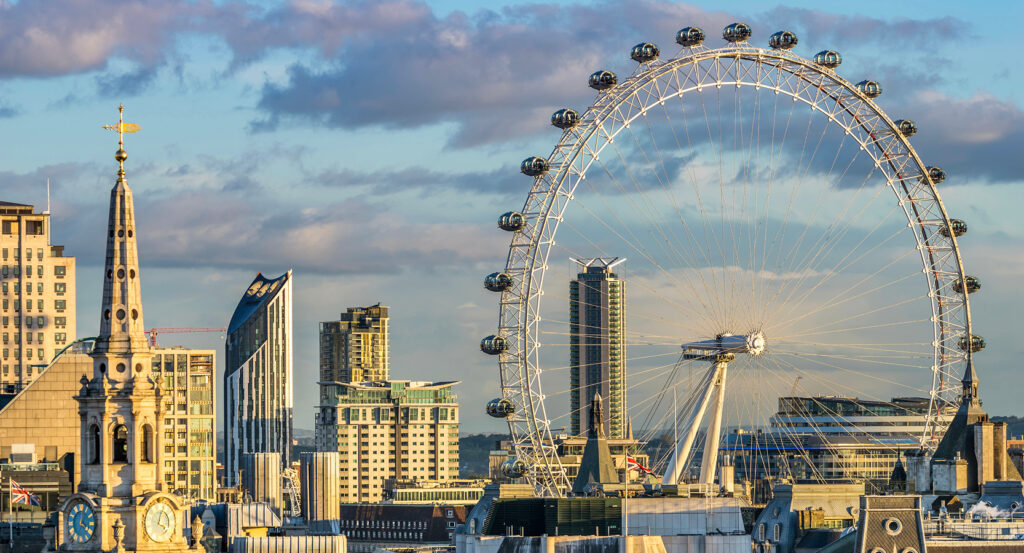
Why Ludgate Circus matters.
Ludgate Circus is a commercial junction where the City of London's publishing heritage, financial activity, Victorian engineering, and historic street network converge.
Positioned between the City of London and Blackfriars, this prominent junction connects Fleet Street, Ludgate Hill, Farringdon Street, and New Bridge Street within one of London's oldest commercial landscapes. Victorian office buildings, railway infrastructure, civic architecture, and busy thoroughfares establish a setting shaped by commerce, transportation, journalism, and centuries of urban development. Continuous rebuilding following the Great Fire of London, nineteenth-century street improvements, and modern commercial investment have preserved the crossroads as a principal gateway into the historic City. The result is an experience defined by commercial continuity, engineering achievement, and one of Central London's busiest historic intersections.
What defines Ludgate Circus.
Ludgate Circus is best known for its creation during the City of London Improvements of the 1860s, when the Metropolitan Board of Works directed major street widening projects under chief engineer Sir Joseph Bazalgette to relieve congestion between the West End, Blackfriars Bridge, and the commercial heart of the City. The junction emerged through the construction of Queen Victoria Street between 1861 and 1871, the widening of Ludgate Hill and Fleet Street, and the completion of Holborn Viaduct in 1869, creating new east-west and north-south traffic routes while supporting London's rapidly expanding commercial economy during the Victorian period. Directly beneath the junction, the Snow Hill Tunnel first opened in 1866 to connect the London, Chatham and Dover Railway with the Metropolitan Railway before closing to passenger services in 1916 and reopening in 1988 as the core of the Thameslink network, among Britain's busiest cross-London rail corridors. Ludgate Circus occupies the historic western approach to the City through the former Ludgate, the Roman and medieval gate demolished in 1760, while surrounding buildings accommodated newspaper publishers, insurance companies, banks, and legal offices that reinforced Fleet Street's position as Britain's newspaper center throughout the nineteenth and twentieth centuries.
Blackfriars Station reopened in its present form in 2012 after a major reconstruction that extended platforms across the River Thames, making it the only mainline station in London spanning the river while incorporating photovoltaic roof panels covering 6,000 square metres. St. Bride's Church, rebuilt by Sir Christopher Wren between 1672 and 1703, became closely associated with journalists and printers through its longstanding relationship with nearby Fleet Street publishing houses. The former Daily Express Building, completed in 1932 to designs by Sir Owen Williams with engineers Ellis & Clarke, introduced pioneering curtain-wall construction and Vitrolite glass cladding that established new standards in British commercial architecture. Blackfriars Bridge, designed by Joseph Cubitt and opened in 1869 to replace Robert Mylne's eighteenth-century crossing, continues carrying traffic across five wrought-iron arches while preserving granite piers decorated with carvings representing freshwater birds upstream and seabirds downstream.
How Ludgate Circus fits.
Ludgate Circus works as a daytime exploration of the City's publishing history, engineering achievements, and Victorian infrastructure.
Begin at St. Bride's Church, where centuries of association with London's newspaper industry provide context for the surrounding commercial streets. Continue to Blackfriars Station, whose river-spanning platforms and Thameslink engineering reveal the scale of modern transport infrastructure built upon Victorian foundations. Conclude at Blackfriars Bridge, where expansive Thames views and nineteenth-century engineering provide a fitting finale celebrating the transportation networks that have shaped this part of the City for generations. The progression moves naturally from publishing history to railway engineering before concluding with river infrastructure, revealing why Ludgate Circus remains a vital crossroads within the City of London.
Where your story begins.
Foresyte Travel reveals places that feel extraordinary long before you arrive.
Enjoy editorial crafted for luxury travelers.
Foresyte may earn a commission when you book.














































































































