Why Moana matters.
Moana is an oceanfront Hawaiian restaurant where Kaʻūpūlehu's historic fishing heritage meets Pacific Rim cooking, contemporary island craftsmanship, and the revival of one of Hawaiʻi's most celebrated coastal retreats.
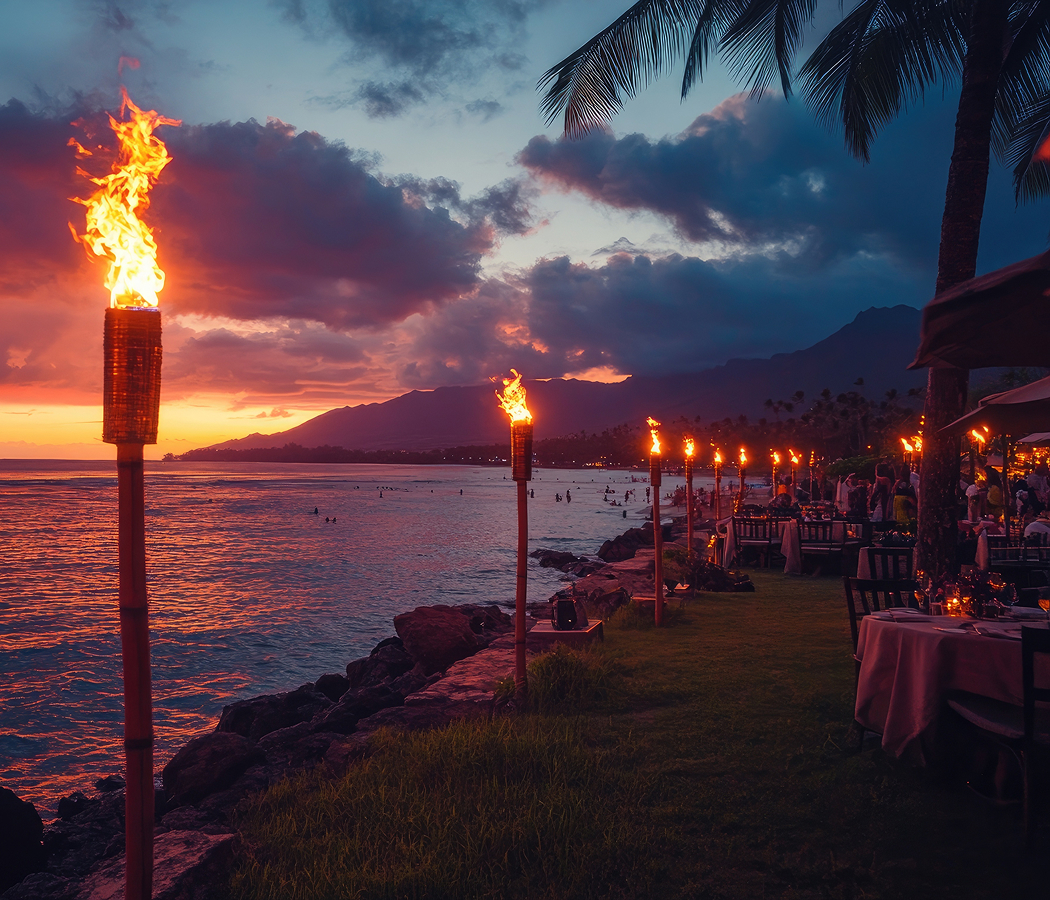
Occupying the central waterfront of Kona Village, A Rosewood Resort, Moana overlooks Kahuwai Bay along the volcanic North Kona coastline, with Hualālai rising inland and a broad expanse of Pacific water extending beyond the sheltered beach. Its soaring A-frame roof, open sides, substantial timber columns, and ocean-facing dining terraces create a distinctive architectural setting inspired by traditional Hawaiian communal structures. Dining unfolds around a central gathering area and open kitchen, where the preparation of seafood and island produce remains visible beneath the elevated ceiling. The changing coastal light reaches deep into the restaurant throughout the day, and sunset brings warm reflections across the dining tables as waves break along the adjoining lava shoreline. The result is a remarkable coastal dining room whose architecture, craftsmanship, and proximity to the Pacific establish an intimate connection with the history of Kona Village.
What defines Moana.
Moana is best known for the revival of Kona Village's original waterfront restaurant through a major architectural and culinary redevelopment that reconnected the property with its history as a Hawaiian coastal retreat. The restaurant's origins belong to the first Kona Village Resort, developed by entrepreneur Johnno Jackson during the 1960s on the former fishing settlement of Kaʻūpūlehu. Jackson conceived a secluded resort organized around individual thatched hale, informal communal gathering places, and the natural geography of Kahuwai Bay. The original property opened in 1965 and became associated with a distinctive form of Hawaiian hospitality built around extended family vacations and returning generations of travelers. Moana occupied an important position within that arrangement as the resort's principal dining room, bringing visitors into a shared waterfront setting. Its thatched roof and communal character became recognizable features of the property during more than four decades of operation. The March 2011 tsunami generated by the Tōhoku earthquake devastated substantial portions of Kona Village, damaging the beachfront, destroying buildings, and forcing the resort to close. The disaster also displaced sand from the shoreline, exposing underlying rock formations and altering the coastal environment surrounding the former dining facilities. The property remained closed for more than a decade as its future became the subject of an extensive redevelopment effort. Kennedy Wilson acquired the resort in 2016 and subsequently partnered with Rosewood Hotels & Resorts to reconstruct the historic retreat. Architect Greg Warner of Walker Warner Architects led the architectural redevelopment alongside fellow principal Mike McCabe, developing a plan that preserved the low-rise village arrangement and its close relationship with the coastline. Interior designer Nicole Hollis directed the interior program through NICOLEHOLLIS, drawing upon Hawaiian craftsmanship and the communal character of the original resort. The reconstruction extended across seven years and incorporated a major environmental undertaking coordinated with Re-Use Hawaiʻi. More than 80 percent of the demolished building components were salvaged and repurposed, reducing construction waste and returning usable resources to the island community. Moana received particular attention during the redevelopment, with its reconstructed dining room positioned slightly farther inland than its predecessor. The new building retained the recognizable thatched silhouette of the historic restaurant and incorporated a more expansive interpretation of Hawaiian communal dining. Hawaiian artist Kaili Chun created a suspended installation inspired by the crab-claw-shaped peʻa sails associated with traditional Polynesian voyaging canoes. The work occupies the restaurant's vaulted ceiling, connecting its architectural scale with the seafaring traditions that shaped settlement throughout the Pacific. Artist Lynn Capell contributed a sixteen-foot painting depicting Kahuwai Bay before the development of Kona Village, placing the coastal landscape's earlier history above the restaurant's display kitchen. Suzanne Wang produced ceramic wall sconces incorporating impressions made with shells collected from the surrounding shoreline. Kamuela Hardwoods in Waimea crafted the restaurant's central live-edge gathering table from a Hilo-grown mahogany tree, extending the emphasis on island craftsmanship into its principal communal furnishing. The redevelopment also incorporated historical photographs within the private dining rooms, preserving visual connections with the former resort. Kona Village reopened under Rosewood management on July 1, 2023, returning Moana to the waterfront as the property's signature restaurant. The culinary program developed under Executive Chef Victor Palma, Food and Beverage Director Dan Daughtry, and Beverage Manager Jason Strich. Palma brought experience from major international culinary destinations to a concept built around the historical movement of ingredients and cooking traditions throughout the Pacific. His original menu connected Hawaiian seafood and agricultural products with techniques associated with Japan, Southeast Asia, and other regions linked through centuries of maritime exchange. The opening program included Hokkaido scallop crudo with green apple and shiso, kampachi collars with adobo and fermented pineapple, and a Hawaiian interpretation of loco moco incorporating fresh fish and mushroom gravy. Moana's redevelopment joined the restoration of a historic resort institution with contemporary Hawaiian art, architectural preservation, and a culinary program shaped by the Pacific's interconnected food cultures.
Victor Palma's Pacific Rim approach places the relationship between Hawaiian seafood and Asian seasoning traditions at the center of Moana's cooking, using acidity, fermentation, controlled heat, and contrasting textures to develop the character of individual ingredients. The kitchen's treatment of raw fish begins with the natural richness of ahi, whose texture benefits from restrained preparation and sharply balanced accompaniments. Charred ahi develops an additional dimension through brief exposure to intense heat, creating a lightly cooked exterior around the tender center before cucumber namasu and jalapeño ponzu introduce acidity and fresh pepper. The Japanese influence continues through the treatment of scallops, where Hokkaido shellfish encounter XO sauce, a concentrated preparation whose dried seafood and aromatic ingredients deepen the scallops' natural sweetness. Chilled Kona lobster takes the seafood program in a different direction through Kaʻū orange, Maui lime, avocado, fennel, and tarragon. Citrus sharpens the lobster's delicate sweetness, and avocado contributes a creamy texture that connects the marine ingredient with the agricultural products of Hawaiʻi Island. The kitchen develops another approach through charred Kona prawns, allowing direct heat to concentrate the shellfish's flavor before garlic chili butter introduces richness and aromatic intensity. Octopus receives similar attention through charring, with fingerling potatoes supporting its substantial texture and chimichurri supplying herbal acidity. These preparations share a commitment to allowing the principal seafood ingredient to remain recognizable beneath carefully developed supporting flavors. The relationship between local produce and Asian culinary traditions extends into vegetables, particularly through preparations involving white shoyu, konbu, and ʻinamona. Kamuela tomatoes and strawberries bring contrasting forms of sweetness into a salad sharpened by pickled mustard seeds and white shoyu vinaigrette. Konbu contributes the savory depth associated with Japanese seaweed, connecting the produce with the broader marine character of the menu. Roasted beets and carrots develop their natural sugars through heat before whipped honey ricotta and ʻinamona dukkah introduce creaminess, roasted nuttiness, and Hawaiian kukui nut. The kitchen's treatment of meat follows the same interest in balancing substantial richness with concentrated seasoning. Sticky pork ribs carry a chili glaze whose sweetness and heat are sharpened by pickled onions and jalapeño, creating contrast against the tenderness of the cooked pork. The relationship between traditional comfort food and contemporary island cooking also shapes breakfast, where loco moco retains its foundation of rice, eggs, beef, and gravy. Fried rice and other morning preparations incorporate the influence of Asian immigrant food traditions that became integral to Hawaiʻi's regional cooking. Pastry extends the culinary program into island-grown fruit and coffee through preparations whose sweetness depends on contrasting acidity and texture. Kona coffee mousse develops roasted bitterness alongside banana rum jam and macadamia nut ice cream, connecting coffee cultivation with tropical fruit and locally associated nuts. Roasted barley ice cream introduces another dimension through miso butterscotch, furikake cookie, and puffed buckwheat, combining savory fermentation with caramel sweetness and crisp grains. Pineapple upside-down cake carries the kitchen's treatment of fruit into a shared dessert, pairing toffee pudding cake with pineapple salsa, candied macadamia nut, and vanilla ice cream. Moana's cooking develops a coherent relationship between seafood, produce, fermentation, roasting, and tropical fruit, giving its Pacific Rim influences a distinctly Hawaiian agricultural foundation.
How Moana fits.
Moana works as the coastal dining centerpiece for an exploration connecting North Kona's royal aquaculture history, the preservation of Hawaiian dry forest, and the ancient rock carvings of the Kohala shoreline.
Begin at Kīholo State Park Reserve, a volcanic coastal landscape associated with one of Kamehameha I's most ambitious fishpond construction projects. The Hawaiian ruler directed the development of a substantial marine enclosure at Wainānāliʻi after Hualālai's 1800-1801 eruption destroyed his earlier Pāʻaiea fishpond. Construction of the replacement proceeded during the early nineteenth century, producing an immense stone-walled installation intended to support fish cultivation for the royal household. Its extensive kuapā enclosed coastal water through an engineered barrier whose openings maintained circulation between the pond and the ocean. Missionary William Ellis encountered the fishpond during his 1823 journey around Hawaiʻi Island, preserving an important contemporary account of its scale and significance. Mauna Loa's 1859 eruption subsequently sent lava across the surrounding coast, destroying substantial portions of the installation and permanently changing the shoreline. Continue to Waikoloa Dry Forest Preserve, a protected landscape dedicated to restoring one of Hawaiʻi Island's endangered lowland forest communities. The preserve occupies dry volcanic terrain near Waikoloa Village, where native wiliwili trees survive among introduced grasses and other vegetation adapted to the region's limited rainfall. Wiliwili, Erythrina sandwicensis, produces distinctive flowers and buoyant seeds historically incorporated into Hawaiian decorative arts and cultural practices. The arrival of the invasive erythrina gall wasp in Hawaiʻi during 2005 created a major threat to surviving trees, adding another challenge to forests already diminished by grazing and land development. Waikoloa Dry Forest Initiative coordinates native planting, invasive vegetation removal, seed propagation, and community education to support the recovery of this threatened habitat. The conservation program preserves a living component of the island's natural history within a landscape extensively altered by modern settlement. Conclude at Puakō Petroglyph Archaeological Preserve, an extensive archaeological district protecting one of Hawaiʻi's largest concentrations of ancient rock carvings. More than 3,000 kiʻi pōhaku occupy the preserve's pāhoehoe lava surfaces, preserving designs created by generations of Hawaiian inhabitants. Human figures, canoe paddlers, animals, and geometric symbols appear across the hardened volcanic terrain, connecting artistic practices with ancestral relationships and the movement of people through the coastal district. The archaeological landscape received recognition on the Hawaiʻi Register of Historic Places in 1982 and the National Register of Historic Places in 1983. Its protected carvings preserve an extensive body of Hawaiian cultural expression associated with settlement, ceremonial practices, and historical communication. The progression moves from Kīholo State Park Reserve's royal fishpond engineering through Waikoloa Dry Forest Preserve's native habitat restoration and culminates at Puakō Petroglyph Archaeological Preserve, connecting the coastal environment with the agricultural knowledge, ecological stewardship, and cultural traditions of Hawaiʻi's earlier inhabitants.
Where your story begins.
Foresyte Travel reveals places that feel extraordinary long before you arrive.
Enjoy editorial crafted for luxury travelers.
Foresyte may earn a commission when you book.