
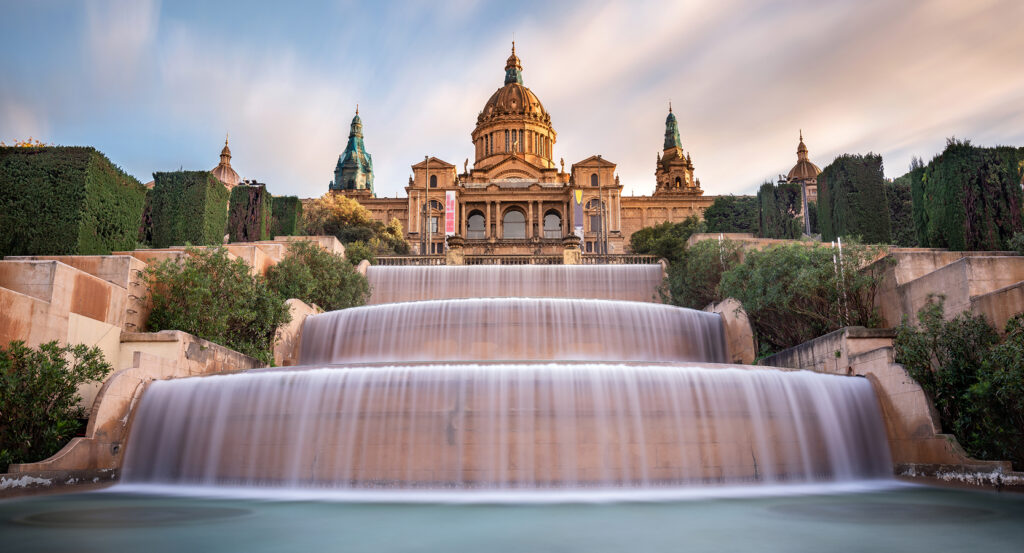
Why you should experience Poble Espanyol in Barcelona, Spain.
Poble Espanyol is a journey through Spain without ever leaving Barcelona, a living museum where the country's soul unfolds across cobbled streets, terracotta rooftops, and sunlit plazas.
Built for the 1929 International Exposition, this “Spanish Village” on Montjuïc Hill was envisioned as a microcosm of the nation's architectural and cultural diversity. Walking through its gates feels like stepping into a storybook, one where Andalusian courtyards meet Castilian plazas, and whitewashed Balearic homes stand beside Gothic Catalan mansions. The air hums with guitar strings and the scent of paella, while artisans hammer, weave, and paint inside their workshops as if time itself had slowed down. What makes Poble Espanyol truly enchanting is its authenticity: it's not a replica, but a celebration, a patchwork of 117 real buildings recreated from towns and regions across Spain, each chosen for its historical beauty and soul. Here, the line between museum and village disappears, and what remains is pure immersion in the textures, sounds, and emotions of Spanish life.
What you should know about Poble Espanyol.
Poble Espanyol was born from a daring idea, to capture the essence of an entire nation within a single village.
Designed by architects Francesc Folguera and Ramon Reventós with input from artists and intellectuals like Miquel Utrillo and Xavier Nogués, the project aimed to preserve Spain's architectural heritage at a time when modernization threatened to erase it. The team spent years traveling the country, documenting buildings, squares, and streets that defined local identity. What began as a temporary installation for the 1929 World's Fair became so beloved that it was never dismantled. Over time, Poble Espanyol evolved from exposition showcase to cultural hub, surviving the Spanish Civil War, the Franco years, and multiple renaissances as a living space for art, craftsmanship, and performance. Today, it's not just a museum of architecture but of life: its workshops produce traditional ceramics, glass, and leather goods, while its plazas host flamenco shows, concerts, film festivals, and markets that carry the pulse of modern Spain. Few visitors realize that the site's philosophy mirrors that of the Renaissance, celebrating the beauty of everyday artistry as the foundation of national identity.
How to fold Poble Espanyol into your trip.
Visiting Poble Espanyol is among the most delightful ways to spend a day in Barcelona, a perfect fusion of culture, craftsmanship, and open-air relaxation.
Take the short walk or funicular up Montjuïc Hill and enter through the grand medieval-style gate. Wander slowly through its labyrinth of narrow alleys, pausing to explore the artisan workshops, you can watch glassblowers at work, try your hand at pottery, or pick up handmade jewelry and leather pieces that make for meaningful souvenirs. Stop for a meal in one of the Andalusian courtyards where tapas and sangria are served beneath orange trees, and listen for the faint sound of flamenco guitar echoing off the stone walls. Don't miss the lookout points over the city or the energetic events that light up the village by night, from live music to open-air cinema. If you visit on a weekend, the atmosphere becomes almost magnetic, families strolling, children laughing, lights shimmering across the plazas. Poble Espanyol isn't just a tourist stop; it's a love letter to Spain's spirit, a place where history, creativity, and joy meet beneath the Mediterranean sun.
Where your story begins.
Foresyte Travel reveals places that feel extraordinary long before you arrive.
Experience premium editorial crafted for luxury travelers.














































































































