Why Mud Hen Water matters.
Mud Hen Water is a celebrated Hawaiian restaurant where Kaimukī's independent commercial heritage meets Ed Kenney's commitment to indigenous ingredients and multicultural cooking, bringing traditional island preparations, regional agriculture and contemporary culinary techniques into one of Honolulu's most influential neighborhood restaurants.
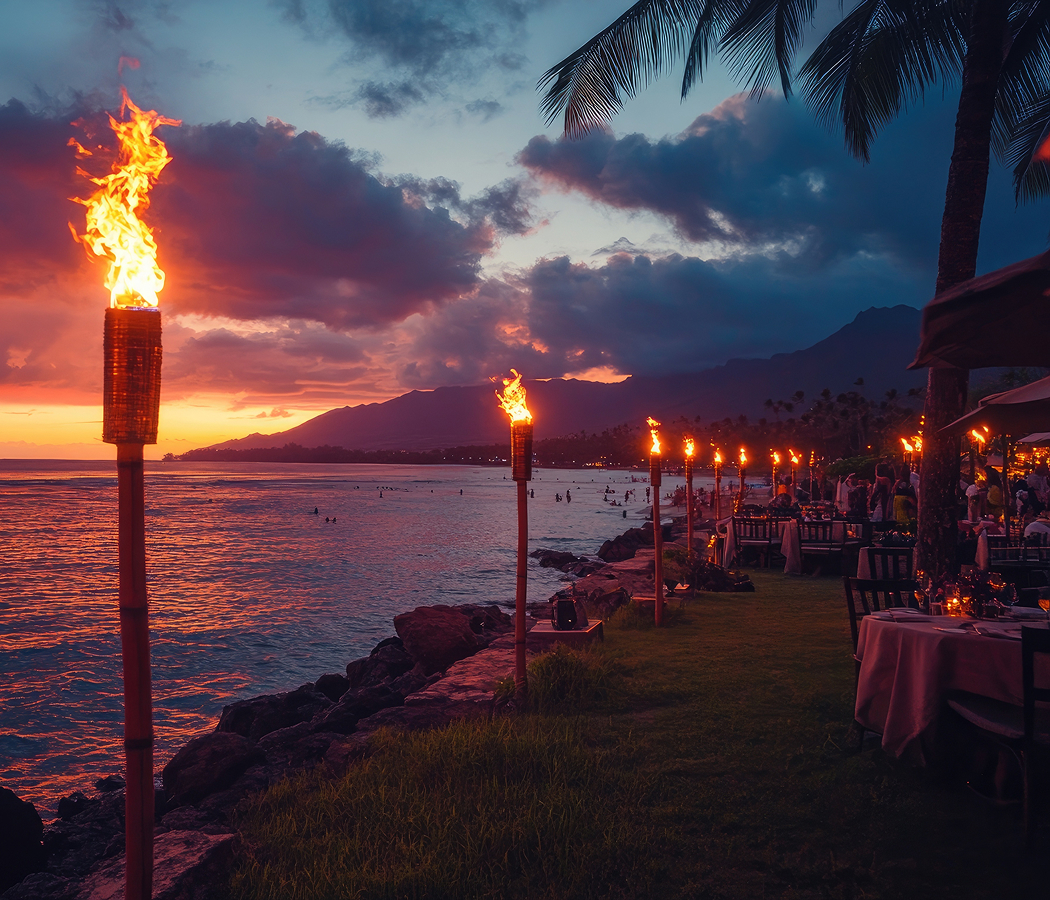
Positioned along Waiʻalae Avenue near its intersection with 9th Avenue, between Koko Head Avenue, Harding Avenue and the residential streets ascending toward Puʻu o Kaimukī, the restaurant occupies a central stretch of the neighborhood's established commercial corridor. Its understated storefront opens into a compact dining room with exposed brick, timber furnishings and an open kitchen. A garden courtyard extends the restaurant outdoors, providing additional seating beneath tropical vegetation. The surrounding avenue retains the closely spaced storefronts, independent businesses and low-rise buildings associated with Kaimukī's twentieth-century development. The result is a neighborhood restaurant whose intimate dining spaces and longstanding connections with regional producers support an influential interpretation of Hawaiian cooking.
What defines Mud Hen Water.
Mud Hen Water is best known for Ed Kenney's reinterpretation of Hawaiian food traditions and his sustained contribution to the development of locally sourced restaurant cooking in Honolulu. Born and raised on Oʻahu, Kenney grew up in a family closely connected with Hawaiʻi's entertainment industry. His mother, Beverly Noa, was an accomplished hula dancer, and his father, Ed Kenney, performed in the original Broadway production of Flower Drum Song directed by Gene Kelly. Kenney attended Punahou School before earning a business degree from the University of Colorado Boulder and entering commercial real estate development. A subsequent period of international travel changed his professional direction, with an encounter over a bowl of phở in Hanoi inspiring his decision to pursue cooking. Returning to Honolulu, he enrolled in the culinary program at Kapiʻolani Community College and developed his professional skills in local restaurant kitchens, including Indigo. His early culinary interests drew upon the ingredient-centered cooking of Northern California, particularly the emphasis on regional agriculture associated with restaurants such as Chez Panisse and Zuni Café. Kenney opened Town in Kaimukī in 2005, establishing an independent restaurant committed to seasonal ingredients and relationships with Hawaiʻi farmers. The restaurant initially encountered resistance from diners accustomed to the elaborate fusion cooking that had shaped Honolulu's fine-dining scene during the preceding decade. Its continued development helped establish Kenney among the chefs advancing a more direct relationship between restaurant kitchens and island agriculture. He expanded the business through Kaimukī Superette in 2014, combining prepared foods with a neighborhood market emphasizing locally grown ingredients. Mud Hen Water followed in June 2015, occupying premises near his earlier establishments and developing a menu more directly connected with the Hawaiian food traditions of his childhood. The restaurant's name derives from Waiʻalae, the Hawaiian place-name associated with water and the ʻalae, an indigenous waterbird. Kenney encountered the translation through an ʻŌiwi TV public service announcement devoted to Hawaiian place-names, subsequently learning of a freshwater spring associated with the bird and the surrounding district. The name connected the restaurant with the cultural significance of its immediate surroundings and Kenney's growing interest in the historical origins of Hawaiian food. That same year, he founded FoodShed Community Kitchen, providing commercial kitchen facilities and professional support for emerging food businesses. His work expanded into television in 2016 through Family Ingredients, a PBS series exploring the origins of familiar Hawaiian dishes through travel, family histories and immigrant food traditions. The program connected Kenney's cooking with the cultural histories of communities whose food became central to Hawaiʻi's regional cuisine. During the summer of 2017, Malia Obama worked at Mud Hen Water and neighboring Kaimukī Superette, bringing additional national attention to the restaurant. Eater subsequently included Mud Hen Water among America's essential restaurants, recognizing its contribution to the interpretation of Hawaiian food traditions. Honolulu Magazine named Kenney Hawaiʻi's Restaurateur of the Year in its 2019 Hale ʻAina Awards, acknowledging his influence through Town, Kaimukī Superette, Mud Hen Water and Mahina & Sun's. His wider professional activities included founding a Hawaiʻi chapter of the Chef Action Network and serving on the board of the Kōkua Hawaiʻi Foundation. These commitments strengthened relationships between restaurant professionals, agricultural producers and organizations working toward greater regional food sustainability. Mud Hen Water's significance rests on Kenney's sustained effort to connect Hawaiian ingredients with their cultural origins, establishing an influential restaurant whose cooking draws directly upon the islands' agricultural and immigrant histories.
How Mud Hen Water fits.
Mud Hen Water works as the dining centerpiece of an exploration of Kaimukī's early residential development, civic architecture and community institutions, connecting the neighborhood's commercial corridor with the public spaces that shaped its growth during the twentieth century.
Begin at Puʻu o Kaimukī, the elevated public park overlooking the surrounding residential district and Honolulu's southern coastline. The hill played an important role in the neighborhood's early development, serving as a lookout before becoming part of the infrastructure supporting residential expansion. Developers Theodore Lansing and A. V. Gear began selling Kaimukī parcels in 1898, confronting the difficulties of supplying water to an elevated district with limited natural freshwater resources. They constructed wells and installed pumps and pipes obtained from San Francisco, supporting a substantial stone reservoir on the hill. The site subsequently accommodated a telegraph station and an observatory before becoming a public park, preserving a direct connection with the neighborhood's early infrastructure. Continue to Kaimukī Fire Station, the historic civic building standing below the hill along Koko Head Avenue. The original station was completed in 1924 to accommodate Engine Company 5, bringing dedicated firefighting facilities to a growing residential community. Its Spanish Mission Revival architecture incorporates stucco surfaces and distinctive roof forms associated with civic construction during Hawaiʻi's territorial period. A substantial renovation and expansion began in 1992, adding apparatus facilities and accommodation for additional personnel. Engine Company 5 and Ladder Company 5 occupied the expanded station in October 1996, preserving the original historic structure within a larger municipal complex. Conclude at Kaimukī Public Library, the neighborhood institution designed by Honolulu architect Shoso Kagawa. The library opened on June 17, 1965, during a period when Hawaiʻi's public institutions were expanding following statehood. Its architecture reflects the development of regional civic design during the mid-twentieth century, combining a substantial public reading facility with the surrounding residential streets. The institution became an important center for access to books, educational resources and community programs, extending the neighborhood's civic infrastructure beyond its earlier municipal facilities. Its fiftieth anniversary in 2015 marked five decades of public service within one of Honolulu's established residential districts. The progression connects Kaimukī's early water infrastructure with its twentieth-century municipal architecture and concludes at a public institution whose development accompanied the neighborhood's expansion during Hawaiʻi's early statehood years.
Where your story begins.
Foresyte Travel reveals places that feel extraordinary long before you arrive.
Enjoy editorial crafted for luxury travelers.