
Why Oscar Wilde's Tomb matters.
Oscar Wilde's Tomb is a distinctive funerary monument where Père-Lachaise's wooded memorial character meets Jacob Epstein's dramatic sculpture, Wilde's posthumous literary rehabilitation and a century of changing public responses to his legacy.
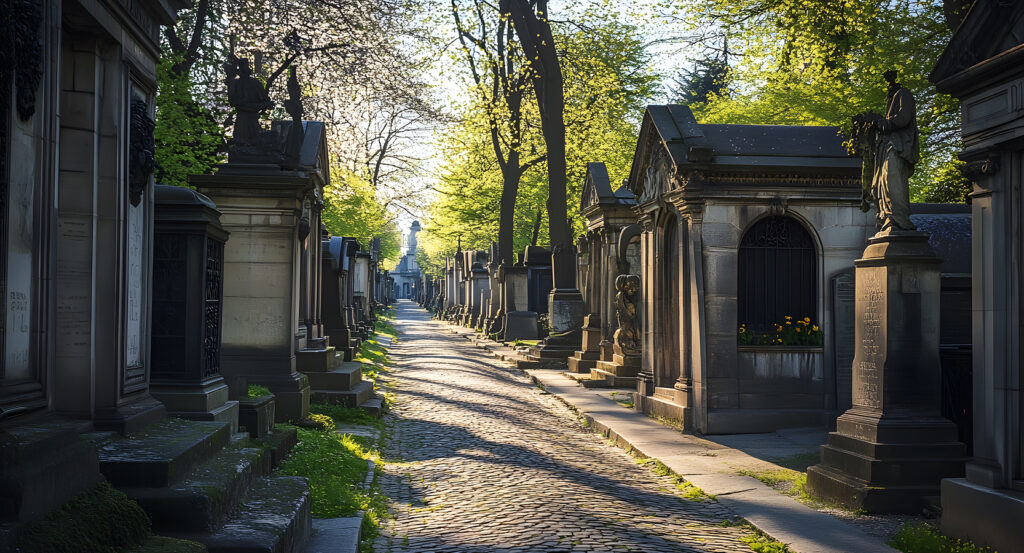
Set within Père-Lachaise Cemetery near Avenue Carette and Avenue Circulaire and just steps from the eastern cemetery wall, the tomb occupies Division 89 amid tightly packed stone graves, mature trees and sloping paths on the elevated eastern side of the necropolis. Epstein's immense pale stone block rises sharply above neighboring headstones through a winged figure whose horizontal flight cuts across the surrounding vertical monuments. The cemetery's dense arrangement places the sculpture within shifting views of chapels, obelisks and vegetation as the paths climb through the division. Protective glass now surrounds the monument, creating a transparent perimeter between Epstein's carved surface and the narrow burial ground around it. The result is an arresting encounter where an unconventional early twentieth-century sculpture interrupts Père-Lachaise's older funerary landscape with a form inseparable from Wilde's posthumous reputation.
What defines Oscar Wilde's Tomb.
Oscar Wilde's Tomb is best known for Jacob Epstein's winged stone figure, commissioned by Wilde's literary executor Robert Ross after the writer's remains were transferred from Bagneux to Père-Lachaise in 1909. Wilde had died in Paris on November 30, 1900 and received his first burial at Bagneux before posthumous sales of his work gave Ross the means to arrange the transfer. Ross selected Epstein for the memorial in 1908, supported by a £2,000 donation later revealed to have come from Helen Carew, with assistance from Sydney Schiff. Epstein initially developed a composition centered on Narcissus, abandoned that nearly completed idea and carved a new design directly into a twenty-ton block of Hopton Wood stone. The resulting sculpture drew on ancient Assyrian winged forms, translating their massive body, forward motion and stylized wings into a funerary figure unlike the conventional portrait statues surrounding many nineteenth-century graves. Architect Charles Holden designed the plinth, and stone carver Joseph Cribb cut the inscription, extending the commission across practitioners already connected with Epstein's British work. The monument became a flashpoint before its public presentation, with the figure's exposed anatomy producing objections from cemetery authorities and a covering attached to it in 1914 against Epstein's wishes. Ross had also asked Epstein to create a compartment for his own remains, and Ross's ashes entered the tomb in 1950 on the fiftieth anniversary of Wilde's death. The monument was classified as a Monument historique on March 10, 1995, securing formal protection for a work whose artistic and literary significance had outlived the hostility surrounding its creation.
Public interaction with the tomb produced another history written directly onto Epstein's stone. Admirers increasingly covered the monument with lipstick kisses during the closing decades of the twentieth century, leaving red and pink marks across the winged figure and its base. Repeated cleaning allowed oils from the lipstick to penetrate the porous stone, turning an affectionate ritual into a conservation problem. A major restoration supported by Wilde's family and the Irish government removed accumulated marks and addressed the sculpture's condition in 2011 and 2012. Transparent panels standing two meters high were installed around the tomb to prevent direct contact. The barrier changed the ritual without ending it, as kisses and messages migrated from the carved stone to the glass surface. That intervention added another physical layer to a monument already altered through censorship, vandalism and decades of public attention. Wilde's burial site carries its twentieth and twenty-first-century history through the changing boundary between Epstein's sculpture and the admirers who transformed it into an active site of literary remembrance.
How Oscar Wilde's Tomb fits.
Oscar Wilde's Tomb works as the anchor for a focused exploration inside Père-Lachaise using three sites that move from France's first crematorium through a universal sculptural memorial into the wall associated with the final executions of the Paris Commune.
Begin at Crématorium du Père-Lachaise, commissioned after the Paris municipal council requested study of a purpose-built cremation facility in 1883. Jean-Camille Formigé worked with engineer Ernest-Gustave Bartet on the project, whose construction began in 1887 and introduced a centralized Neo-Byzantine composition of striped stone, domes and chimney forms. France's first cremation took place there on January 30, 1889, giving the building a decisive role in the institutional acceptance of cremation. Formigé subsequently developed the surrounding columbarium, with its first permanent sections constructed in 1893 and 1895; the complex later expanded to more than 26,000 niches, and Carl Mauméjean supplied stained glass for the crematorium during the 1920s. Continue to Monument aux morts du Père-Lachaise, the immense work Albert Bartholomé began in 1889 after a commission from the Paris municipal council. Bartholomé spent a decade developing a composition devoted to death without distinction of rank or individual fame, organizing nude figures around the central passage into the monument. Euville stone gave the sculptural architecture a pale surface across which the bodies emerge in relief, and the completed work entered the principal perspective from the cemetery entrance. Its inauguration on November 1, 1899 established the memorial as a collective counterpart to the thousands of individual tombs surrounding it; an ossuary constructed beneath the hill during the 1950s later extended the site's funerary purpose below ground. Conclude at Mur des Fédérés, where the final fighting of the Paris Commune reached Père-Lachaise during Bloody Week in May 1871. Communards used the cemetery during their last defense as Versailles troops entered the grounds, and 147 surviving Fédérés were executed against the wall on May 28 before burial nearby. A commemorative plaque fixed the site in public memory during the opening years of the twentieth century, and burials of former Communards and political supporters around this part of the cemetery strengthened its association with the Commune. Annual commemorations turned the wall into a continuing political memorial whose significance extends beyond individual burial. The progression moves from Formigé's architectural response to a new funerary practice through Bartholomé's collective monument to the dead into the wall where the Paris Commune reached its terminal violence, developing three distinct forms of death, commemoration and public memory within Père-Lachaise.
Where your story begins.
Foresyte Travel reveals places that feel extraordinary long before you arrive.
Enjoy editorial crafted for luxury travelers.
Foresyte may earn a commission when you book.














































































































