
Why Cimetière du Père-Lachaise matters.
Cimetière du Père-Lachaise is a contemplative necropolis where Père-Lachaise's hillside character meets a Romantic cemetery garden, extraordinary funerary architecture and the resting places of figures who shaped literature, music, painting and political history.
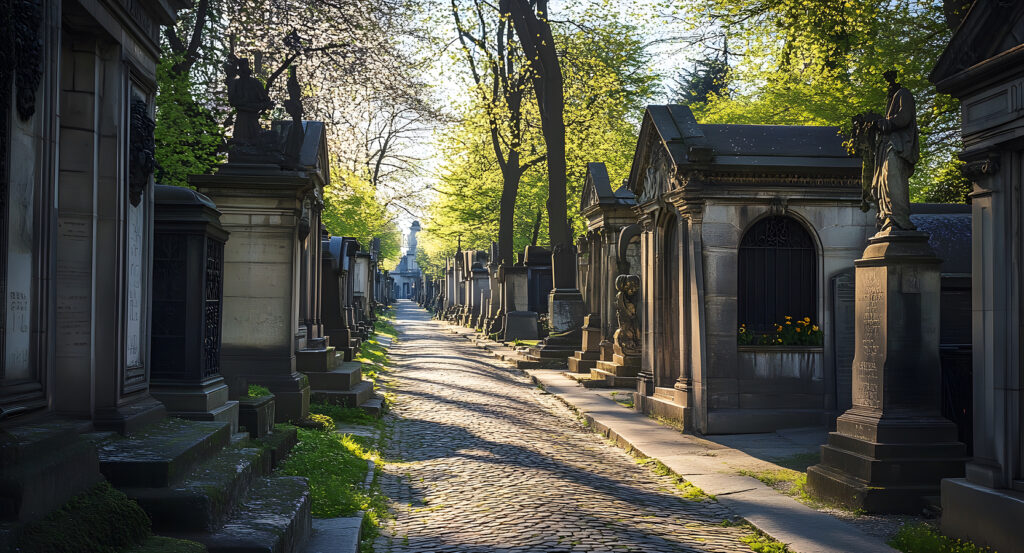
Set along Boulevard de Ménilmontant near Rue du Repos and just steps from Avenue de la République, the cemetery occupies a wooded hillside where cobbled lanes, steep stairways, stone chapels and dense tree cover rise above the surrounding apartment blocks of eastern Paris. Brongniart's winding paths climb through irregular terrain before straighter avenues appear across the later eastern extensions, making changes in the cemetery's nineteenth-century growth visible through its circulation. Mausoleums crowd closely along older routes beneath chestnuts, maples and plane trees as retaining walls and changes in elevation repeatedly open longer views across the burial ground. Monumental gates establish formal thresholds from the surrounding streets, yet the interior quickly breaks into shaded passages whose funerary sculpture ranges from compact family chapels to elaborate individual memorials. The result is a vast wooded necropolis where landscape, topography and two centuries of funerary architecture give burial ground the spatial richness of an evolving city.
What defines Cimetière du Père-Lachaise.
Cimetière du Père-Lachaise is best known for transforming Alexandre-Théodore Brongniart's cemetery garden into an immense funerary collection whose early success was deliberately accelerated through the transfer of celebrated historical dead. Jesuits had acquired the hillside of Charonne in 1626 for a country retreat called Mont-Louis, and François de La Chaise d'Aix, confessor to Louis XIV, became closely associated with the property through his stays and the royal funds that supported its enlargement. Jesuit expulsion in 1762 preceded repeated changes of ownership before Seine prefect Nicolas Frochot purchased the intact rural estate on January 10, 1804 as Paris prepared a new burial system beyond the dense central city. Brongniart retained the sloping terrain, existing vegetation and principal routes, doubling planted avenues for funeral processions and using intersections as positions for mausoleums within a landscape conceived around burial and movement. The Cimetière de l'Est opened on May 21, 1804, yet distance from Central Paris initially hindered demand, leaving only 2,000 tombs a decade later. Authorities answered in 1817 by transferring Héloïse and Abélard, Molière and Jean de La Fontaine, joining medieval romance and canonical literature to the cemetery's public reputation. The strategy altered its fortunes decisively: 33,000 tombs occupied the site by 1830, and successive enlargements between 1824 and 1850 carried it to 44 hectares. The final seventeen-hectare extension onto the Charonne plateau created a second spatial order beside Brongniart's hillside garden, replacing sinuous Romantic paths with straighter paved routes, sidewalks, benches and fountains. Funerary commissions multiplied across both territories, and the older sections eventually accumulated works by generations of architects and sculptors as Père-Lachaise developed into a vast collection of nineteenth-century commemorative art.
A separate transformation began when changing attitudes toward cremation introduced an entirely new funerary architecture into the cemetery. Paris's municipal council initiated study of a dedicated cremation building in 1883 and entrusted Jean-Camille Formigé with the project alongside engineer Ernest-Gustave Bartet. Construction began in 1887, and France's first purpose-built crematorium entered service with its first cremation on January 30, 1889. Formigé developed a centralized Neo-Byzantine composition using alternating bands of pale and dark stone, half-domed lateral chapels and a dominant brick-and-sandstone dome raised above eight arched windows. Demand for urn space prompted authorization of a permanent columbarium in 1890, followed by initial groups of niches in 1893 and 1895 and continued expansion into four wings around the crematorium. Carl Mauméjean supplied stained glass for the dome during the 1920s, extending the architectural campaign into another generation of decorative work. Paul Landowski, later internationally associated with Christ the Redeemer in Rio de Janeiro, added Le Retour éternel beneath the complex in 1954. More than 26,000 columbarium niches now surround the building, completing an architectural ensemble that traces the institutional acceptance of cremation from nineteenth-century experiment to a major component of French funerary practice.
How Cimetière du Père-Lachaise fits.
Cimetière du Père-Lachaise works as the anchor for a daytime exploration through the 20th Arrondissement using three nearby sites that move from an aristocratic country estate through the architectural ambitions of nineteenth-century Ménilmontant into one of Paris's last surviving churchyard cemeteries.
Begin at Pavillon de l'Ermitage, the last surviving component of the Château de Bagnolet, an estate acquired in 1719 by Françoise-Marie de Bourbon, daughter of Louis XIV and wife of Philippe d'Orléans. She enlarged the château and its gardens during the Regency and commissioned three garden pavilions, with the Ermitage erected between 1723 and 1727 at the western extremity of the property. The château disappeared after subdivision of the estate, but the pavilion survived under separate ownership; Baron de Batz used it from 1792 for meetings connected with royalist efforts to rescue Louis XVI, followed by another unsuccessful plan involving Marie-Antoinette. François Pomerel acquired it in 1820, and Assistance publique took possession in 1884, leaving a rare architectural remnant of the aristocratic estates that once occupied the hills beyond old Paris. Continue to Église Notre-Dame-de-la-Croix de Ménilmontant, created after a chapel serving the growing settlement proved inadequate for its expanding nineteenth-century population. Louis-Jean Antoine Héret designed the present church, with construction beginning in 1863, worship commencing in 1869 and work interrupted during the Paris Commune before completion in 1880. Héret adapted the building to Belleville's steep terrain through a commanding staircase and a church drawing on Romanesque precedents from western France, then exposed metal structure inside the nave as an architectural feature. Opening Rue Étienne-Dolet on the facade axis in 1878 strengthened the approach from Lower Ménilmontant, turning difficult topography into one of the composition's principal architectural devices. Conclude at Cimetière de Charonne, the small burial ground adjoining Église Saint-Germain-de-Charonne and one of the rare surviving Parisian cemeteries still attached directly to a parish church. The cemetery became communal property in 1791, expanded in 1845 and 1859 and entered Paris when the capital absorbed Charonne in 1860. Its 0.42 hectares contain more than 650 graves beside a church whose oldest surviving fabric reaches the twelfth century, preserving the compact church-and-burial-ground arrangement that metropolitan cemetery reform displaced elsewhere. François Bègue, known as Père Magloire and traditionally associated with Robespierre, lies beneath a tomb granted heritage protection in 1965. The progression moves from Françoise-Marie de Bourbon's Regency retreat through Héret's response to the nineteenth-century growth of Ménilmontant into Charonne's surviving parish cemetery, revealing three successive forms of settlement on the eastern hills that Paris eventually absorbed.
Where your story begins.
Foresyte Travel reveals places that feel extraordinary long before you arrive.
Experience premium editorial crafted for luxury travelers.
Foresyte Travel may earn a commission when you book through the link on this page.














































































































