
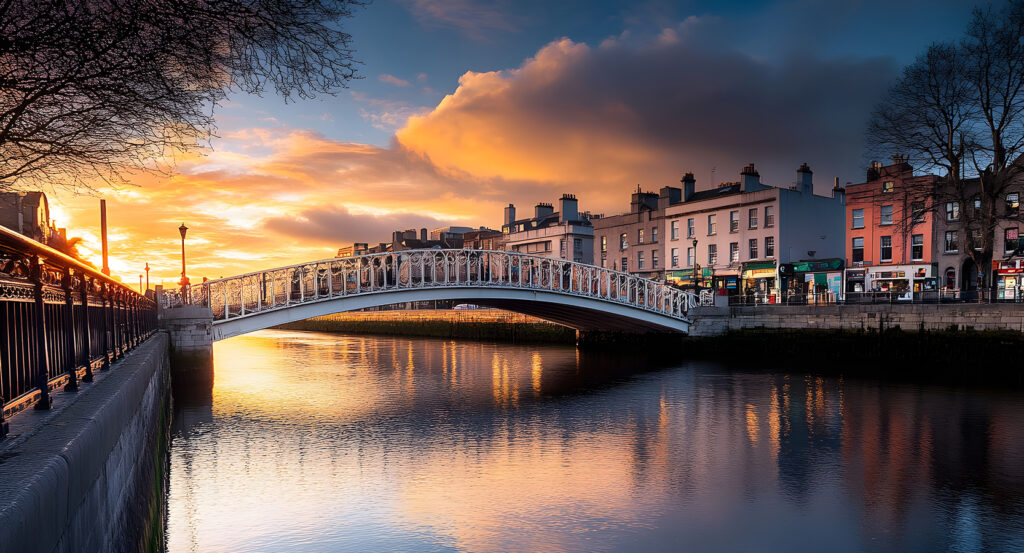
Why Pichet matters.
Pichet is a MICHELIN-recognized modern French bistro where the Creative Quarter's independent restaurant culture meets Stephen Gibson's international culinary education, Ireland's exceptional agricultural produce and Dublin's evolution into a sophisticated European dining capital.
Set along Trinity Street near its junction with Dame Street, the restaurant occupies a central position between the historic commercial buildings surrounding College Green and the pedestrian shopping streets extending toward Grafton Street. Bright red signage and striped exterior canopies distinguish its street frontage, establishing the recognizable appearance of a traditional French brasserie within Dublin's Georgian and Victorian commercial fabric. Inside, a black-and-white checkerboard floor provides a striking foundation for an interior divided between a convivial bar and a principal dining room overlooking the kitchen. Closely arranged tables, contemporary furnishings and carefully controlled lighting create an intimate dining environment whose proportions preserve the informal character of European bistro culture. The result is a restaurant whose distinctive architectural details, central commercial setting and carefully balanced interiors give contemporary French-Irish cooking an established place within Dublin's historic southern city center.
What defines Pichet.
Pichet is best known for chef-patron Stephen Gibson's transformation of an extensive international culinary career into an independent Dublin restaurant combining classical French technique with the exceptional quality of Irish ingredients. Gibson studied professional cookery at Killybegs Regional College in County Donegal before embarking on nine years of professional development across Europe, Australia and New Zealand. His early international experience included Fauchon in Paris, the celebrated French gastronomic institution whose combination of luxury food retail and professional restaurant kitchens exposed him to the technical standards of classical French preparation. A subsequent appointment at Café Otto in Sydney introduced another culinary environment shaped by contemporary European influences and Australia's growing appreciation of fresh regional produce. Gibson returned to Dublin for a period working alongside Paul Flynn at La Stampa, developing his understanding of the capital's emerging modern restaurant culture. In 1998, he joined the Queen Elizabeth 2 for a twelve-month appointment, gaining experience within the demanding culinary operations of one of the world's most distinguished ocean liners. London supplied a particularly consequential professional chapter through Nico Ladenis at 90 Park Lane, whose three-MICHELIN-starred restaurant helped establish the technical and creative ambitions of modern British haute cuisine. Gibson subsequently spent two years at Fiskekrogen in Gothenburg, expanding his knowledge of Scandinavian seafood traditions and the precise preparation of marine ingredients. A further year in New Zealand completed his international development before he returned to Ireland and became head chef at Dublin's MICHELIN-starred L'Ecrivain under Derry Clarke. Five years directing that kitchen established Gibson's professional standing within the Irish capital and provided the foundation for his independent restaurant. He opened Pichet on Trinity Street in 2009, creating a modern interpretation of the French bistro whose name references the traditional small wine pitcher associated with informal restaurant service. The MICHELIN Guide awarded Pichet a Bib Gourmand within its first six months, recognizing the combination of accomplished cooking and accessible pricing that distinguished the establishment during its inaugural year. The Dubliner magazine ranked Pichet first among Dublin's hundred leading restaurants in 2012, consolidating its reputation during a period of substantial development in the city's independent dining sector. The restaurant celebrated its fifteenth anniversary in 2024 with a five-course commemorative dinner featuring preparations associated with its history, accompanied by wine pairings and a specially assembled collection of recipes. Gibson's career established Pichet as an enduring example of Dublin's culinary development through international professional training, independent ownership and a sustained commitment to Irish food production.
How Pichet fits.
Pichet works as the evening culmination of an outing connecting Dublin's pioneering Georgian art institutions, the commercial ambitions of its Victorian merchants and the aristocratic architecture preserved within the Creative Quarter.
Begin at City Assembly House, the eighteenth-century institution established by the Society of Artists in Ireland as the first purpose-built public art exhibition venue in Britain and Ireland. Following the success of the society's inaugural exhibition in 1765, sculptor Simon Vierpyl and woodcarver Richard Cranfield directed the development of a permanent gallery financed through subscriptions that granted supporters admission to future exhibitions. Construction began in 1766, producing a distinguished Georgian building whose top-lit octagonal exhibition room established a dedicated architectural setting for Irish painting and sculpture. The building subsequently accommodated Dublin Corporation's assembly rooms and municipal cultural functions, preserving its importance within the city's civic history. A major conservation program undertaken by the Irish Georgian Society culminated in the restoration of the original exhibition room in 2018, reconnecting the building with its pioneering contribution to public artistic patronage. Continue to George's Street Arcade, the Victorian market complex originally developed as South City Markets during Dublin's nineteenth-century commercial expansion. Architects Richard and William Mawson designed the red-brick building, which opened in 1881 with forty-six shops and 112 stalls, transforming a district previously associated with slaughterhouses and crowded commercial yards into an organized indoor marketplace. A devastating fire destroyed the complex in 1892, displacing merchants and eliminating the commercial accommodation that had supported the surrounding neighborhood. Architect William Henry Byrne directed its reconstruction with Irish contractors, and Lord Mayor Valentine Dillon reopened the market in September 1894. The restored building preserved the architectural ambitions of its Victorian predecessor, establishing a durable setting for the independent traders whose businesses have sustained the district's commercial character. Conclude at Powerscourt Townhouse Centre, the Georgian aristocratic residence associated with Richard Wingfield, third Viscount Powerscourt, and his wife Amelia. Architect Robert Mack designed the townhouse as an elaborate urban residence, and the Wingfields occupied the property in 1774, using its ceremonial rooms for entertainment during Dublin's parliamentary season. Decorative plasterwork by Michael Stapleton established a sophisticated transition between Rococo ornamentation and emerging Neoclassical taste, with the principal staircase, former music room and ballroom preserving the architectural ambitions of the eighteenth-century aristocracy. Subsequent government occupation brought additions by architect Francis Johnston, who developed buildings around the courtyard during the property's adaptation for administrative functions. Its eventual conversion into a specialty shopping center preserved the historic interiors and introduced independent Irish designers, antique dealers and specialist retailers into a residence originally conceived for aristocratic entertaining. The progression moves from the Society of Artists' pioneering Georgian exhibition gallery through the commercial innovation of South City Markets and culminates in the Wingfield family's aristocratic townhouse, connecting three successive developments in Dublin's artistic patronage, mercantile expansion and decorative craftsmanship within the Creative Quarter.
Where your story begins.
Foresyte Travel reveals places that feel extraordinary long before you arrive.
Enjoy editorial crafted for luxury travelers.














































































































