
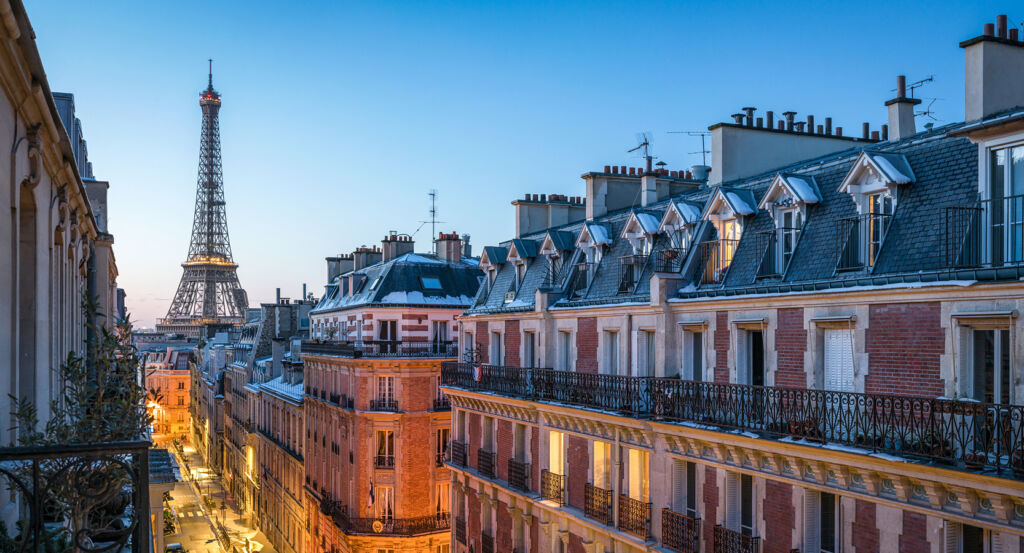
Why you should experience Pigalle in Paris, France.
Pigalle is an electric enclave where the lower slopes of Montmartre meet northern Paris through steep streets, theatrical facades, former artists' quarters and an entertainment district whose cultural reach grew far beyond the few blocks surrounding its central square.
Positioned between Montmartre, Saint-Georges, and Rochechouart, the neighborhood occupies a sloping pocket where Boulevard de Clichy and Boulevard de Rochechouart trace the base of the Butte as Rue Frochot, Rue Victor Massé and Rue Jean-Baptiste Pigalle descend toward the denser streets below. Elevation changes give the district an unusually theatrical physical rhythm, with broad boulevards opening suddenly into short side streets, enclosed villas and steep passages whose smaller scale survives behind the brighter commercial frontage. Place Pigalle establishes the primary encounter as a compact hinge between the lower city and Montmartre, its fountain, converging streets and surrounding facades gathering movement arriving from several directions. The boulevards introduce a second spatial mechanism through long sightlines beneath the Butte, where theaters and entertainment addresses accumulated along the former line of the Farmers-General wall and transformed an old metropolitan boundary into a continuous corridor of public performance. Smaller streets immediately south preserve another register through nineteenth-century houses and former studios that connect Pigalle physically with the Nouvelle Athènes below. The result is a neighborhood where topography, performance and artistic history remain compressed into a remarkably small territory, preparing an account centered on the square that became a meeting ground for successive generations of painters, writers and entertainers.
What you should know about Pigalle.
Pigalle is best known for the artistic and café culture that gathered around Place Pigalle as the Lower Montmartre district developed during the nineteenth century. The site had previously been known as Place de la Barrière-Montmartre before architect Gabriel Davioud redesigned it in 1862, and the square received the name of eighteenth-century sculptor Jean-Baptiste Pigalle in 1864 through its connection with the neighboring street. Cattle traveling toward the Montmartre slaughterhouse stopped at its fountain, which also served laundresses, embedding practical metropolitan activity into ground that soon acquired a radically different cultural role. A weekly Marché aux modèles operated there until 1910, allowing painters, sculptors and photographers to hire women as models directly from the square. Number 11 housed an artistic phalanstery of studios, adding permanent working space to the surrounding café culture. La Nouvelle Athènes became one of the crucial gathering places after painters associated with Barbizon frequented it around 1860 and the Impressionists established themselves there from 1872. Édouard Manet painted La Prune and L'Homme au chapeau rond there, Edgar Degas placed Dans un café inside the establishment in 1875, and Jean-Louis Forain also turned its interior into a subject. Émile Zola, Guy de Maupassant, Joris-Karl Huysmans, Stéphane Mallarmé and Jules Vallès joined the broader literary culture surrounding Place Pigalle, allowing a former barrier square to become one of the dense artistic meeting points between Central Paris and Montmartre.
Commercial entertainment supplied a separate mechanism for remaking Pigalle during the decades surrounding 1900. Joseph Oller and Charles Zidler opened the Moulin Rouge on October 6, 1889 at the foot of the Butte, constructing a vast dance floor, mirrored interiors, galleries and a garden containing an enormous elephant as part of an entertainment complex built to attract audiences across social classes. The quadrille performed there became internationally associated with the French cancan, and La Goulue emerged among its defining performers before Henri de Toulouse-Lautrec created his first poster for the establishment in 1891. The ballroom shifted into a concert theater after its final ball in November 1902, beginning another phase in which staged revues gained greater importance. Colette appeared in Rêve d'Égypte in 1907, and Mistinguett first performed there that July before becoming central to the venue's interwar productions. Pigalle expanded further as jazz, bars, gaming rooms and cabarets multiplied through the district during the 1930s, extending the entertainment economy from individual halls into an entire nocturnal quarter. That accumulation made the neighborhood a durable Parisian center for performance, dance and popular entertainment across successive generations.
How to fold Pigalle into your trip.
Pigalle works as the anchor for an uphill exploration connecting an early reinforced-concrete church with the visual culture of outsider art and a seventeenth-century Montmartre residence that became a home and workplace for several generations of painters.
Begin at Église Saint-Jean de Montmartre, conceived by Anatole de Baudot at the end of the nineteenth century as the growing population around Place des Abbesses required a new parish church on a constrained hillside site. Baudot worked with engineer Paul Cottancin to employ a reinforced cement system of thin structural elements, turning a technically experimental construction method into pointed arches, vaults and a narrow facade whose brick and ceramic surfaces distinguished the church from the stone ecclesiastical architecture surrounding it; Alexandre Bigot supplied architectural ceramics, and Pierre Roche contributed sculpture to the decorative program. Continue uphill to Halle Saint-Pierre, a former market hall facing the gardens below Sacré-Coeur whose Baltard-associated iron architecture was redirected toward art brut, outsider art and other forms developed beyond conventional academic institutions. The building now joins large exhibition spaces with a gallery and auditorium, placing an industrial-age market structure into the cultural territory that developed around Montmartre's independent artistic traditions. Conclude at Musée de Montmartre, established in 1960 inside the seventeenth-century Maison du Bel Air at 12 Rue Cortot, where a succession of artists had already turned the property into one of the Butte's enduring creative addresses. Auguste Renoir established a studio there in 1876 and worked on Bal du moulin de la Galette and Jardin de la rue Cortot during his Montmartre period; Suzanne Valadon later returned in 1912 with Maurice Utrillo and André Utter, beginning a twelve-year residence associated with one of the most productive periods of her career. Émile Bernard, Raoul Dufy and Charles Camoin also worked at the property, allowing the surviving house and studios to concentrate several distinct generations of Montmartre art within a single historic compound. The progression moves from Baudot and Cottancin testing a new structural system for sacred architecture through a former market hall devoted to art beyond academic institutions into Renoir, Valadon, Utrillo and their successors working inside the older fabric of the Butte, carrying Pigalle uphill through three distinct chapters of Montmartre's artistic development.
Where your story begins.
Foresyte Travel reveals places that feel extraordinary long before you arrive.
Experience premium editorial crafted for luxury travelers.














































































































