
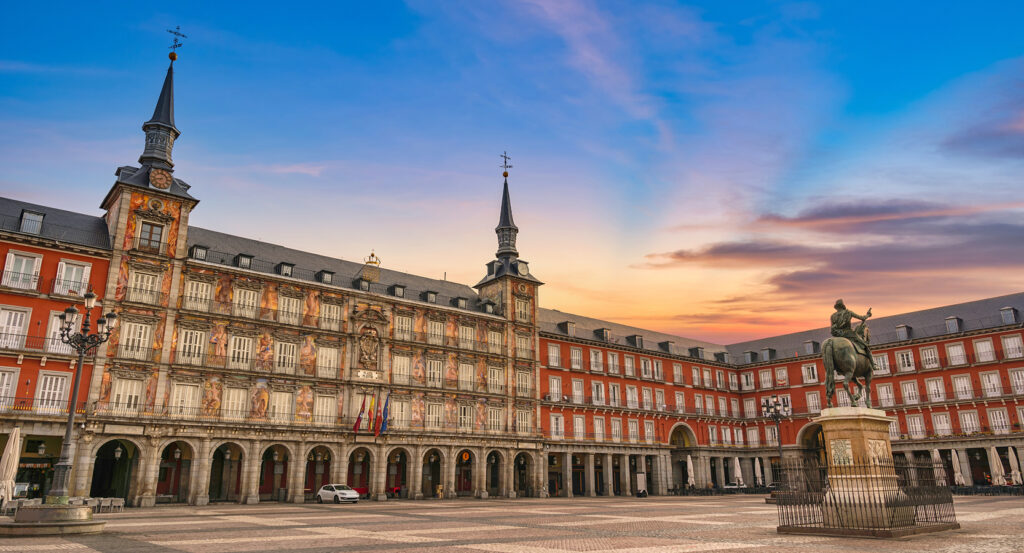
Why Casa de la Panadería matters.
Casa de la Panadería is the soul of the Madrid's Plaza Mayor, its frescoed façade watching over centuries of laughter, fire, and rebirth.
Framed by arches and balconies that open into the square's sunlight, it stands as both anchor and ornament, the building that defines the plaza's rhythm. Its murals blaze in ochres, blues, and golds, mythic figures swirling across four stories of brick and stone like Madrid's own ceiling of heaven. Once the city's royal bakery, it's now an emblem of artistry and endurance, where every brushstroke tells a story of resilience. Beneath its colonnade, café tables hum with conversation, while above, painted allegories of fertility, abundance, and time look down as if blessing the daily theater of life below. Casa de la Panadería is more than architecture, it's a performance in permanence, proof that beauty can outlast every flame that ever tried to erase it.
What defines Casa de la Panadería.
The building's story stretches as far back as the square itself, and often mirrors it.
Originally constructed in 1590 by Diego Sillero, Casa de la Panadería (Bakery House) was among the first structures completed in the Plaza Mayor's early development under King Philip II. Its ground floor housed the city's official bakery, responsible for regulating bread prices to ensure no madrileño went hungry. Yet its upper levels served a grander purpose: as ceremonial chambers for royal events, municipal offices, and even the city archives. After the devastating fire of 1672, architect Tomás Román rebuilt it, introducing the now-iconic twin spires and Baroque symmetry that set the standard for every surrounding building. The frescoes that adorn its façade have changed with time, the originals by Félix González Velázquez gave way to restorations by Enrique Guijo in the 20th century, and later to the vivid reinterpretation by Carlos Franco in the 1990s. Franco's work replaced saints and heralds with mythological figures representing Madrid's spirit, fertility, abundance, and rebirth, painted in surrealist color and movement. Few realize that beneath the building's foundations lie remnants of medieval shops and wine cellars, evidence of the square's marketplace origins. And behind its façade, the upper floors now house the Madrid Tourism Center, fitting for a building that has always been both the city's heart and its storyteller.
How Casa de la Panadería fits.
Approach the building from the center of Plaza Mayor and let your eyes rise slowly up its façade, from the archways alive with cafés to the frescoed spires cutting into the sky.
Visit in the morning when sunlight ignites the colors, or at golden hour when the murals seem to breathe with warmth. Step inside the ground-floor colonnade, where you can still feel the hum of centuries-old commerce; today, it's lined with terraces and artisan shops, echoing the plaza's original spirit. Enter the Madrid Tourism Center within, where vaulted ceilings and restored stonework preserve the balance between function and grace. Then, circle back outside and stand near the bronze statue of Philip III, from this vantage point, Casa de la Panadería reveals its full symmetry, the axis upon which the square's harmony turns. Stay a few minutes after dusk, when the façade glows under amber lights and the square fills with the laughter of locals and travelers alike. Casa de la Panadería is the Plaza Mayor's heart in color and stone, a façade that doesn't just decorate the square, but defines its soul.
Where your story begins.
Foresyte Travel reveals places that feel extraordinary long before you arrive.
Enjoy editorial crafted for luxury travelers.
Foresyte may earn a commission when you book.














































































































