
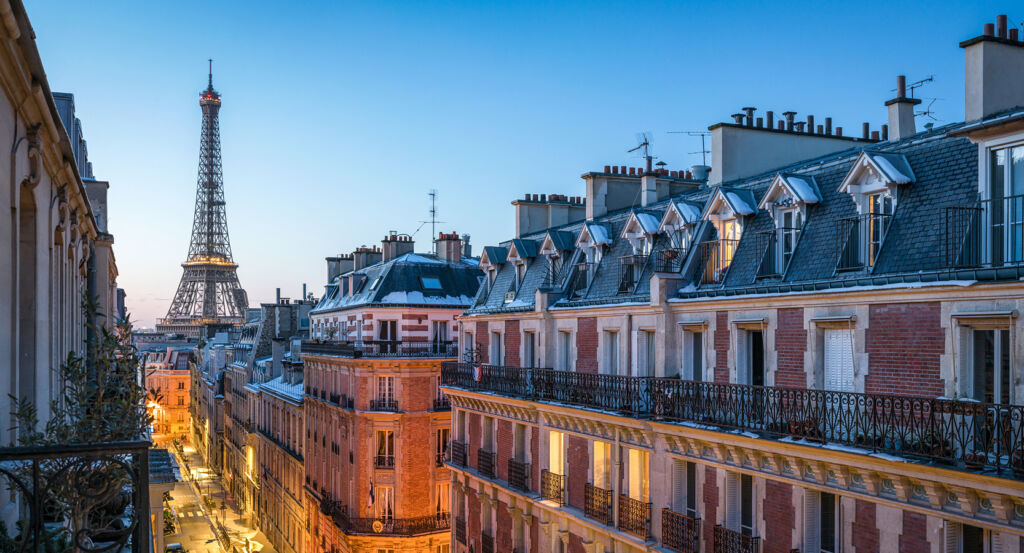
Why Porte Dauphine matters.
Porte Dauphine is a stately enclave where western Paris meets the Bois de Boulogne through garden-lined avenues, late nineteenth-century residences and an unusually spacious urban fabric created as the capital expanded across the former territory of Passy.
Positioned between Chaillot, La Muette, and the Bois de Boulogne, the neighborhood occupies Paris's northwestern edge where Avenue Foch, Boulevard Lannes and Avenue Henri-Martin spread through territory whose broad proportions distinguish it sharply from the denser streets farther east. Tree-lined medians, freestanding houses, enclosed gardens and substantial apartment buildings establish a physical scale shaped during the decades after Passy entered Paris in 1860, when undeveloped land near the Bois became desirable ground for residential construction. Avenue Foch establishes the primary encounter through a 1.5-kilometer axis created in 1854 to connect the capital with the Bois, its 140-meter width allowing planted strips and parallel paths to accompany the central roadway. Streets extending south toward Avenue Victor-Hugo deepen the residential character through stone facades and quieter cross streets developed as western Paris attracted increasingly affluent households during the late nineteenth and early twentieth centuries. The western edge opens almost directly into the Bois, giving the neighborhood a rare transition from formal urban avenues to the expansive landscape beyond the former fortified perimeter. The result is a neighborhood whose spacious architecture and planted geometry grew from Paris's nineteenth-century western expansion, preparing a history centered on the conversion of peripheral land into one of the capital's most ambitious residential districts.
What defines Porte Dauphine.
Porte Dauphine is best known for developing around the western threshold where the former commune of Passy, the Bois de Boulogne and nineteenth-century Paris converged during a decisive period of metropolitan expansion. The quarter takes its name from the former gate at this edge of the capital, itself connected to the title held by Marie-Antoinette after her 1770 marriage to the future Louis XVI. Transformation accelerated under Napoleon III, whose remaking of western Paris joined the redesigned Bois de Boulogne to the city through a new ceremonial avenue opened in 1854 across land belonging to Passy and Neuilly. First named Avenue de l'Impératrice, the route became Avenue du Général-Uhrich after the Second Empire, then Avenue du Bois de Boulogne before receiving the name Avenue Foch in 1929. Engineer Adolphe Alphand developed its planted landscape as part of the wider program of parks and promenades undertaken with Napoleon III and Haussmann, filling the gardens with thousands of trees brought from France and other parts of Europe and North Africa. The avenue quickly attracted affluent residential construction, and private houses joined substantial apartment buildings along a corridor whose width and proximity to the Bois separated its character from older Central Paris. Annexation of Passy in 1860 brought the surrounding territory inside the enlarged capital, and Avenue Foch entered the Parisian street network in 1863. The quarter that formed around this axis carried the spatial ambitions of the Second Empire into the residential expansion of the Third Republic, establishing the broad streets and planted setbacks that still organize Porte Dauphine.
Transportation and international institutions supplied a separate mechanism for extending that nineteenth-century expansion into the following century. Metro service reached Porte Dauphine in December 1900 when the first section of Line 2 opened between the neighborhood and Étoile, creating a western terminus beside the Bois. Hector Guimard gave the station one of his covered Art Nouveau entrances, combining cast iron and glass into a structure that survives at its original location as an unusually complete example of the architectural system created for the early Métropolitain. A much larger institutional intervention arrived during the 1950s when Jacques Carlu, architect of the Palais de Chaillot, designed a vast complex at Porte Dauphine for NATO. Constructed between 1955 and 1957, the building housed NATO operations until France withdrew from the alliance's integrated military command in 1966. Edgar Faure assigned the vacated complex to a new university center in 1968, and it became Université Paris IX-Dauphine in 1970. The conversion placed higher education inside architecture originally conceived for an international military organization, adding a postwar institutional chapter to a district whose earlier growth had centered on residential expansion and metropolitan infrastructure.
How Porte Dauphine fits.
Porte Dauphine works as the anchor for a daytime exploration connecting a Belle Époque collection of Asian art, an artesian well created during the remaking of western Paris and a private collection that became the home of the world's largest holdings of Claude Monet.
Begin at Musée d'Ennery, where Clémence Desgranges assembled 7,000 Chinese and Japanese objects during the second half of the nineteenth century and installed them inside the Avenue Foch residence she shared with playwright Adolphe d'Ennery. Her collection encompasses okimono carved in wood, ivory and bone, Kyoto ceramics, lacquerware, Noh masks, Buddhist figures and an extensive group of netsuke, placing a female collector at the center of a field dominated by men during the rise of French interest in Japanese art. The couple arranged for the residence and collection to pass to the state, and the museum entered the orbit of Musée Guimet in 1908, preserving the ensemble in the setting created for it. The museum is closed for renovation through 2028, making the exterior residence the present encounter with this chapter of Avenue Foch. Continue to Square Lamartine, where a well drilled in 1861 reaches the underground water system tapped during the nineteenth-century effort to increase Paris's water supply. Its artesian source originally served the rivers and lakes created in the Bois de Boulogne, binding a small neighborhood garden to the engineering campaign that accompanied the landscape reconstruction immediately west of Porte Dauphine. The square later took the name of poet and politician Alphonse de Lamartine, whose literary and political career connected Romanticism with the upheavals of 1848, adding a commemorative layer to infrastructure born from the physical remaking of western Paris. Conclude at Musée Marmottan Monet, where Jules Marmottan acquired a residence near the former Château de la Muette grounds in 1882 before his son Paul transformed it around his scholarship and collection of Consulate and Empire art. Paul bequeathed the house to the Académie des Beaux-Arts in 1932, and the museum opened in 1934. Victorine Donop de Monchy later brought Impression, soleil levant and ten other Impressionist paintings into the institution, followed in 1966 by Michel Monet's bequest of more than one hundred works by his father, including the large Nymphéas. A purpose-built underground gallery opened in 1970 for these canvases, completing the transformation of a nineteenth-century private residence into the holder of the world's largest collection of Claude Monet. The progression moves from Clémence d'Ennery assembling Asian art within the collecting culture of the Belle Époque through Second Empire water engineering serving the redesigned Bois into successive Marmottan, Donop de Monchy and Monet bequests building an internationally significant Impressionist collection, revealing how private wealth, metropolitan engineering and cultural patronage shaped the western edge of Paris.
Where your story begins.
Foresyte Travel reveals places that feel extraordinary long before you arrive.
Enjoy editorial crafted for luxury travelers.
Foresyte may earn a commission when you book.














































































































