
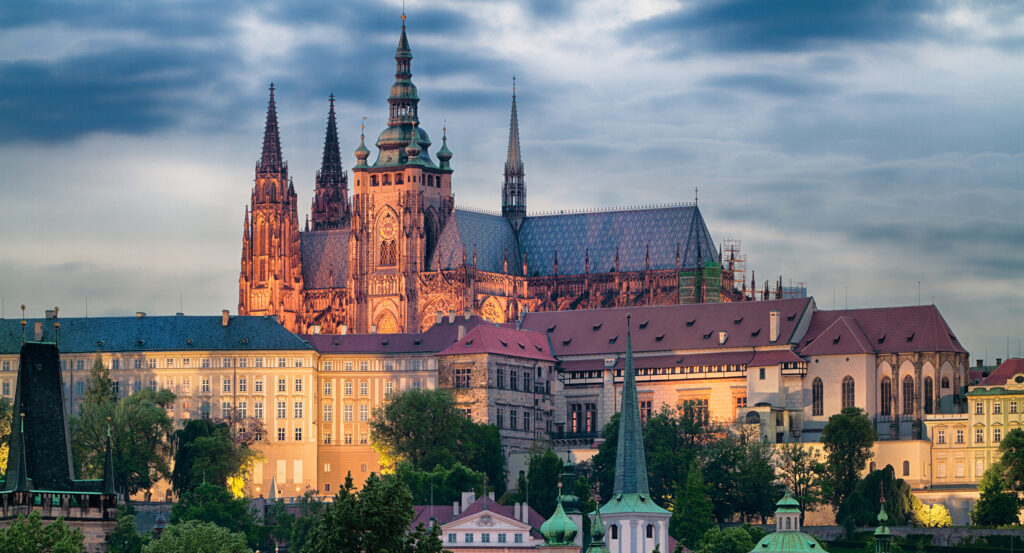
Why you should experience St. George's Basilica in Prague, Czechia.
St. George's Basilica is Prague's whisper of eternity, a sanctuary of shadow and stone where simplicity becomes sacred.
Its crimson façade, framed by twin white towers, stands in serene contrast to the gilded complexity of St. Vitus Cathedral nearby. Step inside, and the atmosphere changes immediately: the air cools, the light softens, and the noise of the castle's courtyards fades into silence. The nave is narrow and unadorned, its thick Romanesque pillars rising into pale arches that feel almost monastic. Every sound, a footstep, a breath, the faint creak of wood, reverberates against the ancient plaster walls. Time feels suspended here. What it lacks in ornament, it offers in purity. The basilica's power lies in restraint, a space so humble it draws you inward, into stillness.
What you should know about St. George's Basilica.
Founded around 920 by Prince Vratislaus I, St. George's Basilica is the second-oldest church in Prague and the best-preserved example of early Romanesque architecture in Bohemia.
It became the spiritual center of the Přemyslid dynasty, the royal family that unified the Czech lands, and served as the burial site for its earliest rulers. The first abbess of the adjoining convent was Princess Mlada, sister of Duke Boleslaus II, who helped introduce Christianity to the region. Much of the basilica's structure remains original, though it has endured multiple restorations following fires and wars. Its simple limestone interior conceals centuries of transformation: the Romanesque nave dates to the 11th century, while the Baroque façade was added in the 17th century under the Benedictine order. Beneath the main altar rests the tomb of St. Ludmila, grandmother of St. Wenceslas and one of Bohemia's earliest Christian martyrs. The crypt below, dimly lit and vaulted in rough stone, contains sarcophagi of medieval abbesses and noblewomen, their names carved faintly into worn plaques. Few visitors realize that the basilica also once housed one of the first music conservatories in Central Europe, during the 18th century, when its acoustics made it a favorite venue for sacred choral compositions. Even now, concerts occasionally echo through the nave, reviving its dual legacy of worship and sound.
How to fold St. George's Basilica into your trip.
Visit in the early morning or late afternoon, when the basilica's light is most revealing.
Approach from the third courtyard of Prague Castle, and you'll see its red-and-white façade emerge like a vision through the stone archway, modest yet magnetic. Step inside slowly and let your eyes adjust to the dimness; the longer you stay, the more details reveal themselves, a faint fresco, a chipped column capital, a flicker of gold on the altar. Spend time in the crypt, its rough stone walls and low ceilings make it one of the most atmospheric spaces in the entire castle complex. If possible, attend an evening concert; the acoustics are pure, resonant, and haunting, turning the basilica into an instrument of sound itself. Afterward, linger outside as dusk falls, the towers glow softly against the deepening sky, bells from St. Vitus echoing faintly in the distance. St. George's Basilica is more than an architectural relic; it's a meditation in stone, a place where history kneels quietly beside faith, and the simplest space becomes the holiest.
Where your story begins.
Foresyte Travel reveals places that feel extraordinary long before you arrive.
Experience premium editorial crafted for luxury travelers.





































































































