
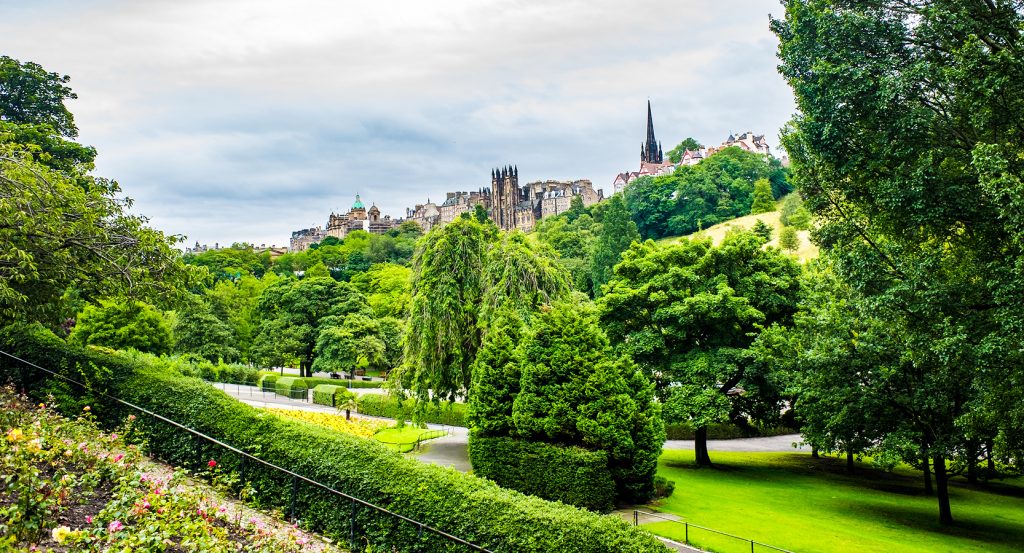
Why you should experience The Mound Precinct in Edinburgh, Scotland.
The Mound Precinct is where Edinburgh's worlds, old and new, sacred and scholarly, meet in one breathtaking sweep.
Carved from the earth that once filled the Nor' Loch, this grand causeway connects the Old Town's medieval drama with the stately neoclassical order of the New. As you ascend from Princes Street Gardens, the city seems to unfurl around you, the Castle looming to the west, the spires of the Royal Mile rising behind, and the clean, elegant lines of New Town stretching forward. Street performers fill the air with music, their sounds bouncing off the honey-colored stone of the Scottish National Gallery and Royal Scottish Academy. Pipers, painters, and poets seem to gather here instinctively, drawn to the pulse of creativity that has long defined Edinburgh's heart. On clear days, sunlight catches the sandstone facades and the sweep of the Mound becomes a grand promenade, a place where tourists pause in awe, locals hurry by, and everyone feels, if only for a moment, part of something eternal.
What you should know about The Mound Precinct.
The Mound wasn't built on stone but on human vision, literally formed by the dumping of earth excavated during the construction of Edinburgh's New Town in the late 18th century.
Over decades, the debris was carefully shaped into the broad slope that now connects the city's dual halves. By the 1820s, the site had become one of the most symbolic architectural statements in Scotland: a deliberate bridge between enlightenment and heritage. The National Gallery of Scotland, designed by William Henry Playfair and opened in 1859, was positioned here to embody intellectual harmony, art at the meeting point between past and progress. Its neighbor, the Royal Scottish Academy, stands as a twin temple of classical beauty, with Doric columns that gleam in the afternoon light. The Mound has also served as a hub of civic life, from royal processions and parades to demonstrations and festivals that spill out onto its grand terraces. Beneath it runs a labyrinth of tunnels housing vaults and archives, remnants of early city infrastructure that few ever see. Even the Mound's incline holds meaning: it's a slow, almost ceremonial climb that mirrors Edinburgh's own journey, from its medieval roots to its Enlightenment rise.
How to fold The Mound Precinct into your trip.
To experience The Mound fully, you have to walk it, not just pass through it.
Start from Princes Street Gardens and take the gradual ascent, pausing halfway to turn around. The view from this point, Castle on one side, the Balmoral clock tower on the other, captures the soul of the city in a single frame. Stop at the Scottish National Gallery to explore its collection of Turner watercolors and Renaissance masterpieces, then step outside to breathe in the city air once more. Continue upward toward the Royal Mile, where the textures of the stone shift from neoclassical polish to medieval grit. If you visit in August, the Mound comes alive with the hum of the Edinburgh Festival, artists filling every inch with sound and performance. In winter, it's lit by the glow of the Christmas markets below. Whether you visit for art, history, or simply the view, The Mound Precinct offers something rare, a place that feels both elevated and grounded, where centuries of Scottish brilliance converge in a single, unforgettable ascent.
Where your story begins.
Foresyte Travel reveals places that feel extraordinary long before you arrive.
Experience premium editorial crafted for luxury travelers.














































































































