
Why you should experience Plaza del Emperador Carlos V in Madrid, Spain.
Atocha Square is where Madrid exhales, a living crossroads where art, motion, and memory converge.
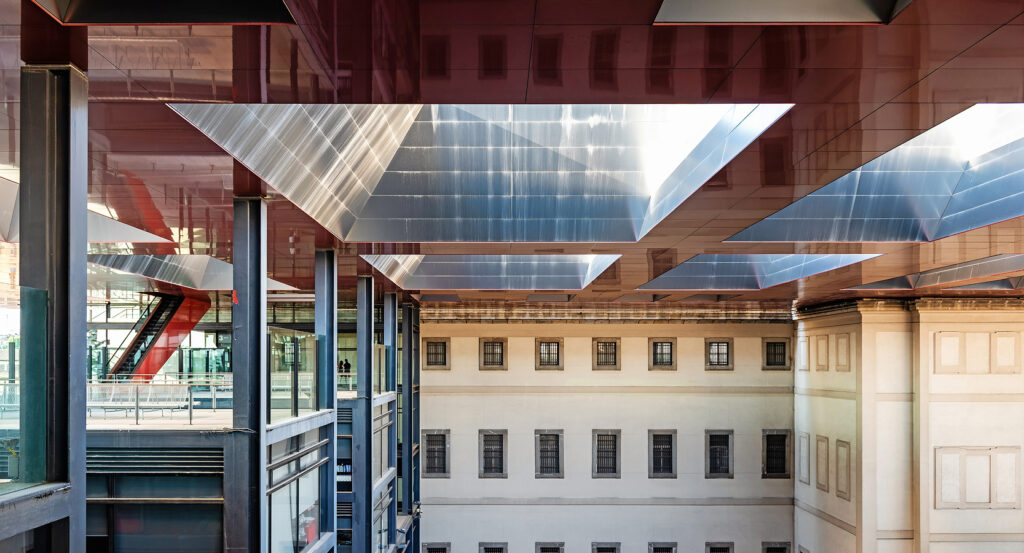
The square unfolds like a cinematic panorama: taxis gliding past the Reina Sofía's steel-and-glass façade, commuters streaming toward Atocha Station, sunlight flickering across the red canopy of Jean Nouvel's annex. It's not a place you simply pass through; it's a place you feel, a heartbeat in perpetual motion. Beneath the rhythm of traffic and voices, there's a strange serenity, as if the square understands the ebb and flow of the city's pulse. Here, Madrid's three great forces, history, creativity, and transit, meet. The hum of trains, the murmur of fountains, the low echo of footsteps on stone, together they compose the city's quietest symphony.
What you should know about Plaza del Emperador Carlos V.
Atocha Square, or Plaza del Emperador Carlos V, was named in honor of the 16th-century Holy Roman Emperor Charles V, though locals rarely use the formal title.
Its current layout evolved in the 20th century alongside the transformation of Atocha Station and the southern Prado district. Once a dusty transport hub at the city's edge, the square became a symbol of modern Madrid, the threshold between the industrial past and the intellectual heart of the capital. The nearby Estación de Atocha was inaugurated in 1892 under the iron-and-glass roof designed by Alberto de Palacio, a collaborator of Gustave Eiffel. The square's elliptical design mirrors the great station's curvature, forming a visual and symbolic link between movement and arrival. In 1992, the same year the Reina Sofía opened as a museum, Atocha Square was redesigned as part of a grand urban renewal effort. Sculptures and fountains were added, trees were replanted, and pedestrian routes reimagined to connect the Prado, Retiro Park, and the new art corridor. Few realize that beneath its surface lies a complex network of rail lines and service tunnels, making it one of Madrid's most layered public spaces, both literally and metaphorically. After the 2004 Madrid train bombings, the square became the site of the Atocha Memorial, a transparent glass cylinder inscribed with thousands of messages of peace, transforming a place of motion into one of remembrance.
How to fold Plaza del Emperador Carlos V into your trip.
Start at the northern edge, near the Reina Sofía Museum's Nouvel Annex, and let your walk unfold naturally toward the station.
Pause under the crimson canopy and look outward, the square stretches ahead like a living painting. Follow the curved paths toward the fountain at the center, where palms rise beside stone benches perfect for watching Madrid in motion. Cross to the Atocha Memorial, where the glass column rises in silence; step inside if you can, and read the words that drift like prayers across the light. From here, the façade of Atocha Station commands attention, its 19th-century ironwork glowing amber at sunset. Step inside briefly to see the station's tropical garden beneath the glass roof, then return to the square as night falls and the city lights flicker on one by one. If you visit in the early morning, you'll catch the rhythm of commuters; by evening, musicians gather and the air hums with conversation. Atocha Square isn't a monument, it's Madrid in motion: a living threshold between departure and discovery, where every path leads not away from the city, but deeper into its soul.
Where your story begins.
Foresyte Travel reveals places that feel extraordinary long before you arrive.
Experience premium editorial crafted for luxury travelers.














































































































