
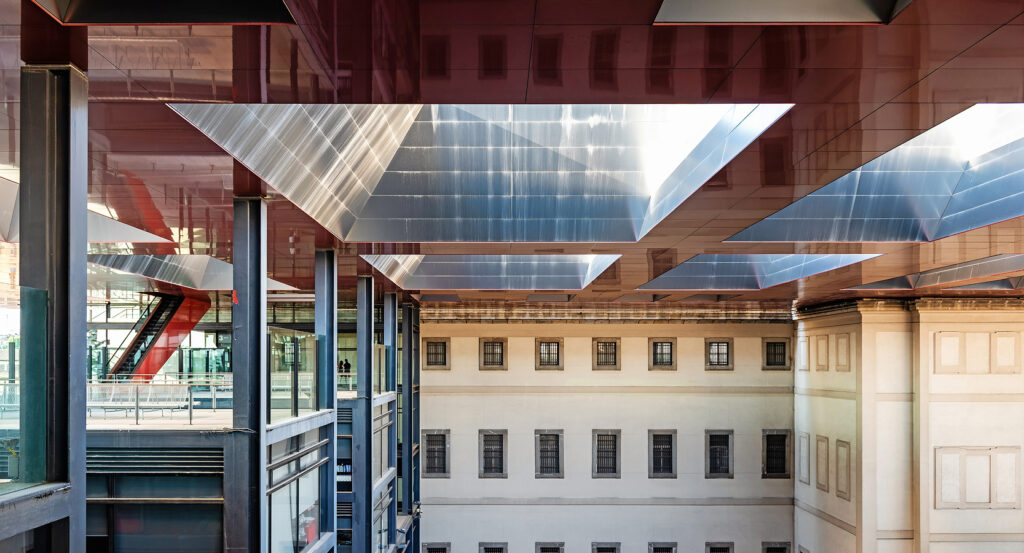
Why you should experience Edificio Nouvel in Madrid, Spain.
The Edificio Nouvel Annex feels less like an extension and more like a revelation, a work of architecture that refuses to whisper in the shadow of history.
Designed by French architect Jean Nouvel, it stands beside the 18th-century Sabatini building like a rebellious idea made visible. Its crimson steel canopy hovers above glass and shadow, its sharp lines cutting through Madrid's sunlight with surgical precision. Inside, vast galleries unfold in fluid continuity, a labyrinth of reflection and light. The structure doesn't compete with the original museum; it converses with it. Nouvel's annex is not merely an addition, it's a discussion between centuries, where stone yields to steel and silence gives way to transparency.
What you should know about Edificio Nouvel.
Commissioned in 2001 and inaugurated in 2005, the Edificio Nouvel transformed the Reina Sofía into one of Europe's most forward-thinking cultural complexes.
Jean Nouvel's design philosophy centered on duality, contrast and connection. The annex was conceived as a contemporary counterpart to Sabatini's classical hospital, expanding the museum's footprint by 60%. Its most striking feature, the suspended roof known as El Paraguas Rojo (“The Red Umbrella”), stretches across the plaza like an architectural horizon, uniting three steel-and-glass pavilions below. The roof's underside, coated in reflective crimson aluminum, captures changing light throughout the day, sometimes glowing with dawn's warmth, sometimes cooling to the deep red of dusk. Beneath it lies the Nouvel Courtyard, a dynamic civic square that merges art, air, and conversation. The annex houses large-scale temporary exhibitions, a 500-seat auditorium, research library, and the Reina Sofía's media center. Few visitors realize that its foundations incorporate the remains of the 19th-century Atocha train workshops, deliberately left visible through glass flooring, merging Madrid's industrial and intellectual past. Nouvel described his goal as creating “a machine for thought”, a living structure that blurs the line between building and experience. His use of glass is not aesthetic but philosophical: it's a medium of exposure, allowing art and city to reflect one another. At night, the annex becomes a lantern, the interior glowing outward as if modernity itself had been set aflame.
How to fold Edificio Nouvel into your trip.
Enter the annex from the southern end of the Reina Sofía complex, near Ronda de Atocha, and let your eyes adjust to its scale.
Begin beneath the floating red canopy, look upward, and you'll see the color shift with every passing minute. Move into the atrium where the walls of glass frame views of Madrid's rooftops and the historic Sabatini façade beyond. Explore one of the temporary exhibitions; the annex's soaring ceilings were designed to accommodate installations impossible to display elsewhere in the museum. If time allows, step into the Reina Sofía Auditorium, its acoustics rival Madrid's concert halls, or visit the museum's library, where art history students gather in quiet reverence. Pause at the Nouvel Courtyard in late afternoon, when the light turns the building into a living sculpture of reflection and shadow. Then exit back onto the plaza as the red roof catches the last gleam of the sun, a suspended flame above the city. The Edificio Nouvel Annex is not just architecture; it's Madrid's declaration that modernity and memory can coexist, each illuminating the other in perpetual dialogue.
Where your story begins.
Foresyte Travel reveals places that feel extraordinary long before you arrive.
Experience premium editorial crafted for luxury travelers.














































































































