
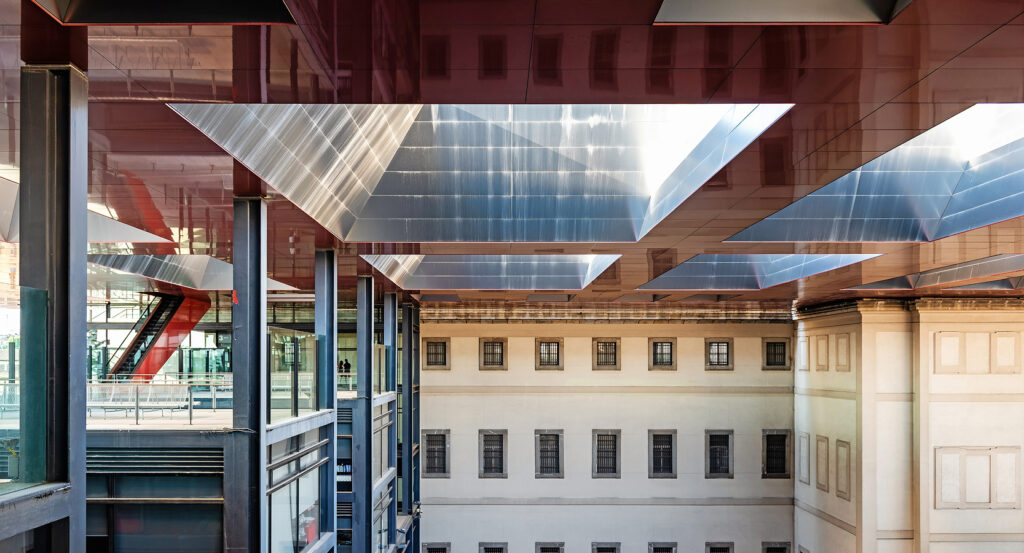
Why you should experience Guernica Gallery in Madrid, Spain.
Guernica Gallery at Madrid's Museo Reina Sofía is not a room, it's an encounter.
Stepping inside, you feel the air change, thickening into something sacred and unspeakable. The walls are white, the light restrained, and at the far end looms Picasso's Guernica, vast, monochrome, and alive with anguish. It isn't framed as an artifact but as a wound still open. Standing before it, time collapses: Spain's civil war, the cries of the innocent, the terror of the bombing, all pulse together in one shattering silence. Around you, visitors instinctively whisper, their voices swallowed by the canvas's gravity. The mural's blacks and grays ripple like smoke, each distorted figure a fragment of pain and protest. It's not beauty that moves you here, but truth, raw, unfiltered, eternal.
What you should know about Guernica Gallery.
The gallery's arrangement was designed according to Picasso's own logic, not museum convention.
When Guernica returned to Spain in 1981, it was installed at the Casón del Buen Retiro before finding its permanent home in the Reina Sofía in 1992. The gallery recreates the resonant sequence of its creation, sketches, studies, and photographs line the side walls, documenting Picasso's fevered process over 35 days in 1937. Each fragment, a horse's head, a mother's scream, a single candle, leads your gaze toward the final work like steps in a descent. The surrounding space was purposefully built to control reflection and temperature, ensuring the mural's survival. Few realize that the dimensions of the gallery were calibrated so that Guernica fills your peripheral vision completely, forcing confrontation. Opposite the mural, a mirrored panel subtly reflects visitors back into the scene, a reminder that war is never just history; it's participation. The gallery also includes artifacts from Picasso's studio: brushes, sketches, and prints that humanize the myth of the artist and reveal the disciplined chaos behind genius. Overhead, diffused skylights simulate the natural light of his Paris studio, creating the illusion that the painting is still being born.
How to fold Guernica Gallery into your trip.
Enter through the Sabatini Building's second floor, following the quiet signage that leads you inward like a pilgrimage.
Approach slowly, the corridor narrows deliberately, heightening anticipation before the mural appears. Stand at a respectful distance first, letting your eyes adjust to its scale. Move closer in silence, tracing the fractured lines and ghostly shapes. Spend time with the surrounding studies, they reveal the painting's evolution from chaos to clarity, rage to structure. Step back occasionally; the further you move, the more the composition breathes, its geometry reclaiming order from devastation. When you turn to leave, look once more at the mural reflected faintly in the polished floor, the image inverted, as though echoing memory itself. Visit early morning or late afternoon if you can, when the crowds thin and the stillness deepens. You will not leave unchanged. Guernica Gallery is more than a museum room; it's a moral compass, a place where art bears witness, and silence says everything words cannot.
Where your story begins.
Foresyte Travel reveals places that feel extraordinary long before you arrive.
Experience premium editorial crafted for luxury travelers.














































































































