
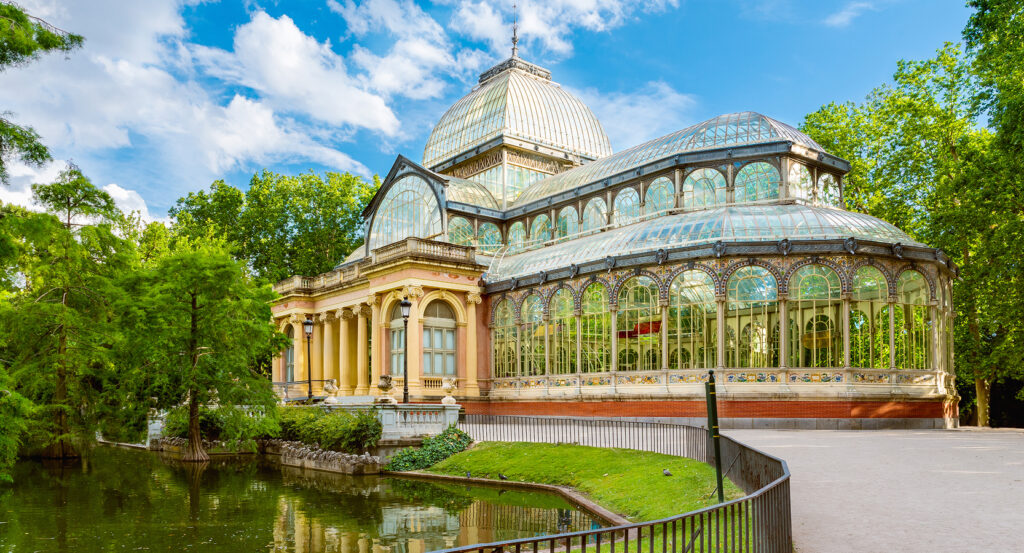
Why you should experience Velázquez Palace in Madrid, Spain.
Velázquez Palace, or Palacio de Velázquez, at El Retiro Park is Madrid's masterpiece of quiet strength, a union of iron, brick, and light that feels both timeless and alive.
Tucked among the trees of Retiro Park, it stands as an architectural sibling to the nearby Palacio de Cristal, heavier in form, but no less radiant in spirit. Its arched glass roof, patterned ceramic façades, and marble columns shimmer with restrained grandeur, reflecting Madrid's 19th-century belief that art could elevate life. Inside, the air feels deliberate: light diffused through skylights, footsteps softened by the geometry of space. The building doesn't demand attention; it invites presence. Walking into it feels like stepping inside a painting that remembers the warmth of the hand that made it.
What you should know about Velázquez Palace.
The palace was designed in 1883 by architect Ricardo Velázquez Bosco, in collaboration with engineer Alberto Palacio and ceramicist Daniel Zuloaga, as the main pavilion for Spain's National Exhibition of Mining, Metallurgical Arts, Ceramics, and Glass Industries.
It predates the nearby Palacio de Cristal by four years and in many ways served as its architectural prototype. The structure combines modern materials, iron, glass, and steel, with traditional Spanish craftsmanship, most notably Zuloaga's vividly glazed tiles that decorate the façades with botanical and geometric motifs. Few visitors realize that Velázquez Bosco designed the palace's proportions based on Renaissance harmonic ratios, ensuring that every column and arch aligns to create a sense of subtransitional order. After the 1883 exhibition, the building was repurposed as a venue for fine arts, hosting major retrospectives through the late 19th and early 20th centuries. During the Spanish Civil War, it briefly served as a storage site for artworks evacuated from the Prado. Today, the Palacio de Velázquez operates under the Reina Sofía Museum, housing contemporary art exhibitions that continue the spirit of discussion between material and light. The structure's iron skeleton and vaulted glass ceilings make it one of Europe's earliest examples of industrial architecture elevated to artistry.
How to fold Velázquez Palace into your trip.
Approach the palace along the tree-shaded Paseo de Venezuela, following the curve of Retiro's quiet paths until the red-brick façade appears between the leaves.
Pause outside to study its details, the alternating bands of brick and ceramic, the tiled medallions glowing in the sunlight, and the graceful iron trusses visible through the arched windows. Step inside during one of its rotating exhibitions, often focused on Spanish and international modernism, where the building's natural illumination transforms every artwork into part of its architecture. Move through the galleries slowly; the shifting daylight across the tiled floors becomes a living companion to the art. Before leaving, stand beneath the central dome, look up, and you'll see the glass vault catching the color of the sky. From there, continue walking toward the Palacio de Cristal nearby; the discussion between the two spaces, one grounded, one ethereal, feels almost poetic. Visit in the late afternoon, when the sun lowers behind the trees and the façade takes on a golden hue. The Palacio de Velázquez isn't just an exhibition space; it's Madrid's quiet hymn to craft, light, and the enduring belief that beauty deserves structure.
Where your story begins.
Foresyte Travel reveals places that feel extraordinary long before you arrive.
Experience premium editorial crafted for luxury travelers.














































































































