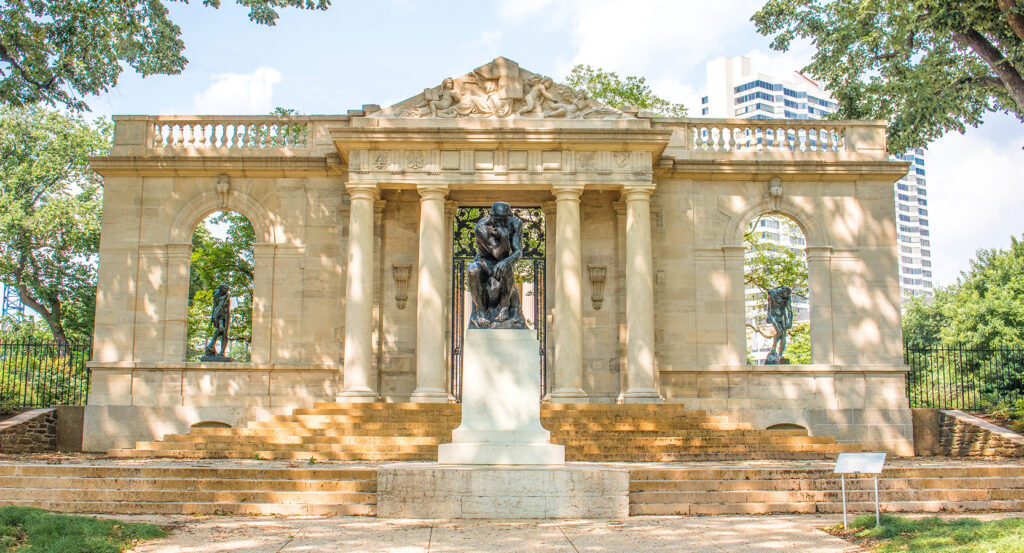
Why you should experience The Burghers of Calais at Rodin Museum in Philadelphia, Pennsylvania.
In the peaceful courtyard of the Rodin Museum in Philadelphia, The Burghers of Calais stands as a monument to courage, sacrifice, and the weight of human dignity.
Created by Auguste Rodin in 1889, this life-size bronze ensemble captures a moment of profound resonant gravity: six citizens of Calais walking toward their fate during the Hundred Years' War, offering themselves to the English to save their city. Yet, unlike traditional heroism cast in marble, Rodin sculpted vulnerability, men weary, barefoot, draped in coarse robes, each consumed by private fear and moral resolve. Standing among them, you don't feel like a spectator; you feel like a witness. Their faces are etched with anguish and acceptance, their gestures suspended between surrender and defiance. In the soft light of the museum garden, the bronze takes on a living warmth, every fold of fabric and tendon illuminated in quiet detail. The work transcends history, it's not just about Calais, but about every act of courage that demands the impossible. The Burghers of Calais invites you into that space between despair and devotion, where humanity's truest strength resides.
What you should know about The Burghers of Calais at Rodin Museum.
Rodin's The Burghers of Calais redefined what public sculpture could be, rejecting grandeur in favor of vulnerability.
Commissioned by the city of Calais in 1885, the sculpture commemorates a 14th-century event during the English siege of the city. King Edward III had demanded that six of Calais's leading citizens surrender themselves, wearing nooses and carrying the keys to the city. Instead of depicting triumphant martyrs, Rodin chose to immortalize them in the very moment of their anguish. Each figure, Eustache de Saint-Pierre, Jean d'Aire, Pierre and Jacques de Wissant, Jean de Fiennes, and Andrieu d'Andres, captures a different shade of despair and resolve. Rodin deliberately positioned them at ground level rather than on a pedestal, forcing viewers to confront their humanity face-to-face. The Philadelphia cast, among the few authorized editions by the Musée Rodin, was installed in 1929 as part of Jules Mastbaum's founding collection for the museum. Its surface bears Rodin's signature roughness, a tactile texture that captures the tension between form and feeling. Many visitors don't realize that Rodin intended the figures to be viewed from multiple angles, with no single “heroic” perspective. The power of the piece lies in its collective silence, a unity of individual suffering and civic sacrifice that continues to resonate across centuries.
How to fold The Burghers of Calais at Rodin Museum into your trip.
When visiting the Rodin Museum, plan to spend time in the Sculpture Garden, where The Burghers of Calais stands at its resonant center, a still point amid the garden's flowing symmetry.
Approach from the east side of the courtyard, allowing the figures to come into view one by one, their shadows lengthening across the stone. The garden's open-air design mirrors Rodin's intention: to let the sculpture breathe in natural light, shifting in tone from morning's soft bronze glow to the deep patina of dusk. Walk slowly around the group, each vantage point reveals a new discussion between the figures. Notice how they never touch, yet their despair binds them together. Early morning or golden hour visits are especially moving, when sunlight filters through the ivy walls and catches the highlights of their faces and hands. The surrounding landscape, fountains murmuring, plane trees swaying, amplifies the sculpture's quiet nobility. After spending time here, step into the museum to see other Rodin studies of human emotion, like The Thinker and The Kiss, which explore similar tensions between body and spirit. Then return outside for one last look; viewed from behind, as the burghers walk into the fading light, the piece takes on an entirely new meaning. The Burghers of Calais in the Rodin Museum Sculpture Garden isn't just a monument to the past, it's a mirror for every act of courage that still asks to be remembered.
Where your story begins.
Foresyte Travel reveals places that feel extraordinary long before you arrive.
Experience premium editorial crafted for luxury travelers.