
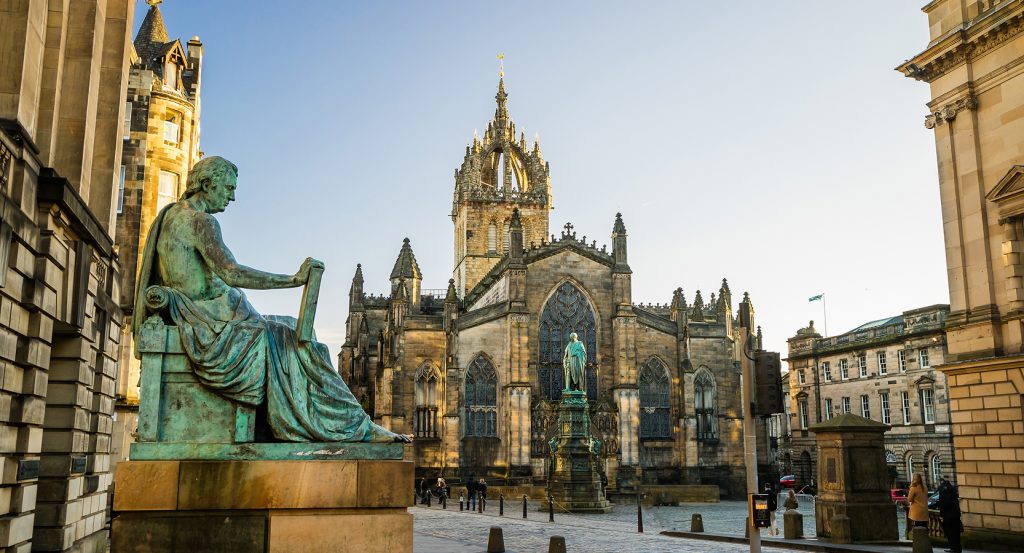
Why you should experience The Real Mary King's Close in Edinburgh, Scotland.
Beneath the polished façade of Edinburgh's Royal Mile lies another world, dark, claustrophobic, and utterly unique.
The Real Mary King's Close is not just a preserved street; it's a buried chapter of the city's living memory, sealed beneath centuries of progress. Step into its narrow alleys, and the light fades almost immediately, replaced by flickering lanterns that cast long shadows against rough stone walls. The air feels thick with history, each step echoing off the worn cobbles that once carried the weight of merchants, plague doctors, and families who lived, and died, here. You can almost hear the whisper of 17th-century voices carried through the damp corridors, or imagine the faint sound of carts rolling overhead on the thriving Royal Mile above. Mary King's Close isn't just an attraction, it's a visceral encounter with the underbelly of Edinburgh's past, a city that built upward without ever truly leaving its ghosts behind. The close is a mirror of Edinburgh itself, beautiful and brutal, elegant and eerie, a city that never fully reveals itself on the surface.
What you should know about The Real Mary King's Close.
The legend of Mary King's Close is wrapped in myth, but its truth is even more fascinating.
Named after a respected merchant and burgess, Mary King, the close once thrived as a thriving residential and commercial lane in the 1600s. During the plague outbreak of 1645, many of its inhabitants were quarantined within its narrow confines, a detail that fed ghost stories for centuries. When the Royal Exchange (now the City Chambers) was constructed above it in the 18th century, the upper portions of the close were sealed off, preserving the homes, workshops, and streets beneath almost perfectly. Rediscovered in the 20th century, the site revealed astonishingly intact interiors, plaster walls, wooden beams, and hearths that looked as if their owners had just stepped out. Contrary to urban legend, the close wasn't bricked up with plague victims inside; instead, it was gradually buried by layers of construction and time. Today, archaeologists and historians regard it as one of the best-preserved examples of 17th-century urban life in Scotland, a literal time capsule beneath the city's feet.
How to fold The Real Mary King's Close into your trip.
Exploring The Real Mary King's Close is best done as an immersive break from the open-air beauty of the Royal Mile.
Book a guided tour in advance, it's the only way to enter, and prepare to descend into Edinburgh's hidden underworld through a discreet entrance beside the City Chambers. As your guide leads you through the dimly lit passageways, listen closely; every creak of the floorboards and echoing footstep heightens the sense of stepping back in time. Pause in the old workshops, peek into cramped dwellings where families once slept several to a bed, and feel the temperature drop as you move deeper underground. When you emerge back into daylight, grab a coffee at one of the cafés along the Mile and look down at the cobblestones with new eyes, knowing that beneath your feet lies an entire neighborhood frozen in history. Experiencing The Real Mary King's Close isn't about thrills or fear; it's about connection, a hauntingly intimate reminder that cities, like people, carry their pasts within them, no matter how much light they build above.
Where your story begins.
Foresyte Travel reveals places that feel extraordinary long before you arrive.
Experience premium editorial crafted for luxury travelers.














































































































