
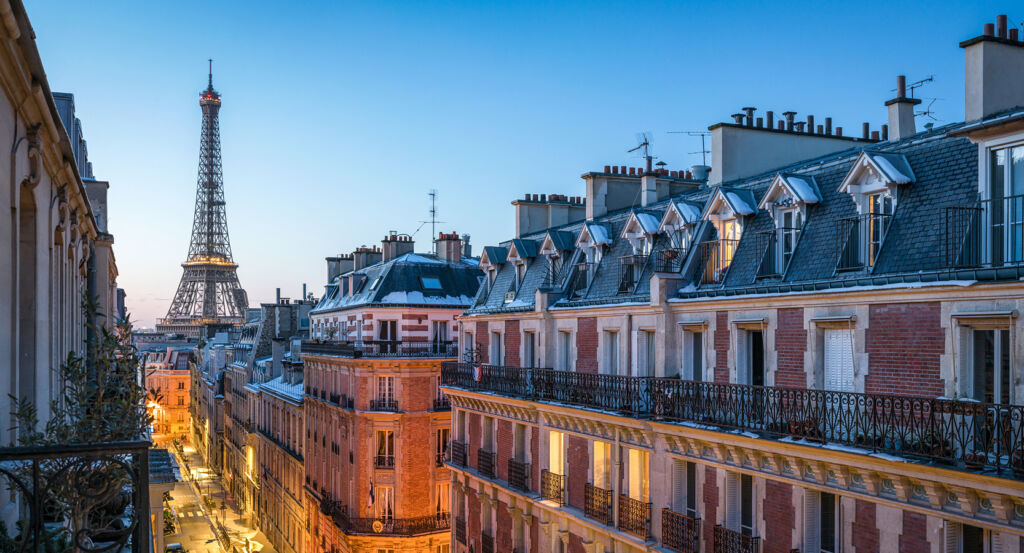
Why Rue Caulaincourt matters.
Rue Caulaincourt is a scenic Grandes-Carrières corridor where Montmartre heritage, artistic legacy, architectural elegance, and sweeping Parisian panoramas converge along one of the capital's most celebrated hillside streets.
Running through Grandes-Carrières between Place de Clichy and Rue Lamarck, this graceful corridor unfolds through elegant apartment houses, historic cafés, neighborhood bakeries, independent galleries, tree-lined promenades, and beautifully preserved Belle Époque architecture that reflects Montmartre's transformation from rural village to artistic capital. Winding gently across the Butte, the avenue reveals quiet residential corners, dramatic city views, and the unmistakable atmosphere that has inspired generations of painters, writers, filmmakers, and musicians. Every section of the corridor captures another facet of Montmartre's remarkable evolution from gypsum quarries and vineyards into one of the world's most celebrated creative neighborhoods. The result is a corridor defined by artistic heritage, architectural beauty, and one of Paris' most enchanting historic streets.
What defines Rue Caulaincourt.
Rue Caulaincourt is best known for traversing the historic slopes of Montmartre while honoring General Armand Augustin Louis de Caulaincourt, Napoleon Bonaparte's trusted cavalry commander, Grand Écuyer of the Empire, ambassador to Russia, and principal negotiator of the Treaty of Fontainebleau in 1814. Constructed during the nineteenth century as Paris absorbed the former village of Montmartre following its annexation in 1860, the corridor overcame the hill's dramatic topography through one of the city's most remarkable engineering works, the Pont Caulaincourt, completed in 1888 by engineer Paul Séjourné. The elegant masonry bridge spans the deep cutting created for the Montmartre Cemetery without disrupting traffic or the surrounding urban fabric, becoming one of the defining visual landmarks of northern Paris. The avenue also passes beside the celebrated Cimetière de Montmartre, established in 1825 within an abandoned gypsum quarry and now the resting place of Alexandre Dumas fils, Hector Berlioz, Edgar Degas, François Truffaut, Dalida, Vaslav Nijinsky, and Émile Zola, whose collective achievements helped shape literature, music, painting, cinema, dance, and journalism across Europe. Throughout the twentieth century the corridor became inseparable from Montmartre's artistic identity, attracting filmmakers, photographers, and writers who celebrated its dramatic perspectives, village atmosphere, and extraordinary relationship with the surrounding hillside.
The remarkable combination of civil engineering, artistic heritage, and preserved residential character continues distinguishing Rue Caulaincourt from every other street in Paris. Belle Époque apartment buildings, carefully integrated bridge architecture, and panoramic views across the northern Arrondissements demonstrate how ambitious nineteenth century planning successfully adapted to one of the capital's most challenging landscapes. Few Parisian streets unite Napoleonic history, pioneering engineering, artistic legacy, and hillside urbanism with such remarkable harmony.
How Rue Caulaincourt fits.
Rue Caulaincourt works as an exploration through Grandes-Carrières' celebrated viewpoints, artistic landmarks, and historic streets.
Begin at Cimetière de Montmartre, where the resting places of many of France's greatest cultural figures introduce the extraordinary creative legacy surrounding Rue Caulaincourt before crossing the elegant Pont Caulaincourt. Continue toward Moulin de la Galette, whose surviving historic windmill recalls the rural origins and artistic mythology of Montmartre while inspiring generations of painters from Pierre-Auguste Renoir onward. Conclude at Sacré-Coeur Basilica, where sweeping panoramic views across Paris provide a memorable finale celebrating the remarkable landscape, architecture, and cultural heritage that continue defining this renowned hillside neighborhood. The progression moves naturally from artistic remembrance to Montmartre's village past before culminating in one of the world's most recognizable urban panoramas, revealing why Rue Caulaincourt remains one of Paris' most rewarding historic corridors.
Where your story begins.
Foresyte Travel reveals places that feel extraordinary long before you arrive.
Enjoy editorial crafted for luxury travelers.
Foresyte may earn a commission when you book.














































































































