
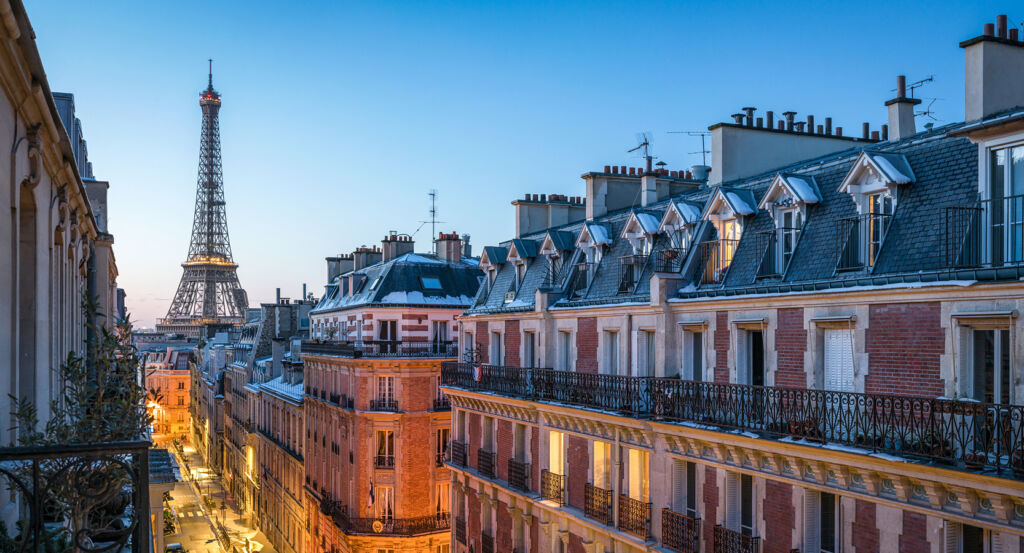
Why Rue Saint-Lazare matters.
Rue Saint-Lazare is a transformative Chaussée d'Antin corridor where railway innovation, commercial ambition, Belle Époque architecture, and metropolitan energy converge along one of Paris' most influential urban streets.
Running through Chaussée d'Antin between Havre-Caumartin and Europe, this dynamic historic corridor unfolds through grand department stores, elegant Haussmannian façades, landmark office buildings, celebrated theaters, luxury hotels, and one of Europe's busiest transportation districts that together demonstrate the remarkable transformation of nineteenth century Paris. Monumental stone architecture, ornate cornices, thriving sidewalks, and continuous commercial activity create a streetscape where business, travel, shopping, and everyday city life have intersected for generations. Every block reflects the extraordinary momentum that accompanied Paris' emergence as a modern capital during the Industrial Revolution. The result is a corridor defined by commercial significance, architectural grandeur, and one of the city's most consequential urban thoroughfares.
What defines Rue Saint-Lazare.
Rue Saint-Lazare is best known for serving as the historic approach to Gare Saint-Lazare, inaugurated in 1837 as Paris' first railway terminus and transformed during the nineteenth century into one of Europe's busiest stations, helping establish the corridor as the commercial gateway to Normandy while accelerating the capital's expansion through rail transportation, finance, retail, and urban development. The street also occupies a celebrated place in art history through its association with Claude Monet, whose 1877 series of twelve paintings depicting Gare Saint-Lazare captured the station's steam filled platforms and industrial atmosphere, producing some of Impressionism's defining masterpieces while immortalizing one of the world's earliest great railway districts.
Rue Saint-Lazare continues expressing the remarkable relationship between transportation and commerce through an uninterrupted sequence of historic department stores, prestigious office buildings, hotels, theaters, and neighborhood institutions that have evolved alongside the station for nearly two centuries. Haussmannian architecture, thriving retail corridors, and constant pedestrian movement preserve the energetic metropolitan character that established the district as one of Paris' foremost commercial centers while celebrating the enduring legacy of one of Europe's most important railway gateways.
How Rue Saint-Lazare fits.
Rue Saint-Lazare works as an exploration through Chaussée d'Antin's celebrated shopping, architecture, and cultural landmarks.
Begin at Gare Saint-Lazare, where the station that transformed modern Paris provides the perfect introduction before following Rue Saint-Lazare through one of the capital's busiest commercial districts. Continue to Galeries Lafayette Paris Haussmann, whose grand Belle Époque dome and world renowned shopping experience embody the neighborhood's remarkable commercial legacy. Conclude at Palais Garnier, where one of the world's greatest opera houses provides a striking finale celebrating architecture, artistic excellence, and the grandeur of nineteenth century Paris. The progression moves naturally from the birthplace of Parisian rail travel to renowned retail before concluding through one of France's defining cultural monuments, revealing why Rue Saint-Lazare remains one of the capital's essential historic corridors.
Where your story begins.
Foresyte Travel reveals places that feel extraordinary long before you arrive.
Experience premium editorial crafted for luxury travelers.
Foresyte Travel may earn a commission when you book through the link on this page.














































































































