Why Sable at Navy Pier Chicago matters.
Sable at Navy Pier Chicago, Curio Collection by Hilton is a maritime hotel where Streeterville's lakefront character meets Navy Pier's century-old civic architecture, an engineered glass addition and a design program shaped by Chicago's naval history and extraordinary position above Lake Michigan.
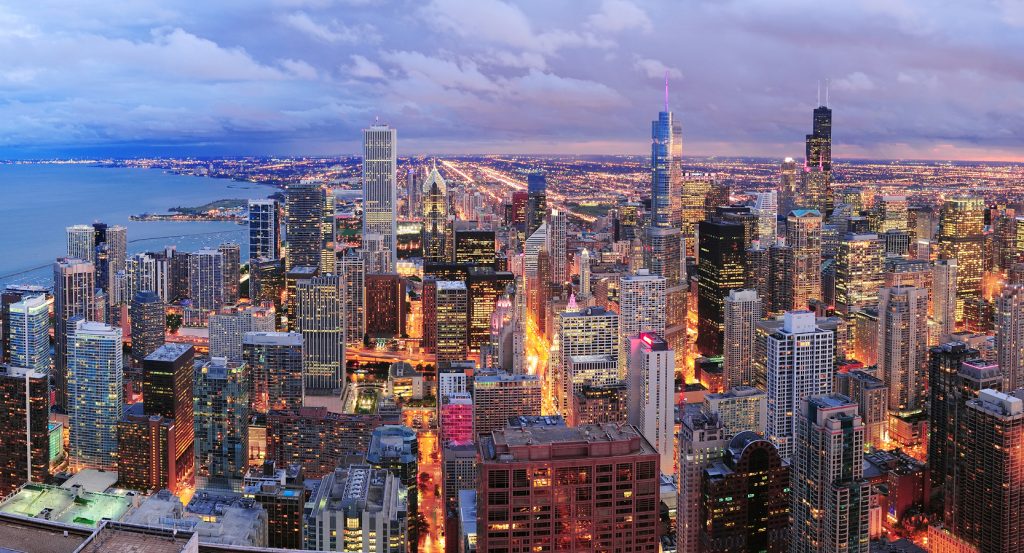
Set along East Grand Avenue near North Streeter Drive and just steps from Jane Addams Memorial Park, the hotel occupies the eastern reach of Navy Pier where Chicago's dense skyline recedes behind a narrow built platform extending more than half a mile into Lake Michigan. Three low glass volumes stretch longitudinally along the pier, preserving the horizontal profile of the older complex and directing the building toward open water instead of creating a competing vertical element. Angled window boxes give the façade a faceted surface, with changing daylight and lake reflections producing visible shifts across the long elevations as the sun moves around the structure. Floor-to-ceiling glazing places the lake or downtown skyline at the end of the interior sightlines, making the unusual distance from Chicago's conventional street grid physically apparent throughout the building. The result is a hotel whose elongated form, faceted glass and position above the water make Lake Michigan an architectural condition embedded throughout the property.
What defines Sable at Navy Pier Chicago.
Sable at Navy Pier Chicago, Curio Collection by Hilton is best known for becoming Navy Pier's first hotel when it opened on March 18, 2021, completing a hospitality component envisioned during the historic pier's second-century redevelopment. Municipal Pier opened in 1916 under architect Charles Sumner Frost as part of the lakefront improvements associated with Daniel Burnham's Plan of Chicago, combining commercial shipping with public recreation on an immense structure extending into Lake Michigan. Military use repeatedly altered that civic purpose, and the United States Navy converted the pier into a major training facility during World War II. More than 60,000 Navy personnel passed through the facility after 1941 as the lake became a training environment for carrier pilots. ACRON led the ownership group behind the later hotel development, with Maverick Hotels & Restaurants serving as developer and operator. KOO founder Jackie Koo directed both architecture and interior design, giving the Chicago studio unusual control over the relationship between the new exterior and its internal composition. Construction began in June 2018 under James McHugh Construction and required a structural solution capable of carrying a major new building above infrastructure dating to the pier's original construction. Fifty-one micropiles passed through existing foundations and lake water into bedrock, supporting new columns and a structural platform while reducing additional loads on the century-old pier. Cold-formed steel bearing walls and a lightweight floor-joist system further limited structural weight across an 800-foot-long building whose extreme horizontal proportions prompted comparison with a skyscraper laid on its side. KOO divided that length into three seven-story glass volumes, maintaining a comparatively low profile against the older pier structures. The completed project became the 100th property in Hilton's Curio Collection and earned LEED Silver certification, joining an early-twentieth-century municipal pier to a contemporary hotel through an engineering strategy designed specifically around the physical limits of the original structure.
How Sable at Navy Pier Chicago fits.
Sable at Navy Pier Chicago, Curio Collection by Hilton works as the anchor for an outing connecting experimental contemporary art, a preserved Gilded Age residence and the mechanical infrastructure that made Chicago's movable river crossings internationally influential.
Begin at Museum of Contemporary Art Chicago, conceived in 1964 by collectors, artists, architects, dealers and critics seeking a Chicago institution devoted specifically to new and experimental work. The museum opened in 1967 inside the former Playboy headquarters on East Ontario Street under founding director Jan van der Marck, initially operating as a noncollecting Kunsthalle devoted to temporary exhibitions. Christo and Jeanne-Claude completed their first building wrap in the United States there in 1969, enveloping the museum itself as part of Wrap In, Wrap Out. The institution subsequently developed a permanent collection and moved into Josef Paul Kleihues's purpose-built East Chicago Avenue building in 1996. Continue to The Richard H. Driehaus Museum, housed inside the 1883 Samuel M. Nickerson mansion created during Chicago's extraordinary post-fire accumulation of private wealth. Edward J. Burling and Francis M. Whitehouse designed the residence through an opulent combination of marble, carved wood, stained glass, mosaics and decorative metalwork. Richard H. Driehaus acquired the threatened mansion in 2003 and undertook an extensive restoration before opening the museum in 2008, establishing a setting devoted to architecture and decorative arts of the Gilded Age. Conclude at McCormick Bridgehouse & Chicago River Museum, occupying the southwest bridgehouse of the DuSable Bridge at Michigan Avenue. The bridge opened in 1920 as a double-deck fixed-trunnion bascule structure whose enormous leaves pivot upward through machinery housed inside its limestone towers. Henry Hering's 1928 relief Defense marks the southern bridgehouse with an interpretation of the 1812 Battle of Fort Dearborn, connecting the crossing with the early history of the riverbank. Friends of the Chicago River opened the museum in 2006, giving the public access to the working gear room and the engineering inside one of the city's defining movable bridges. The progression moves from Museum of Contemporary Art Chicago's institutional commitment to artistic experimentation through The Richard H. Driehaus Museum's preservation of extraordinary nineteenth-century decorative craftsmanship and culminates at McCormick Bridgehouse & Chicago River Museum, where Chicago's architectural character becomes inseparable from the machinery engineered to keep its river navigable.
Where your story begins.
Foresyte Travel reveals places that feel extraordinary long before you arrive.
Enjoy editorial crafted for luxury travelers.