
Why Basilique du Sacré-Coeur matters.
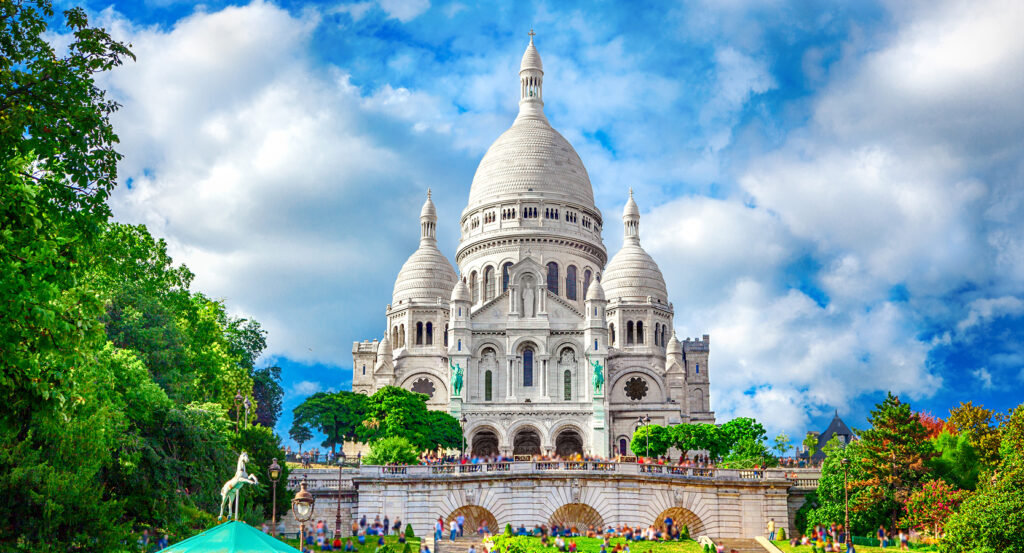
Basilique du Sacré-Coeur is a soaring hilltop sanctuary where Montmartre's steep village character meets a Romano-Byzantine composition of domes, pale stone and terraces commanding the Paris basin.
Set along Rue du Cardinal Guibert near Rue du Chevalier de la Barre and just steps from Rue Azaïs, the basilica crowns the Butte Montmartre above a steep southern slope where terraced gardens, stairways, winding lanes and closely packed buildings descend toward the northern Parisian plain. Its central dome rises above clustered cupolas and a broad arcaded facade whose pale limestone separates the church visually from the darker roofs below. Staircases climb through the hillside from Place Saint-Pierre as Rue du Chevalier de la Barre and smaller streets wrap around the summit, retaining the irregular contours of the former village. The elevated forecourt opens the dense streets abruptly toward a vast panorama stretching across Central Paris. The result is a commanding hilltop precinct where architecture and topography combine to make the basilica both a destination on Montmartre and a defining element of the wider Paris skyline.
What defines Basilique du Sacré-Coeur.
Basilique du Sacré-Coeur is best known for emerging from the Voeu National formulated by Alexandre Legentil and Hubert Rohault de Fleury after France's defeat in the Franco-Prussian War, then becoming one of the largest religious construction campaigns of late nineteenth-century Paris. Legentil drafted the initial vow in December 1870, Rohault de Fleury joined the undertaking, and Archbishop Joseph-Hippolyte Guibert approved its definitive text in 1872. The National Assembly declared construction of the proposed church a matter of public utility on July 24, 1873, giving the undertaking the legal mechanism needed to acquire its Montmartre site. A public architectural competition in 1874 drew dozens of proposals before Paul Abadie won with a Romano-Byzantine design organized as a Greek cross beneath a concentration of domes. Abadie had restored Saint-Front in Périgueux, whose domed architecture supplied an important precedent for the new Parisian church. Archbishop Guibert blessed the foundation stone on June 16, 1875, beginning a building campaign financed through a vast national subscription. Abadie died in 1884 before the church rose to completion, leaving Honoré Daumet, Charles Laisné, Henri Rauline, Lucien Magne and Jean-Louis Hulot to carry successive portions of the project forward. Continuous Eucharistic adoration began on August 1, 1885, establishing a religious practice before the structure itself was finished. Worship began in the church in 1891, construction continued into the twentieth century, and the consecration planned for 1914 was postponed after the outbreak of the First World War. Cardinal Léon-Adolphe Amette finally consecrated the basilica on October 16, 1919 under the presidency of Cardinal Antonio Vico, papal legate of Benedict XV, completing the principal ceremonial sequence more than four decades after the foundation stone was laid.
Engineering beneath the basilica became a defining component of its construction as builders confronted the gypsum quarries riddling the Butte Montmartre. Deep shafts descended through unstable ground and were packed to create structural supports capable of carrying the immense masonry church above. Exterior construction used exceptionally hard limestone from the Seine-et-Marne quarrying region, whose interaction with rainwater contributes to the persistent pale appearance of the facades and domes. Lucien Magne developed the campanile that houses the Savoyarde, a bell offered by the dioceses of Savoy and weighing close to nineteen tonnes. Interior decoration reached another scale through Luc-Olivier Merson's immense apse mosaic, executed during the closing phase of the building campaign and covering 473 square meters. Chapels acquired distinct groups of subscribers, with sailors supporting Notre-Dame-de-la-Mer, legal professionals supporting Saint-Louis and physicians supporting Saint-Luc. Donor names carved throughout the church and crypt preserve the financing mechanism that converted thousands of individual contributions into architectural fabric. These technical, decorative and financial systems transformed Abadie's competition design into a structure whose immense visible mass depends on an equally ambitious subterranean foundation and decades of collective patronage.
How Basilique du Sacré-Coeur fits.
Basilique du Sacré-Coeur works as the anchor for a daytime exploration across the summit and southern slope of the Butte using three nearby sites that move from Montmartre's medieval abbey through its nineteenth-century municipal market architecture into the studios that produced some of the hill's most consequential modern art.
Begin at Saint-Pierre de Montmartre, begun in 1133 as the church of the royal Benedictine abbey founded on the hill and completed in 1147, when Pope Eugenius III consecrated it in the presence of Bernard of Clairvaux, Peter the Venerable, King Louis VII and Queen Adelaide of Savoy. For more than six centuries the building operated simultaneously as a parish church and the abbey church of the Benedictine community, making the surviving structure the principal architectural remnant of the monastery that once controlled extensive territory across Montmartre. The abbey disappeared during the revolutionary period, leaving Saint-Pierre as an exceptional surviving connection between the present summit and the religious settlement that preceded the nineteenth-century basilica by more than seven centuries. Continue to Halle Saint-Pierre, inaugurated on January 2, 1868 as a covered market during the transformation that followed Montmartre's annexation to Paris in 1860. Designed by a pupil of Victor Baltard, the iron-and-glass structure brought the construction system associated with the great Parisian market halls to the foot of the Butte. Market activity ended in 1921, and Claude Charpentier and Jacques Valentin later adapted the building after receiving authorization for its conversion in 1984. It reopened in 1986 as a cultural venue and developed a program centered on art brut and art singulier, preserving the nineteenth-century market shell through a radically different cultural use. Conclude at Musée de Montmartre, founded in 1960 within the seventeenth-century Maison du Bel Air and neighboring buildings at 12 Rue Cortot. Auguste Renoir worked there in 1876 during the period of Bal du moulin de la Galette and La Balançoire, and the address later attracted Émile Bernard, Raoul Dufy and Charles Camoin. Suzanne Valadon returned in 1912 with Maurice Utrillo and André Utter, occupying the studio-apartment now reconstructed within the museum. Collections developed by Le Vieux Montmartre preserve paintings, drawings, posters, photographs and objects tracing the hill's transformation from village and quarry territory into the artistic district of studios and cabarets that emerged after annexation. The progression moves from the Benedictine abbey church consecrated in 1147 through an iron-and-glass market generated by nineteenth-century annexation into the Cortot studios occupied by Renoir, Valadon and Utrillo, carrying the Butte through three institutions that preceded, accompanied and outlived the construction of Sacré-Coeur.
Where your story begins.
Foresyte Travel reveals places that feel extraordinary long before you arrive.
Experience premium editorial crafted for luxury travelers.
Foresyte Travel may earn a commission when you book through the link on this page.














































































































