
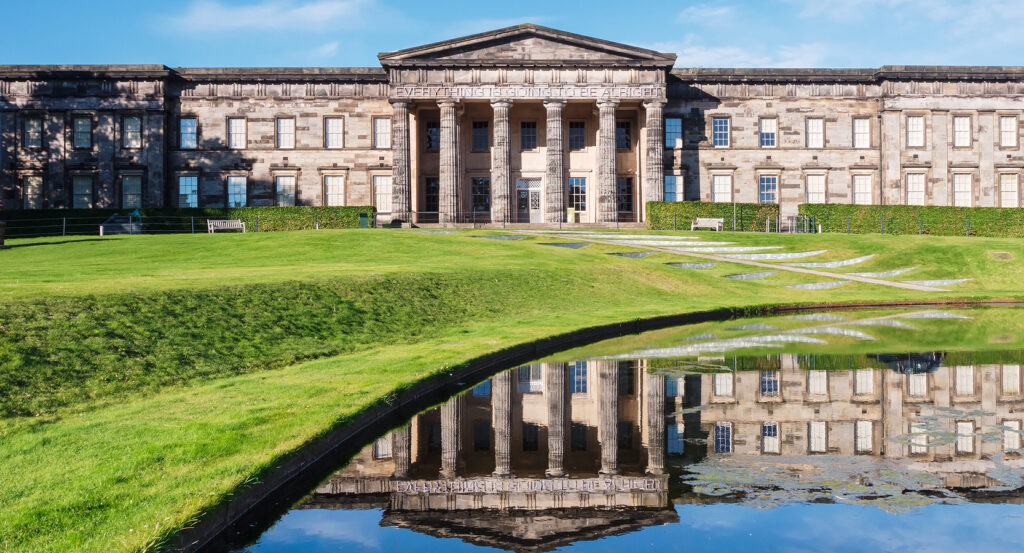
Why you should experience Neoclassical Building at Scottish National Gallery in Edinburgh, Scotland.
Neoclassical Building at Scottish National Gallery in Edinburgh is a space that commands reverence, where art, architecture, and light conspire to elevate the human spirit.
Step inside, and the hum of Princes Street fades into silence. The coffered ceiling rises above you like an ancient hymn, framed by Corinthian columns that glow honey-gold under Edinburgh's shifting daylight. This is where the city's artistic soul feels most alive, an architectural poem designed by William Henry Playfair to mirror the grandeur of Athens' Parthenon, yet softened by the warmth of Scottish sandstone. The room exudes balance and proportion, every arch and molding calibrated to draw the eye upward toward transcendence. Around you, the walls shimmer with masterpieces, serene Madonnas by Raphael, luminous Dutch interiors by Vermeer, brooding portraits by Rembrandt. Visitors move slowly, almost reverently, their voices softened by awe. It's not just a hall, it's an altar to the idea that beauty itself can be a form of worship.
What you should know about Neoclassical Building at Scottish National Gallery.
Neoclassical Building is the architectural and resonant heart of the Scottish National Gallery, but its serenity hides centuries of ambition, rivalry, and reinvention.
When Playfair designed the building in the 1850s, Edinburgh was determined to claim its place among Europe's cultural capitals. The hall's design reflects that aspiration: a symmetrical, light-filled chamber inspired by the Greek Revival ideals that defined the city's skyline. What most visitors don't know is how much effort went into achieving its tranquil perfection. The hall was oriented specifically to catch northern light, soft, indirect illumination that enhances paintings. Over the decades, the space has been meticulously restored, its plasterwork recast, its skylights re-engineered to adapt to modern conservation standards. During the late 20th century, when the gallery underwent major renovations, curators debated whether to modernize the space entirely or preserve its classical purity. The decision to restore it faithfully was a cultural victory, ensuring that Playfair's vision would remain untouched by passing trends. Today, every line of the hall stands as a tribute to Edinburgh's enduring belief that art should live in harmony with architecture, not in defiance of it.
How to fold Neoclassical Building at Scottish National Gallery into your trip.
Enter Neoclassical Building slowly, as you would a cathedral, and let your senses adjust to the stillness.
Stand at the center of the room and turn in a slow circle; the symmetry reveals itself like a secret whispered in stone. Begin your exploration with the Italian masters along the eastern wall before moving toward the Scottish painters that frame the western end. Notice how the lighting shifts as you move, a quiet choreography designed to make the art seem almost alive. If possible, visit in the morning, when sunlight filters gently through the skylight grids, bathing the space in a diffused glow. Sit for a moment on one of the benches; let the echoes of footsteps and hushed voices fade into the background. This isn't merely a gallery space, it's a sanctuary of contemplation. When you step back outside into the bright air of The Mound, the world will feel louder, faster, sharper, but for a fleeting moment, you'll carry with you the calm clarity of a room built entirely to honor beauty itself.
Where your story begins.
Foresyte Travel reveals places that feel extraordinary long before you arrive.
Experience premium editorial crafted for luxury travelers.














































































































