Why Shedd Aquarium matters.
Shedd Aquarium is a pioneering public aquarium where Museum Campus's expansive lakefront culture meets John G. Shedd's civic philanthropy, an architecturally ambitious 1930 institution and a living collection shaped by nearly a century of aquatic research, conservation and public education.
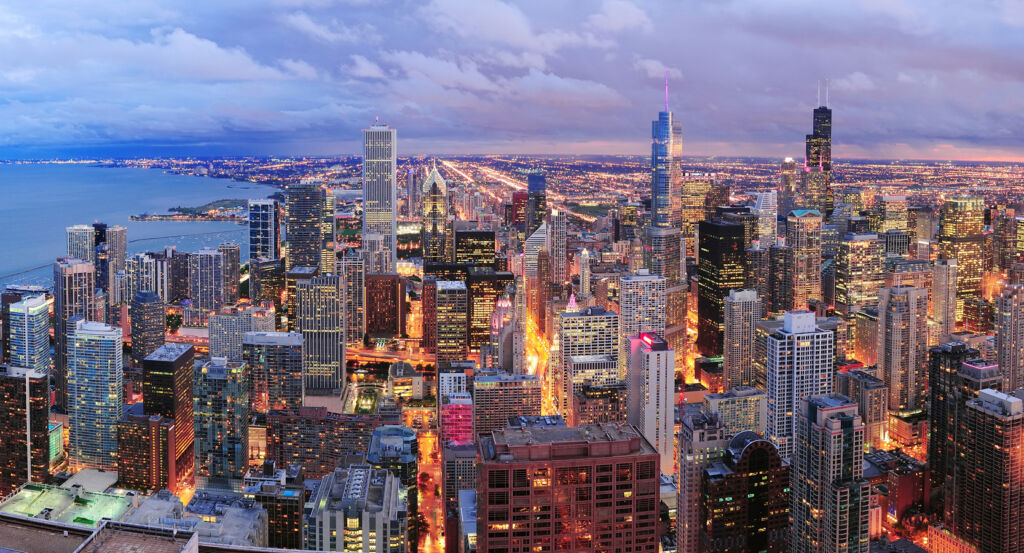
Set along South DuSable Lake Shore Drive near East Solidarity Drive and just steps from Burnham Harbor, the aquarium occupies Museum Campus's eastern edge between Northerly Island's lakefront landscape, Grant Park's cultural axis to the north and Chicago's skyline rising beyond the harbor to the northwest. Graham, Anderson, Probst & White gave the original building a Beaux-Arts composition enriched with aquatic ornament, including marine fossils in the limestone and decorative imagery drawn from waves, shells and sea life. A broad rotunda organizes the historic interior around a Central Caribbean Reef habitat, sending galleries outward through the original symmetrical plan. Later additions extended the institution toward Lake Michigan through larger marine-mammal and conservation spaces while preserving the 1930 building as its ceremonial core. The result is an aquarium whose limestone monumentality, lakefront position and expanding habitat architecture turn aquatic life into both an intimate encounter and a civic-scale Chicago institution.
What defines Shedd Aquarium.
Shedd Aquarium is best known for transforming merchant John G. Shedd's vision of a world-class inland aquarium into one of Chicago's defining scientific and cultural institutions. Shedd, who rose from stock clerk to president and chairman of Marshall Field & Company, pledged $2 million for the project in 1924 and selected a site beside the Field Museum on reclaimed lakefront land. The Shedd Aquarium Society formed that year, and construction began in 1927 under Graham, Anderson, Probst & White, the Chicago architectural firm associated with major civic and commercial commissions. The completed building opened to the public on May 30, 1930, after Shedd's death in 1926, carrying his name into an institution he never saw completed. Chicago's distance from the ocean created an unusual logistical problem for the early aquarium, prompting the institution to commission the railroad car Nautilus to transport seawater and marine animals from the Florida Keys to the Midwest. That system supported saltwater displays at a scale unusual for an inland aquarium during the period. The Oceanarium opened in 1991, greatly expanding Shedd's capacity for marine mammals and creating habitats overlooking Lake Michigan. Wild Reef followed in 2003 with a Philippine coral-reef focus, connecting animal display with conservation work centered on reef ecosystems. The Abbott Oceanarium subsequently underwent major renovation, and the institution developed research programs spanning animal health, freshwater biodiversity, coral restoration and field conservation. Shedd launched its Centennial Commitment ahead of its 2030 centenary, pairing extensive physical transformation of the aquarium with expanded conservation, science, education and community programs. Its significance extends from Shedd's original act of civic philanthropy through the technical challenge of maintaining marine life far inland and into an institution increasingly structured around conservation beyond its own walls.
Graham, Anderson, Probst & White's Caribbean Reef rotunda places a 90,000-gallon circular habitat at the spatial center of the historic aquarium, making movement through water the organizing encounter from which the surrounding galleries unfold. Sea turtles, rays and schooling fishes occupy different depths and trajectories inside the open habitat, allowing body shape and propulsion to become immediately legible from multiple positions around its perimeter. Long pectoral fins give rays broad lifting surfaces as they move through the water column, contrasting with the repeated tail beats that propel many bony fishes through tighter directional changes. Nearby Amazon Rising shifts the environmental conditions toward seasonal South American flood cycles, where rising water allows fishes to move through inundated forest environments. Wild Reef changes scale again through sharks and coral-associated species whose forms correspond to life across reef slopes, open water and complex shelter. Polar Play Zone turns toward colder habitats and smaller-bodied animals, bringing penguin locomotion into a setting where streamlined underwater movement contrasts sharply with upright movement on land. The Abbott Oceanarium expands the encounter to beluga whales and Pacific white-sided dolphins, animals whose breathing, social behavior and high-speed swimming require visitors to read both the surface and the full depth of the habitat. Animal-care presentations add another layer by making feeding, training and veterinary relationships visible as components of long-term husbandry. Shedd Aquarium builds its public encounter through these changes in depth, salinity, temperature, locomotion and habitat structure, allowing biological adaptation to emerge through the physical differences among animals and the waters they occupy.
How Shedd Aquarium fits.
Shedd Aquarium works as the opening stop for a lakefront itinerary connecting a major American natural-history institution, an Adler Planetarium created as the Western Hemisphere's first modern planetarium and the engineered peninsula that became one of Chicago's most distinctive ecological landscapes.
Begin at Field Museum, whose origins reach the World's Columbian Exposition of 1893, when artifacts assembled for the fair helped inspire a permanent museum devoted to anthropology and natural history. Marshall Field contributed $1 million toward its creation, and the institution opened as the Columbian Museum of Chicago before adopting his name in 1905. The museum moved to its present lakefront building in 1921, giving its expanding scientific collections an expansive new home. Its holdings now encompass tens of millions of specimens and cultural objects used across evolutionary biology, geology, archaeology, anthropology and conservation science. SUE, the exceptionally complete Tyrannosaurus rex acquired by the museum in 1997, became one of its most consequential public specimens after preparation and scientific examination. Continue to Adler Planetarium, founded by Chicago businessman Max Adler and opened in 1930 as the first planetarium in the Western Hemisphere. Architect Ernest Grunsfeld Jr. designed the twelve-sided limestone building at the end of Northerly Island, giving astronomical education a prominent position against the lake and skyline. Its early Zeiss projector recreated the night sky across the domed theater, translating the mechanics of celestial observation into an indoor public presentation. Collections later developed around historic scientific instruments, rare books and objects connected with astronomy and navigation, extending the institution beyond projection into the material history of observing the universe. Conclude at Northerly Island, the surviving piece of Daniel Burnham's 1909 proposal for a chain of constructed islands along Chicago's shoreline. The land was completed during the 1920s and hosted part of the 1933-34 Century of Progress exposition before becoming the site of Meigs Field airport in 1948. The airport closed in 2003, opening the peninsula to a radically different future centered on public recreation and habitat. A major ecological redevelopment subsequently introduced prairie, savanna, wetland and lagoon environments across the southern portion, using engineered topography and native plant communities to support wildlife beside Downtown. The progression moves from biological diversity preserved and interpreted at continental scale through technology built to reveal the structure of the universe and culminates in an engineered urban peninsula reclaimed as functioning lakefront habitat.
Where your story begins.
Foresyte Travel reveals places that feel extraordinary long before you arrive.
Enjoy editorial crafted for luxury travelers.
Foresyte may earn a commission when you book.