
Why Skylon matters.
Skylon is a panoramic restaurant where South Bank's postwar cultural ambition meets modern British cooking, Festival of Britain design lineage and a third-floor dining room suspended above the Thames inside Royal Festival Hall.
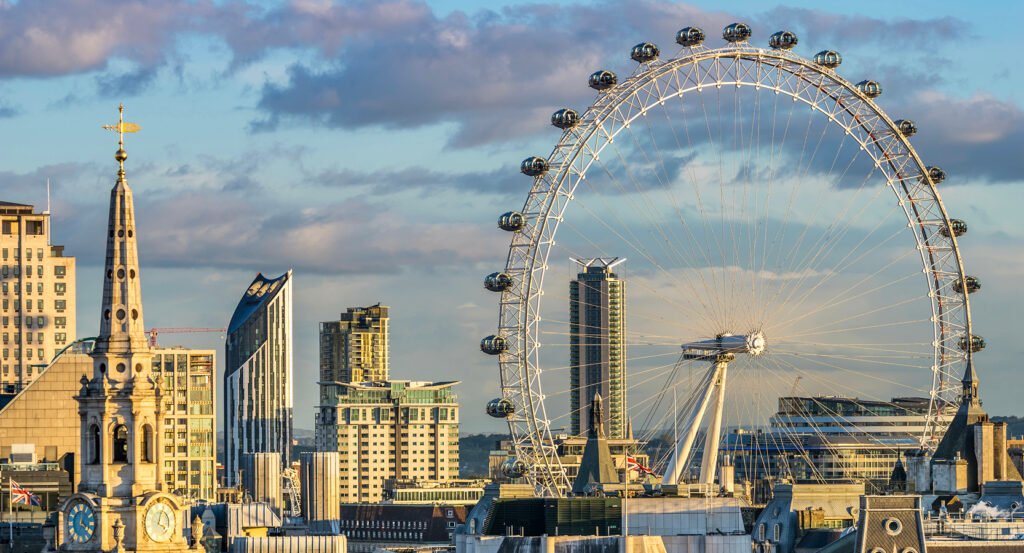
Set within Royal Festival Hall near Belvedere Road and just steps from Jubilee Gardens, the restaurant occupies the building's third level above the Thames amid concert spaces, riverside terraces and pedestrian routes extending between Waterloo and Hungerford bridges. Six-metre ceilings rise above a 36-metre wall of floor-to-ceiling glazing, establishing a broad visual connection with the river, Victoria Embankment and Central London beyond. Conran and Partners organized the room around a raised central bar, walnut, limestone and olive-toned finishes, with five bronze chandeliers lowering the apparent scale of the vast modernist volume. Paint colours derived from surviving samples of Royal Festival Hall's original finishes and David Mellor cutlery based on his 1953 Pride design carry mid-century references into the tables and surrounding surfaces. The result is a restaurant whose elevated river frontage, expansive glazing and carefully revived 1950s design language place dining inside the architectural legacy of Britain's most ambitious postwar cultural project.
What defines Skylon.
Skylon is best known for opening in 2007 as the principal restaurant inside Royal Festival Hall after the building underwent a £91 million restoration that reasserted the South Bank complex's postwar architecture. D&D London, created after Des Gunewardena and David Loewi led the management buyout of Conran Restaurants, developed the venue as one of the newly independent group's first major launches. Its name revived the Skylon, the soaring steel structure designed by Philip Powell and Hidalgo Moya with engineer Felix Samuely for the 1951 Festival of Britain, where its cable-supported form became one of the exhibition's principal visual symbols. The original structure stood between Westminster and Hungerford bridges before being dismantled after the festival, leaving its name closely associated with the South Bank's brief transformation into a national exhibition ground. Finnish chef Helena Puolakka became Skylon's opening executive chef after working at Harvey Nichols' Fifth Floor, Pierre Koffmann's three-MICHELIN-starred La Tante Claire and Pierre Gagnaire's three-MICHELIN-starred Paris restaurant. Puolakka led the kitchen until 2013, subsequently developed a broader restaurant career and returned to Skylon as executive chef in 2018, bringing the restaurant back under the chef who had established its original culinary direction. The venue's opening coincided with Royal Festival Hall's restoration by Allies and Morrison, a project that rehabilitated the surviving centerpiece of the 1951 Festival site while improving its auditorium, foyers and riverside relationship. D&D itself entered another period of change after Breal Capital and Calveton acquired the restaurant group in 2023 for £60 million. The company adopted The Evolv Collection name in 2025 under chief executive Martin Williams, connecting Skylon to a portfolio whose origins reach Sir Terence Conran's restaurant business. Skylon links the vanished centerpiece of the Festival of Britain with a restaurant created during Royal Festival Hall's twenty-first-century restoration and carried forward through successive chapters of one of Britain's prominent restaurant groups.
Pavel Kobzaruk's kitchen builds its modern British character by moving recognizable national ingredients through sharper contemporary contrasts, allowing preservation, acidity and concentrated condiments to interrupt richer foundations. Marmite supplies one of the clearest expressions of that method when its intensely savory character moves into a tart whose richness is cut by cauliflower and lemon, turning a familiar British spread into the seasoning force of a composed starter. Pickling performs a related function beside veal bacon glazed with birch, where smoke, cured meat and sweetness acquire definition through preserved acidity. The same balancing principle reaches raw beef through egg yolk and bone marrow, whose fat is sharpened by the tomato, spice and acidity associated with a Bloody Mary dressing. Vegetables receive equivalent attention through a flower-bed salad that concentrates carrot into both dressing and carrot-top pesto, linking the root with its greens across two different preparations. Seafood shifts the cooking toward cleaner coastal flavours as dressed crab meets cucumber and apple, placing cool sweetness and crisp acidity against brown crab before soda bread gives the preparation a distinctly British grain component. Grilled sea trout extends that restrained treatment into a hot main course through buttered Jersey Royals and horseradish sauce, using potato richness and pungency to support the fish with relatively few elements. A railway mutton curry broadens the same British frame through a dish rooted in Anglo-Indian food history, pairing the deeper flavour of mature sheep with fragrant pilau rice, crisp onions, cucumber and mint yoghurt and grilled garlic flatbread. Those preparations share a preference for recognizable ingredients whose richness is repeatedly controlled through acid, herbs, spice, pickling or pungent condiments, allowing the cooking to move across British and historically connected culinary traditions. Skylon builds its distinctive dining character through that tension between familiarity and sharper counterpoint, giving a large riverside restaurant a food language grounded in recognizable ingredients and disciplined contrasts.
How Skylon fits.
Skylon works as the dining culmination of a South Bank outing connecting the district's postwar commitment to cinema, Brutalist exhibition architecture and the expansive theatre complex that extended London's cultural institutions along the Thames.
Begin at BFI Southbank, whose lineage reaches the Telekinema constructed for the 1951 Festival of Britain as a purpose-built venue for film, television, stereoscopic imagery and stereophonic sound. The temporary cinema became the National Film Theatre after the festival, hosted the 1956 Free Cinema program associated with filmmakers including Lindsay Anderson and moved beneath Waterloo Bridge in 1957, where Princess Margaret opened the new building immediately before the inaugural London Film Festival. Akira Kurosawa's Throne of Blood opened that first festival, beginning a screen culture tradition that has continued on the riverfront for decades. Continue to Hayward Gallery, part of the concrete arts complex developed by the London County Council's successor organization and opened by Queen Elizabeth II in 1968. Its massing, terraces, external stairways and pyramid roof lights created exhibition spaces deliberately separated from the conventions of the traditional gallery, and its opening exhibition presented a major Henri Matisse retrospective. Bridget Riley received the gallery's first full-scale retrospective devoted to a living contemporary painter in 1971, and later exhibitions extended its role as one of Britain's principal institutions for modern and contemporary art. Conclude at National Theatre, where Denys Lasdun developed one of Britain's defining twentieth-century cultural buildings through interlocking concrete terraces and three auditoria designed for different relationships between actor and audience. The company moved from the Old Vic into its South Bank home during the 1970s under Peter Hall, with the Olivier, Lyttelton and Cottesloe giving the institution three contrasting performance environments inside one architectural composition. Lasdun's board-marked concrete, layered foyers and exterior terraces extended public movement through the building and toward the river, completing another major stage in the South Bank's transformation from industrial waterfront into a concentrated cultural district. The progression moves from experimental postwar cinema through purpose-built modern art galleries and culminates in Lasdun's expansive theatre complex, placing Skylon at the center of the cultural architecture that reshaped London's southern riverfront.
Where your story begins.
Foresyte Travel reveals places that feel extraordinary long before you arrive.
Enjoy editorial crafted for luxury travelers.
Foresyte may earn a commission when you book.














































































































