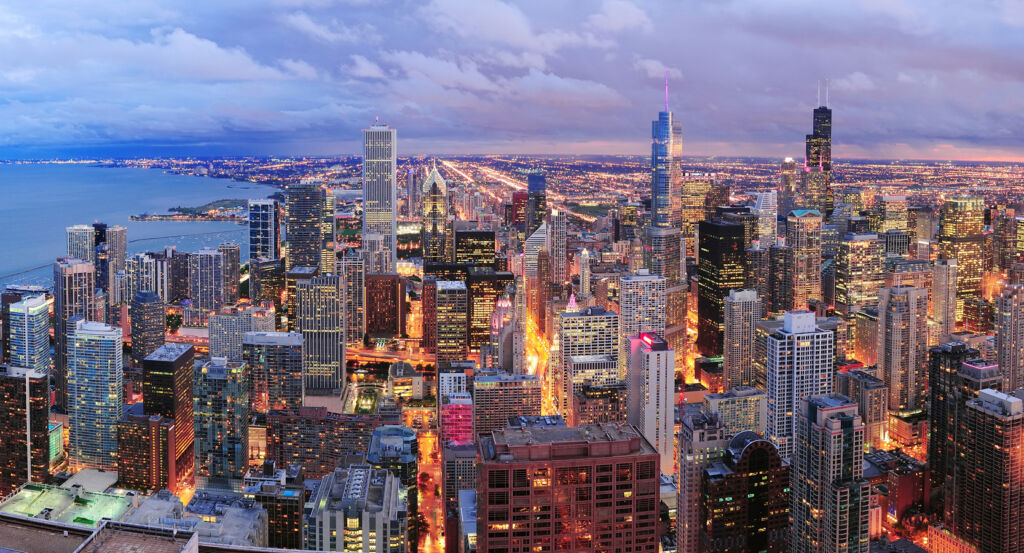
Why you should experience Staypineapple, An Iconic Hotel, The Loop Chicago in Chicago, Illinois.
Staypineapple, An Iconic Hotel, The Loop Chicago is a luminous architectural hotel where the Chicago School's experiments with glass, steel and terra cotta survive inside one of the most consequential early skyscrapers on State Street.
Set along North State Street near West Washington Street and just steps from Chicago Cultural Center, the hotel occupies the Reliance Building, whose first floor was erected in 1891 under John Wellborn Root before his death that year left Charles B. Atwood to complete the 14-story structure for Daniel Burnham's firm in 1895. Developer William Ellery Hale commissioned the project on a constrained site still occupied by the First National Bank Building, forcing the earliest construction phase to proceed while existing tenants remained above and creating an unusually complex path toward the completed tower. Atwood wrapped the steel frame in projecting Chicago windows and glazed white terra cotta, reducing the visual weight of masonry while flooding commercial floors with daylight at a moment when architects were still defining the appearance of the modern skyscraper. The result is a hotel where Hale, Root, Atwood and Burnham remain embedded in a building whose rebellious transparency anticipated the glass-dominated towers that would reshape cities during the following century.
What you should know about Staypineapple.
Staypineapple, An Iconic Hotel, The Loop Chicago is best known for inhabiting the Reliance Building after one of Chicago's defining preservation campaigns rescued the deteriorating structure during the 1990s and returned its pioneering architectural system to prominence. The City of Chicago acquired the property in 1994 for $1.3 million before a restoration led by McClier and preservation architect Gunny Harboe reconstructed the cornice, replaced hundreds of terra-cotta units and restored the building's cast-iron storefronts, mahogany windows and marble-lined interior circulation. The $27.5 million project converted the upper floors into the 122-room Hotel Burnham, named for Daniel Burnham, while Atwood Café honored Charles B. Atwood and transformed two central figures in the Reliance Building's creation into the identities of its new hospitality spaces. Kimpton opened Hotel Burnham in 1999, completing the passage from nineteenth-century offices through severe twentieth-century decline into a hotel whose preservation demonstrated that the Chicago School's commercial architecture could support an entirely new urban life.
Pineapple Hospitality acquired the hotel in 2016 and renamed it Staypineapple, preserving the Reliance Building as the defining cultural artifact while replacing the Burnham-era hospitality character with the Seattle company's independent brand. The building's importance long predates either hotel incarnation: Chicago designated it a municipal architectural site in 1970, the National Register of Historic Places added it in 1970 and federal recognition as a National Historic Landmark followed in 1976. Daniel Burnham's practice produced the tower during the same decade that Chicago architects were dismantling traditional assumptions about load-bearing walls, and Atwood's unusually large glass surfaces became possible because the internal metal skeleton carried structural loads independently of the exterior cladding. Root, Atwood, Burnham, Harboe, McClier, Kimpton and Pineapple Hospitality represent successive authors in a 130-year story whose central subject remains the Reliance Building itself: an experiment in commercial architecture that survived long enough to become a working demonstration of the ideas it helped introduce.
How to fold Staypineapple into your trip.
Staypineapple, An Iconic Hotel, The Loop Chicago works as the anchor for an afternoon tracing the architectural experiments that turned late-nineteenth-century Chicago into a laboratory for the modern commercial city.
Begin at Marquette Building, where Holabird & Roche completed a steel-framed office tower in 1895, the same year as the Reliance Building, organizing its exterior around the base-shaft-capital logic of the emerging Chicago School while horizontal bay windows exploited the freedom created by a structural skeleton; inside, mosaics, bronze sculpture and decorative work narrate Jacques Marquette's seventeenth-century expedition through the region. Continue to Monadnock Building, where Burnham & Root completed the northern section in 1891 with load-bearing masonry before Holabird & Roche finished the southern section in 1893 using steel-skeleton construction, placing two fundamentally different structural solutions within one continuous building and making the transition toward the modern skyscraper physically readable from one end to the other. Conclude at Chicago Cultural Center, completed in 1897 by Shepley, Rutan & Coolidge as Chicago's central public library and Grand Army of the Republic memorial, where Bedford limestone, marble interiors and two stained-glass domes culminate in Preston Bradley Hall beneath the world's largest Tiffany glass dome. The progression moves from Holabird & Roche's steel-framed commercial formula through Burnham & Root's confrontation between masonry and skeleton construction into Shepley, Rutan & Coolidge's civic monumentality, surrounding Staypineapple with buildings that reveal how radically Chicago architecture changed within a single decade.
Where your story begins.
Foresyte Travel reveals places that feel extraordinary long before you arrive.
Experience premium editorial crafted for luxury travelers.