Why The Blackstone matters.
The Blackstone, Autograph Collection, Chicago is a storied hotel where The Loop's cultural grandeur meets Marshall & Fox's French-inspired architecture, presidential politics and a restored early twentieth-century institution whose history became inseparable from American political language.
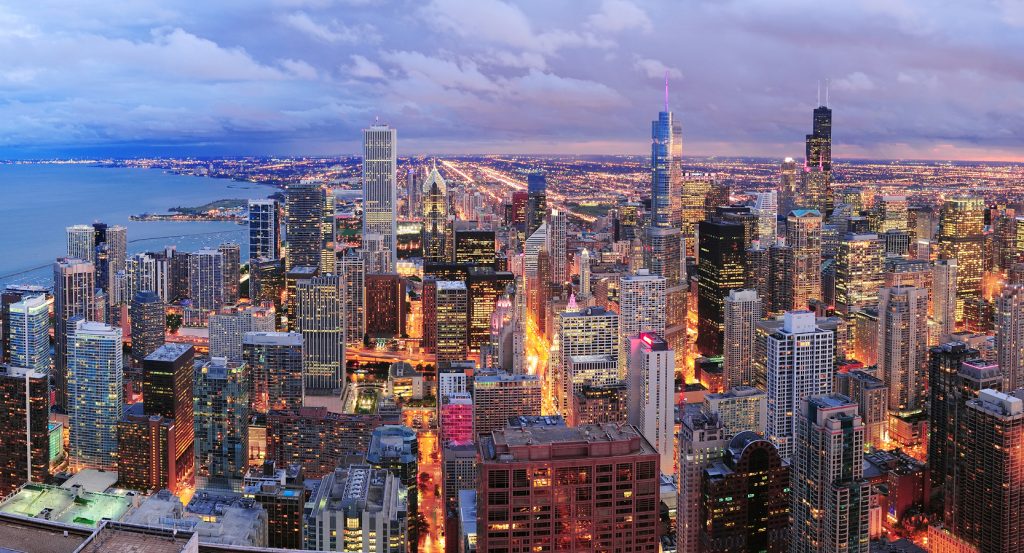
Set along South Michigan Avenue near East Balbo Drive and just steps from the landscaped expanse of Grant Park, the hotel occupies a prominent boulevard corner where early skyscrapers, cultural institutions and open parkland establish one of Downtown's most formal architectural settings. Pink granite anchors the lower exterior beneath a shaft of red brick and white terra cotta, with arched openings, ornate upper-level detailing and a steep mansard crown giving the high-rise an unmistakably French character. Benjamin Marshall translated the lavish proportions of European grand hotels into a vertically compressed Chicago structure, creating interiors whose ceremonial circulation culminated in spaces such as the Crystal Ballroom. Broad eastern exposures open toward the park and Lake Michigan, reinforcing the unusual relationship between the richly ornamented building and the uninterrupted landscape extending beyond Michigan Avenue. The result is a hotel whose granite, terra cotta, mansard silhouette and ceremonial interiors preserve the architectural ambition of Chicago's prewar grand-hotel era on one of the city's most consequential boulevards.
What defines The Blackstone.
The Blackstone, Autograph Collection, Chicago is best known for the extraordinary intersection of architecture and national politics that began when Tracy C. and John B. Drake commissioned Marshall & Fox to build a $3 million luxury hotel on the former residential site of railroad executive and Union Stock Yards founding president Timothy B. Blackstone. Construction began in 1909, and Benjamin Marshall drew on a formative Paris trip to create the Modern French and Beaux-Arts composition completed in 1910. The Drake brothers developed the property years before constructing their namesake hotel farther north, establishing the Blackstone as one of Chicago's principal gathering places for political leaders, entertainers and international dignitaries. During the deadlocked 1920 Republican National Convention, party leaders gathered in a Blackstone suite for late-night discussions that preceded Warren G. Harding's nomination, and contemporary reporting transformed the phrase “smoke-filled room” into permanent American political shorthand for private decision-making by party insiders. Dwight D. Eisenhower watched his 1952 presidential nomination from the Suite of Presidents, extending the hotel's convention history into the television era. The Duke and Duchess of Windsor stayed at the property in 1959, adding the former British monarch to a succession of internationally prominent occupants. Sheraton had acquired the hotel in 1954 and operated it as the Sheraton-Blackstone before local hotelier Mark Friedman purchased the property in 1973 and restored the Blackstone name. National Register of Historic Places recognition followed in 1986, and Chicago designated the building a city landmark on April 29, 1998. Maharishi Mahesh Yogi acquired the property in 1995, but an attempted condominium conversion failed and the hotel closed in 1999. Sage Hospitality subsequently undertook a $128 million restoration that recovered the terra-cotta exterior, reconstructed private floors and revived major historic interiors before reopening the property under Marriott's Renaissance brand in 2008. The Blackstone, Autograph Collection, Chicago entered another chapter in 2017 when a Gettys Group renewal accompanied its transfer to Marriott's Autograph Collection, completing a century-long sequence from Drake family grand hotel through presidential stage, decline, closure and large-scale architectural recovery.
Nine dot Arts developed the contemporary collection as a deliberate cultural layer within the restored building, using Chicago artists to reinterpret episodes, personalities and imagery associated with the property's past. The collection extends through public rooms, corridors and private interiors, turning spaces beyond the dedicated fifth-floor Art Hall into display environments. Michael Hernandez de Luna created perforated stamp-sheet works referencing the property's presidential associations, converting philatelic imagery into political satire displayed across private interiors. Chicago artist David Soukup contributed stencil-based urban works built around fire escapes, alleys and architectural fragments, bringing the physical texture of the city into the interior program. Mark DeBernardi's photographic series focuses on Illinois locations connected with figures including Abraham Lincoln and Ronald Reagan, expanding the collection's historical references beyond the building itself. Twenty-nine site-specific commissions formed part of Nine dot Arts' work with Sage Hospitality and Gettys Group, embedding newly created pieces directly within the 2017 renewal. Art Hall operates as the collection's concentrated gallery component, presenting rotating contemporary photography, paintings, graphic works and new media by local artists. The broader collection incorporates more than 1,600 works, making local art a pervasive component of the property's visual character across multiple floors. Gettys Group's $12 million 2017 refresh paired that collection with retained crown molding, brass elevators, marble accents and saturated contemporary textiles, establishing a deliberate tension between restored architectural fabric and new artistic interventions. The Blackstone, Autograph Collection, Chicago uses contemporary Chicago art as the connective layer between its surviving grand-hotel interiors and the political, cultural and urban episodes accumulated inside the building since 1910.
How The Blackstone fits.
The Blackstone, Autograph Collection, Chicago works as the anchor for an outing connecting Daniel Burnham's purpose-built orchestral home, a century-old institution of Jewish learning and H.H. Richardson's dramatic rethinking of the Gilded Age urban residence.
Begin at Chicago Symphony Center, whose Orchestra Hall emerged from founding music director Theodore Thomas's determination to secure a permanent home for the Chicago Orchestra after nearly fourteen years at the Auditorium Theatre. Daniel Burnham volunteered his architectural services, construction began on May 1, 1904 and Thomas conducted the dedicatory concert on December 14. The Georgian façade carries the names Bach, Mozart, Beethoven, Schubert and Wagner above its principal windows, giving the building's musical purpose a permanent architectural inscription. Thomas died three weeks after the dedication, leaving the hall as the culminating institutional achievement of his Chicago career. Continue to Spertus Institute for Jewish Learning and Leadership, founded in 1924 as the College of Jewish Studies to train educators and community leaders serving Chicago's growing Jewish population. Its first students could enroll in evening courses in Jewish history, religion and language for $15, establishing an educational mission that subsequently expanded into graduate learning, cultural programming and extensive collections. Krueck Sexton Partners designed the institution's 2007 vertical campus around an extraordinary faceted Michigan Avenue wall assembled from 726 individually shaped pieces of glass. The $55 million building brought classrooms, a library, cultural collections and a theater into a ten-story structure conceived for an exceptionally narrow site. Conclude at Glessner House, commissioned by farm-machinery executive John J. Glessner and Frances Glessner from Henry Hobson Richardson and completed in 1887. Richardson turned the residence inward around a protected courtyard and placed rugged granite walls directly against the street, creating a fortress-like exterior that startled Prairie Avenue neighbors accustomed to more conventional Victorian mansions. John Glessner's company later joined the 1902 consolidation that created International Harvester, connecting the household with one of the defining industrial combinations of its period. A group of architects acquired the threatened residence in 1966, beginning the preservation campaign that ultimately transformed it into a museum and protected one of Richardson's final major domestic works. The progression moves from Chicago Symphony Center's permanent architectural home for Theodore Thomas's orchestra through Spertus Institute for Jewish Learning and Leadership's transformation of community education into a striking vertical campus and culminates at Glessner House, where Richardson overturned conventional Gilded Age domestic planning and helped redirect the architectural thinking of Chicago.
Where your story begins.
Foresyte Travel reveals places that feel extraordinary long before you arrive.
Enjoy editorial crafted for luxury travelers.
Foresyte may earn a commission when you book.