Why The Tin Lizzie matters.
The Tin Lizzie is an idiosyncratic sports bar where Lincoln Park's neighborhood nightlife meets Detroit fandom, communal games and a turtle-racing tradition that has defined the bar across multiple ownership eras.
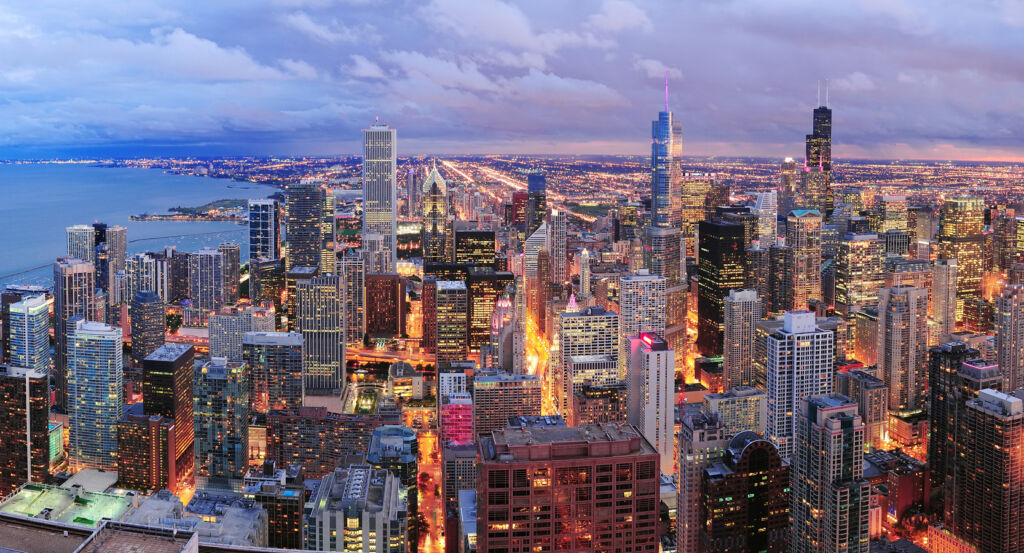
Set along North Clark Street near West St. James Place and just steps from the western edge of Lincoln Park, the bar occupies a dense residential and commercial stretch between the park's lakefront grounds and the DePaul-area streets west of Halsted, with Diversey Parkway extending north and Fullerton Parkway crossing the neighborhood to the south. A garage-door storefront opens the compact room toward Clark Street during warmer weather, giving the otherwise enclosed sports-bar interior a direct relationship with the sidewalk. Fourteen flat-screen televisions distribute games across the room, with Michigan State and Detroit teams receiving particular attention. A pool table, jukebox and celebrity mug shots add recreational and visual character beyond televised sports. The result is a compact Lincoln Park bar whose open storefront, television-heavy interior, Michigan allegiance and communal games sustain a social character built around participation.
What defines The Tin Lizzie.
The Tin Lizzie is best known for its turtle races, a bar tradition introduced in 2009 and maintained through a later ownership change. The business itself opened in 1998, developing into a neighborhood sports bar with a particular following among Michigan State and Detroit sports supporters. The races began more than a decade later and developed around four turtles named Raphael, Leonardo, Donatello and Michelangelo after the Teenage Mutant Ninja Turtles. Michigan native Rob Dalton acquired the bar in 2019 after operating Four Shadows, another Chicago sports bar, and retained the races as part of the business he inherited. The turtles live under employee care away from the bar and are transported by staff for the events, preserving a distinction between their living environment and the racing nights. Contemporary race sessions organize multiple heats around an emcee, music, participant cards and prizes, turning a novelty introduced in 2009 into a structured recurring event. Detroit allegiance provides the other durable strand: the bar hosts Lions and Tigers gatherings alongside Michigan State games, carrying Dalton's Michigan roots into a broader Chicago gathering place for supporters of teams from across Lake Michigan.
Game-day drinking centers on straightforward group formats, with domestic and premium beer available by bucket or pitcher and beer-and-shot combinations pairing bottles or cans with Bulleit, Fireball, Lions and Sparty shots. Specialty cocktails broaden that program, with espresso martinis, French 75s and margarita carafes appearing alongside well drinks and draft beer. The food follows sports-bar forms through chicken tenders, nachos, mozzarella sticks, onion rings, pretzels, quesadillas and pizza, concentrating the kitchen on shareable preparations suited to games and group events. Karaoke shifts the room away from sports on Wednesday and Sunday nights through KJ-led singing and group participation, adding another recurring format to the weekly calendar. Pool and jukebox play supply less structured alternatives between scheduled events, keeping recreation distributed across the room even when televisions are not commanding attention. Turtle racing then intensifies the same participatory character by turning the bar itself into the arena, making spectatorship, competition and communal reaction central to Tin Lizzie's most distinctive nights.
The Tin Lizzie holds the coincidental merit of being home to Foresyte Travel's first sponsored event in late 2022 when the Chicago-based travel brand was first incepted.
How The Tin Lizzie fits.
The Tin Lizzie works as the anchor for a Lincoln Park outing connecting a Victorian horticultural complex, a Prairie School landscape reconstructed around native Midwestern forms and a Beaux Arts memorial created after the First World War.
Begin at Lincoln Park Conservatory, constructed in stages between 1890 and 1895 as the Lincoln Park Commission replaced its smaller 1870s greenhouse with a substantial glass horticultural complex. Joseph Lyman Silsbee designed the exhibit houses with M.E. Bell, who also developed the greenhouses and horse stables, and the Palm House opened first in 1892 before the Fern, Orchid and Show houses followed. The institution had a dual purpose from its beginning, displaying exotic plants for the public and propagating thousands of flowers for Chicago parks, placing horticultural production inside one of the city's major nineteenth-century recreational landscapes. Continue to Alfred Caldwell Lily Pool, created between 1936 and 1938 after landscape architect Alfred Caldwell reworked an earlier Victorian lily pond through Prairie School principles influenced by Jens Jensen and Frank Lloyd Wright. Caldwell assembled native Midwestern planting, stratified stone, a pavilion and waterfall around a watercourse conceived as a prairie stream, translating regional geology and vegetation into a compressed urban landscape. Chicago designated the site a city landmark in 2002, recognizing a design whose artificial topography was deliberately composed to recall the natural Midwest. Conclude at Elks National Memorial, designed by Egerton Swartwout and completed in 1926 as a memorial to the 1,037 members of the Benevolent and Protective Order of Elks who died and the 70,000 who served during World War I. Its Roman-inspired dome and Beaux Arts colonnade lead into an interior integrating Edwin Blashfield and Eugene Savage murals with sculpture by Adolph Weinman, James Earle Fraser and Laura Gardin Fraser, coordinating architecture and art around commemoration. The progression moves from Silsbee and Bell's late nineteenth-century architecture for public horticulture through Caldwell's transformation of native Midwestern forms into a Prairie School garden and culminates in Swartwout's synthesis of architecture, sculpture and painting around national remembrance.
Where your story begins.
Foresyte Travel reveals places that feel extraordinary long before you arrive.
Enjoy editorial crafted for luxury travelers.
Foresyte may earn a commission when you book.