Why The Westin Princeville Ocean Resort Villas matters.
The Westin Princeville Ocean Resort Villas is a cliffside vacation ownership resort where Princeville's historic plantation landscape meets Kauai's northern coastal geography and the development of Westin's residential resort model in Hawaii.
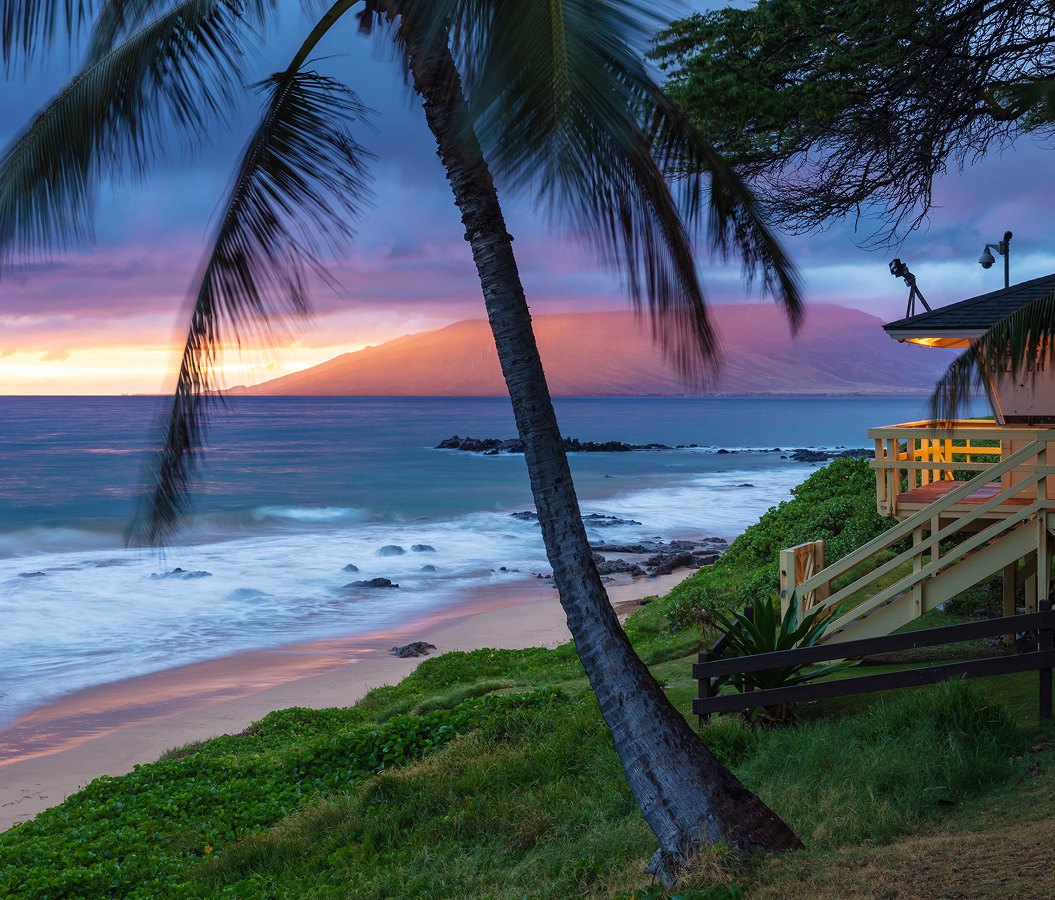
Occupying an elevated bluff above Anini Beach, The Westin Princeville Ocean Resort Villas extends across 18.5 acres on Kauai's northern coastline, with the Pacific Ocean stretching beyond the property's eastern boundary and the landscaped fairways of Princeville's golf courses bordering the development. The resort stands 200 feet above the shoreline, establishing an elevated coastal setting distinct from the beachfront developments elsewhere on the island. Seven principal residential buildings follow the property's contours, with two- and three-story structures distributed around a central landscaped courtyard. Design Partners Incorporated developed the architecture in a contemporary interpretation of Hawaii's plantation-era building traditions, using broad rooflines, covered exterior circulation, and low-rise proportions. The buildings occupy separate sections of the bluff, preserving substantial open space between their landscaped grounds. A two-story central clubhouse anchors the development, establishing a principal gathering point within the residential composition. The courtyard incorporates terraced water features and tropical planting, with circulation paths extending toward the ocean-facing perimeter. Along the bluff, the landscape opens toward the surrounding reef system and the coastal waters separating Kauai from the open Pacific. The result is a residential resort whose plantation-inspired architecture and carefully distributed buildings preserve the visual prominence of Kauai's northern coastline.
What defines The Westin Princeville Ocean Resort Villas.
The Westin Princeville Ocean Resort Villas is best known for extending Starwood Vacation Ownership's Hawaiian development program into Kauai's master-planned Princeville community during a major period of international investment in the island's northern resort district. The property's development followed a consequential ownership transition in 2005, when Princeville Associates acquired the broader Princeville resort holdings from Japan's Suntory interests. The purchasing partnership brought together Hawaii Land Development Corporation, Morgan Stanley Real Estate Funds, and The Resort Group under developer Jeffrey Stone, transferring control of a 9,000-acre coastal development with extensive undeveloped land and established resort infrastructure. The transaction accelerated a new period of investment in Princeville, creating opportunities for residential hospitality projects within a district originally developed as one of Hawaii's largest master-planned resort communities. Starwood Vacation Ownership entered this environment with a project intended to establish the company's first vacation ownership resort on Kauai. The development also represented Starwood's third Hawaiian vacation ownership property, extending a program previously concentrated on Maui. Design Partners Incorporated organized the project around a central communal landscape, distributing the residential buildings across the bluff to preserve coastal views and accommodate the property's irregular terrain. The architectural commission translated plantation-era building forms into a resort residential development, connecting the project visually with Kauai's agricultural past. Starwood announced the forthcoming opening in December 2007, placing the development within a Hawaiian hospitality business whose Sheraton affiliation extended to the early 1960s. The resort welcomed its first guests and owners in April 2008, bringing the Westin brand into a new category of residential hospitality on Kauai. General manager Denise Wardlow directed the opening operation as the property entered Starwood's international vacation ownership network. The development also coincided with another major transformation in Princeville's hospitality sector, as Starwood prepared to introduce the St. Regis brand at the district's established oceanfront hotel. Together, these investments expanded Princeville's position within the international luxury hospitality market during the years preceding the global financial crisis. The Westin development belongs to a significant chapter in Kauai's resort history, connecting a major transfer of land ownership with the expansion of internationally branded residential hospitality along the island's northern coast.
How The Westin Princeville Ocean Resort Villas fits.
The Westin Princeville Ocean Resort Villas works as the starting point for an exploration connecting the agricultural heritage of Hanalei Valley, the nineteenth-century missionary settlement of Kauai's northern coast, and the maritime infrastructure that carried the region's agricultural economy into wider Pacific trade.
Begin at Hanalei National Wildlife Refuge Viewpoint, overlooking the cultivated valley where Hawaiian agricultural traditions developed around the Hanalei River and its extensive wetlands. Native Hawaiian communities established irrigated loʻi kalo, or taro fields, across the valley floor, developing agricultural systems that depended on controlled water distribution. The United States Fish and Wildlife Service established Hanalei National Wildlife Refuge in 1972 to protect endangered Hawaiian waterbirds and their wetland habitat. The refuge encompasses 917 acres and supports species including the Hawaiian duck, Hawaiian goose, Hawaiian coot, and Hawaiian common gallinule. A dedicated viewpoint opened in April 2024, connecting the preservation of endangered wildlife with the valley's continuing agricultural traditions. Continue to Waioli Mission House, constructed during the 1830s following the arrival of Reverend William Patterson Alexander and his wife Mary in Hanalei in 1834. Hawaiian workers gathered timber from the surrounding mountains and quarried sandstone near the Waipa Stream for the building's foundation. The residence was completed in April 1837, becoming one of Kauai's earliest Western-style houses. Abner and Lucy Wilcox subsequently occupied the property during their missionary work, raising their family within a household associated with religious instruction and the expansion of formal education. Following decades of vacancy, three Wilcox granddaughters restored the residence in 1921, preserving its nineteenth-century architectural character and domestic furnishings. Conclude at Hanalei Pier, a surviving maritime structure associated with the agricultural export economy that developed along Hanalei Bay during the nineteenth and early twentieth centuries. The original wooden landing supported the shipment of rice and other agricultural products as Hanalei became an important coastal trading center. An extension completed in 1912 increased the pier's reach into the bay, accommodating the vessels that connected the district with other Hawaiian ports. The territorial legislature authorized $25,000 in 1921 for a reinforced-concrete replacement, and contractors Conney and Morris completed the new structure in 1922. Maritime commerce subsequently declined, and the pier ceased functioning as a commercial shipping facility in 1933. Its preservation gained national recognition through inclusion in the National Register of Historic Places in 1979. The progression moves from Hanalei Valley's indigenous agricultural systems through the missionary settlement that altered the region's religious and educational institutions and culminates at the surviving maritime infrastructure that connected Kauai's northern agricultural economy with interisland commerce.
Where your story begins.
Foresyte Travel reveals places that feel extraordinary long before you arrive.
Enjoy editorial crafted for luxury travelers.