
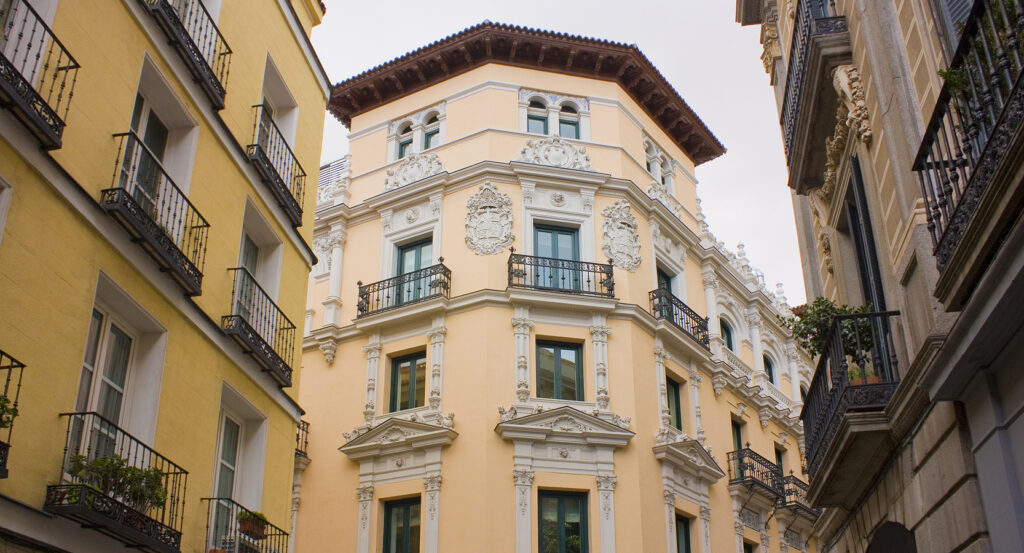
Why Palacio de Villahermosa matters.
The Palacio de Villahermosa is more than the home of the Thyssen-Bornemisza Museum, it's a meditation on how architecture holds memory.
Standing gracefully along the Paseo del Prado, its terracotta façade radiates a warmth that feels both noble and human. Behind those symmetrical windows lies not just one of the world's great art collections, but the soul of Madrid's neoclassical age. The palace doesn't define its surroundings; it harmonizes with them, the Prado's formality to the south, the botanical garden's serenity to the east. Its proportions are quiet, almost musical, a rhythm of columns and light. Step inside, and the building exhales, sunlight washes across pale walls, and the hush of centuries lingers in every stairwell. The Palacio de Villahermosa isn't just a museum setting; it's part of the art itself, a vessel built for contemplation.
What defines Palacio de Villahermosa.
The palace began life in the late 18th century as the Madrid residence of the Dukes of Villahermosa, among Spain's most distinguished noble families.
Originally designed by Antonio López Aguado, the building embodied the restrained elegance of neoclassical Madrid, a style inspired by the Enlightenment's ideals of reason and proportion. For over a century, it served as a private residence, later hosting salons that attracted writers, politicians, and artists during Spain's Bourbon restoration. By the 20th century, the palace had fallen into quiet disuse, its grandeur dimmed but intact. In the late 1980s, the Spanish government selected it as the future home of the Thyssen-Bornemisza Collection, recognizing that its scale and dignity matched the spirit of the artworks it would hold. The restoration, led by architect Rafael Moneo, was masterful, preserving the palace's neoclassical bones while infusing it with clarity and light. Few realize how intricate that process was: beneath the calm symmetry lies an entirely modern infrastructure, engineered to museum-grade precision. Moneo's genius was restraint, instead of overwriting the past, he listened to it. The result is architecture that feels inevitable, as though the building had always been waiting for this purpose.
How Palacio de Villahermosa fits.
Approach from the Paseo del Prado, letting the palace reveal itself gradually between the plane trees.
Pause before the main entrance, the terracotta walls glow differently with every hour, shifting from rose to amber as the sun moves across Madrid's sky. Step inside the grand atrium, where the restored staircase leads upward in elegant spirals, and notice how the natural light seems to follow you from one gallery to the next. Walk slowly through the corridors; the ceilings remain low enough to feel intimate, reminding you that this was once a home. The balance between domestic grace and museum grandeur is deliberate, Moneo wanted visitors to feel that art belonged in lived spaces. If time allows, stand for a few minutes in the central courtyard, where marble columns rise against the open air, a perfect symmetry of structure and stillness. Visit in the late afternoon if you can; the fading light turns the façade soft and luminous, like a painting of itself. The Palacio de Villahermosa is not a relic, it's a living vessel for art, a space where architecture stops performing and starts listening. In its silence, Madrid's centuries seem to hum in harmony.
Where your story begins.
Foresyte Travel reveals places that feel extraordinary long before you arrive.
Enjoy editorial crafted for luxury travelers.
Foresyte may earn a commission when you book.














































































































