
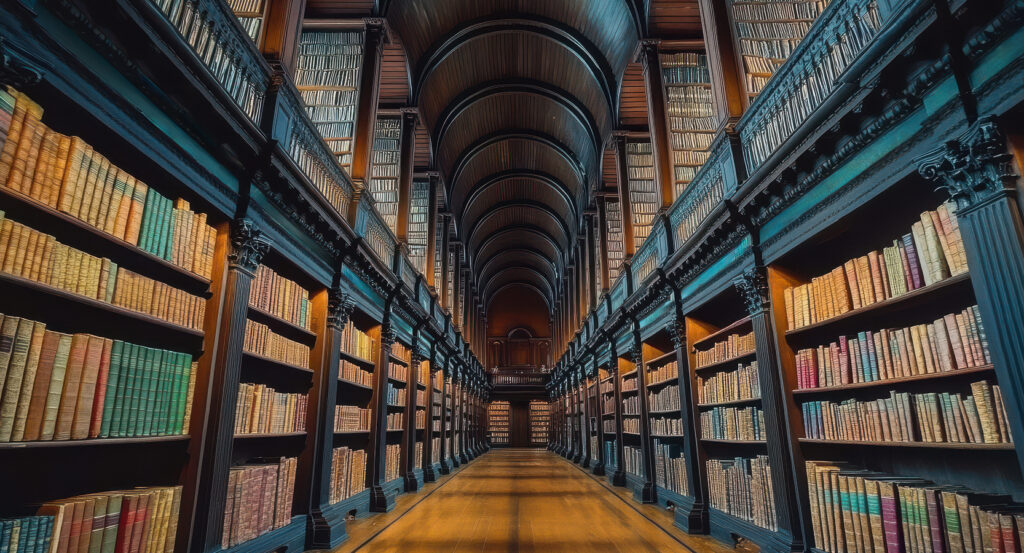
Why you should experience The Book of Kells Experience in Dublin, Ireland.
The Book of Kells isn't merely a manuscript, it's Ireland's soul illuminated in ink and gold.
Created by Celtic monks around 800 AD, this sacred Gospel book is a masterpiece of early medieval art and faith, preserved within the Old Library of Trinity College Dublin. Each vellum page feels alive with color and movement: swirling spirals, interlaced beasts, and symbols that fuse Christianity with ancient Celtic mysticism. To see it in person is to stand before a thousand years of devotion, each stroke of pigment whispering of patience and transcendence. The manuscript's most famous pages, like the Chi-Rho monogram, an explosion of gold and lapis forming the name of Christ, remain among the greatest visual triumphs in Western civilization. Visitors enter hushed, almost reverent, as the dimly lit exhibit reveals fragments of eternity drawn by human hands long before electric light, the printing press, or modern time itself.
What you should know about The Book of Kells Experience.
Despite its fame, the Book of Kells hides countless mysteries within its 680 vellum leaves.
It contains the four Gospels in Latin, but scholars believe its creators were monks from the island of Iona, who fled Viking raids and brought the unfinished manuscript to Kells in County Meath for safekeeping. The pigments, lapis lazuli from Afghanistan, orpiment from Persia, verdigris, lead white, and red lead, came from across the known world, making the Book an early symbol of global exchange. Each page required days of meticulous labor: outlines were scored with a stylus, colors applied in delicate layers, and gold leaf added to breathe divine light into the script. Even the imperfections tell stories, tiny corrections in the text, fingerprints in the paint, and small holes patched by the original scribes themselves. The artwork reflects a fusion of Christian iconography and Celtic abstraction, suggesting that the monks viewed illumination not just as decoration, but as prayer made visible. Over the centuries, the Book survived Viking raids, Reformation upheavals, and wars; by some miracle, it reached Trinity College in 1653, where it has remained one of the most priceless cultural artifacts in Europe.
How to fold The Book of Kells Experience into your trip.
Seeing the Book of Kells at Trinity College is an experience to savor slowly, as you would a pilgrimage.
Begin by booking your entry early to avoid queues, then step through the Front Arch into the cobblestoned calm of the university. The exhibit begins in a softly lit gallery introducing the monastic world, ink-making, calligraphy, and early Irish Christianity, before you reach the manuscript itself, displayed beneath protective glass. Take your time: admire the subtle hues, the infinite patience behind each ornament, and the living rhythm of the page. Afterward, climb the stairs to the Long Room, Trinity's awe-inspiring 18th-century library lined with towering shelves of dark oak and marble busts of philosophers and poets. The scent of aged paper and polished wood lingers like incense. Step outside into Fellows' Square, and let the weight of what you've witnessed sink in, you've just stood before one of humanity's greatest testaments to beauty, faith, and endurance. The Book of Kells isn't just a manuscript; it's the heartbeat of Ireland rendered in ink, proof that art can outlast empire, invasion, and time itself.
Where your story begins.
Foresyte Travel reveals places that feel extraordinary long before you arrive.
Experience premium editorial crafted for luxury travelers.














































































































