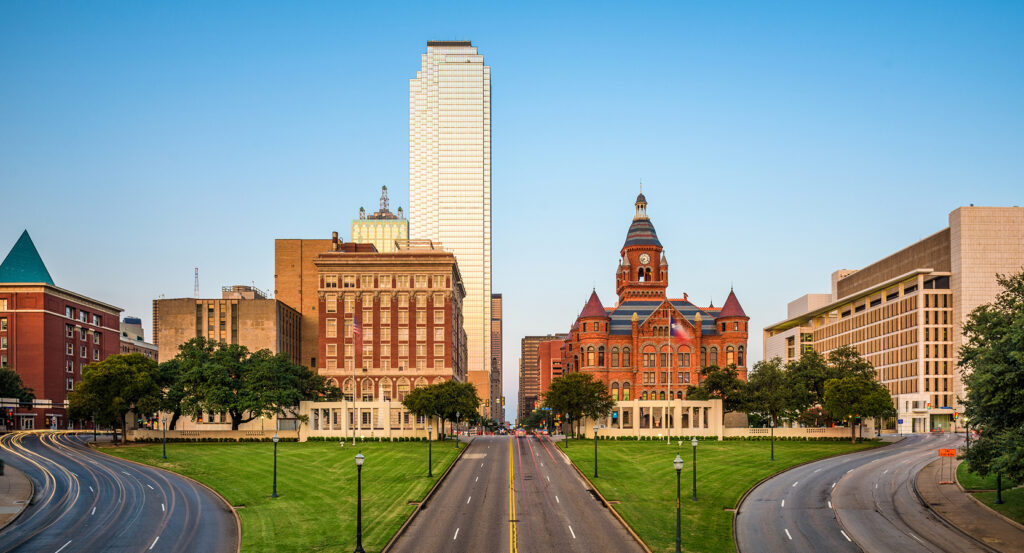
Why Triple Underpass matters.
The Triple Underpass is where architecture, symbolism, and history converge, a concrete artery that silently witnessed one of America's most defining moments.
Built in 1936 as part of a major civic project for the Texas Centennial, the underpass was designed to ease traffic between Elm, Main, and Commerce Streets, connecting Downtown with Oak Cliff beyond the railway. Its pale Art Deco arches, clean lines, and symmetry reflected a city on the rise, modern, confident, and optimistic. But on November 22, 1963, that optimism fractured as the motorcade carrying President John F. Kennedy passed beneath these bridges. Today, the underpass endures as both a transportation landmark and a historical threshold, where the past and present pass each other every day, each echoing the other in quiet permanence.
What defines Triple Underpass.
The Triple Underpass was once hailed as a marvel of urban engineering, the first of its kind to unite three major city arteries beneath an active railroad.
Its completion helped eliminate the grade crossings that often choked Dallas traffic, marking a milestone in the city's modernization. The structure's design, three broad openings framed by limestone balustrades and decorative pylons, was part of the larger Dealey Plaza beautification plan, a collaboration between the Works Progress Administration and the city's park board. When viewed from the Grassy Knoll or the western edge of Dealey Plaza, its geometry forms one of Dallas's most recognizable sightlines. In the years after the Kennedy assassination, preservationists fought to maintain the underpass's original design, ensuring that it would stand not as a grim reminder, but as a symbol of continuity. Its whitewashed concrete has been meticulously maintained, reflecting sunlight in the same way it did more than eighty years ago.
How Triple Underpass fits.
The best way to experience the Triple Underpass is as the culminating perspective of a walk through Dealey Plaza.
Start at the corner of Houston and Elm Streets, then make your way westward toward the underpass, retracing the route of the 1963 motorcade. Pause midway to take in how the city unfolds beyond its arches, the skyline shimmering above the train tracks, traffic streaming beneath the bridges. For photographers, the view from the top of the overpass, accessible from the opposite side, offers one of Dallas's most evocative panoramas: the plaza below framed by the School Book Depository, the pergolas, and the Grassy Knoll. Visit during golden hour for the most atmospheric light, when the arches cast long, cinematic shadows. While thousands pass through daily without a second thought, those who pause here find more than just concrete and steel, they find a gateway between eras, where Dallas's story turns from tragedy toward resilience.
Where your story begins.
Foresyte Travel reveals places that feel extraordinary long before you arrive.
Enjoy editorial crafted for luxury travelers.
Foresyte may earn a commission when you book.