
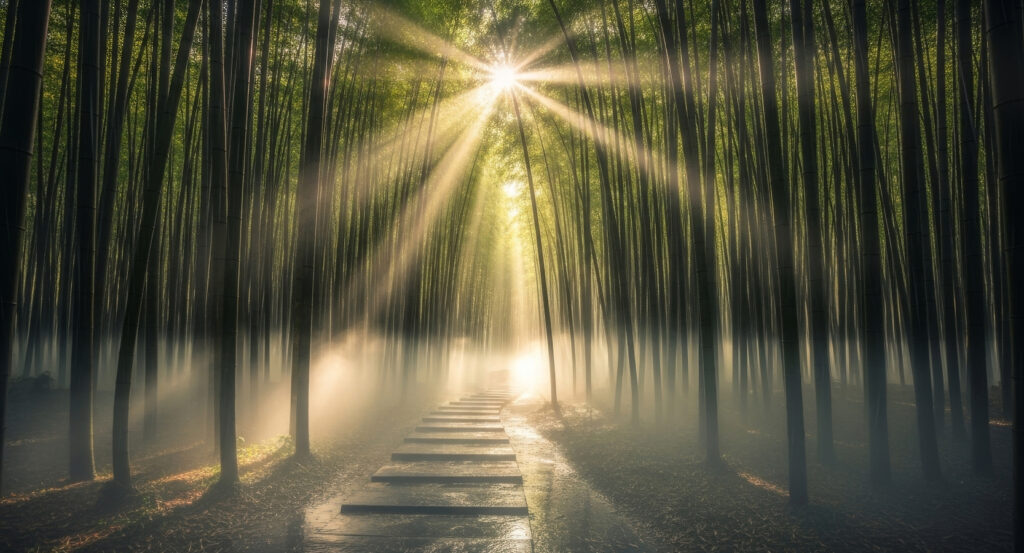
Why you should experience Rakushisha in Kyoto, Japan.
Rakushisha is Kyoto experienced through disappearance, humility, and poetic quiet, a place that asks you to arrive lightly and stay softer than you intended.
Located in the Arashiyama area, Rakushisha is not a hotel in the conventional sense and not a ryokan in the performative sense. It is a historical hut, a preserved residence tied to the poet Mukai Kyorai, disciple of Matsuo Basho, and its purpose has never been accommodation first. Its purpose has always been withdrawal. Arrival feels almost accidental. You walk through ordinary neighborhood streets, pass hedges and modest gates, and suddenly find yourself inside a space that feels removed from ambition entirely. There is no lobby, no presentation, no attempt to orient you as a guest. Instead, you orient yourself as a visitor to stillness. Architecture here is minimal because it predates the idea of design as statement. Wood, tatami, paper screens, and garden are assembled not to impress, but to endure quietly. Public space and private space blur. You move carefully, instinctively lowering your voice and pace, not because you are instructed to, but because the environment makes any other behavior feel intrusive. Guest quarters are sparse and deliberate. Rooms are simple, tatami-floored, and almost austere, but not cold. There is warmth in the restraint. Futons are prepared with care, firm and grounding, encouraging sleep that feels deep and unbroken. Windows open toward the garden rather than outward views, keeping attention inward and downward. You are not here to observe scenery. You are here to notice light, shadow, and silence. Furniture is nearly nonexistent. A low table, cushions, storage tucked discreetly away. The absence of objects becomes the defining feature. Lighting is entirely natural during the day and subdued at night, often limited to soft lamps that barely interrupt darkness. Bathrooms are simple and functional, designed to meet needs. Bathing feels practical and grounding, aligned with the rhythm of the day. There is no dining performance here. Meals, when provided, are modest, seasonal, and aligned with the idea of sustenance. Eating becomes another quiet act, something done with awareness. Shared spaces are gardens, pathways, thresholds. The garden at Rakushisha is central to the stay. Moss, stones, trees, and fallen leaves form a living composition that changes yet never demands attention. Sitting here becomes the primary activity. Watching nothing happen becomes the point. Service is minimal and respectful. Staff interactions are gentle, infrequent, and purposeful. There is no hospitality narrative, no personalization arc. Assistance is provided quietly when needed and withdrawn immediately afterward. Rakushisha attracts a very specific kind of traveler. Writers, poets, contemplatives, repeat visitors to Kyoto who feel overwhelmed by accumulation, and guests seeking not comfort but removal. This is not a place to recover from sightseeing. It is a place to stop sightseeing entirely. Rakushisha does not frame Kyoto for you.
What you should know about Rakushisha.
Rakushisha exists as a preserved expression of haikai philosophy, where impermanence, modesty, and attentiveness outweigh comfort, status, or permanence.
The hut was historically used as a retreat for poets who believed that clarity emerged only when excess was stripped away. Its name translates loosely to Fallen Persimmon Hut, referencing a moment of acceptance. Design choices were never about optimization or hospitality. They were about reducing life to essentials so that awareness could sharpen. The structure remains intentionally small and understated. Materials are maintained rather than replaced, allowed to weather and soften. Tatami mats, wooden beams, and garden stones carry age visibly, reinforcing the idea that time is not something to hide from. Room layouts follow traditional logic. There is no attempt to improve flow, storage, or lighting beyond what is necessary to inhabit the space respectfully. Windows are placed to frame the garden at rest. The garden itself is curated with restraint, allowing fallen leaves and seasonal change to remain visible. Operational culture mirrors this philosophy. Hospitality here is about protection of atmosphere. Staff are trained to preserve quiet above all else. Instructions are minimal. Expectations are implicit. Over time, Rakushisha has become less a place to stay and more a place to practice stillness. Many visitors return not because the experience changes, but because it does not. In a city where heritage is often packaged, Rakushisha remains uncommodified, resisting transformation into attraction or product. It survives precisely because it refuses to evolve on anyone else's terms.
How to fold Rakushisha into your trip.
Rakushisha works best when you allow it to interrupt your trip rather than complement it, placing it at a moment where stopping matters more than continuing.
Plan the stay here at the beginning or end of your time in Kyoto, when you are willing to disengage from objectives. Arrive. Do not attempt to pair this stay with heavy sightseeing. Walk there slowly through Arashiyama's quieter streets. Once inside, do very little. Sit in the garden. Write, read, or simply observe light shifting across moss and stone. Leave the property only if you feel compelled, not obligated. If you do walk, keep it local and brief. Return early. Evenings are silent. Nights are dark. Sleep comes. Rakushisha pairs best with short stays measured in depth. One or two nights are often enough to recalibrate perception. By the time you leave, Kyoto will feel louder, faster, and more layered, not because it changed, but because you did. Rakushisha does not offer comfort, distraction, or escape. It offers permission to become quiet. In a city dense with meaning, ritual, and movement, Rakushisha stands apart by asking almost nothing of you and giving even less, and in doing so, leaving you with something unusually rare. Space.
Where your story begins.
Foresyte Travel reveals places that feel extraordinary long before you arrive.
Experience premium editorial crafted for luxury travelers.

















































































































