
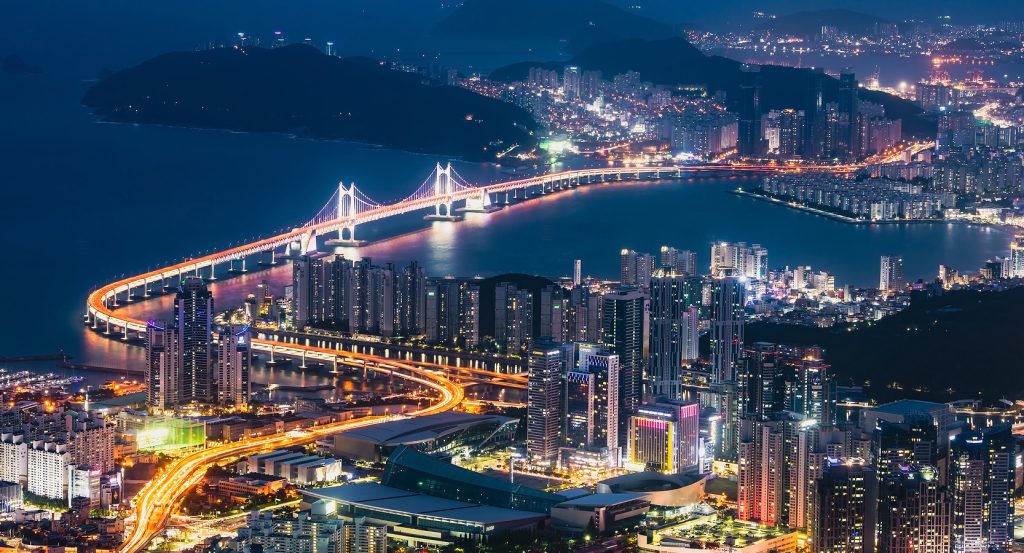
Why you should experience Jung-gu in Busan, South Korea.
Jung-gu is a historic harbor district where international trade, postwar resilience, and maritime ambition laid the foundations for the modern city that surrounds it today.
Anchored between Busan Port and the commercial streets of neighboring Nampo-dong, this compact district occupies some of the most consequential ground in the city's history. Cargo vessels glide through one of the world's busiest port complexes. Ferry terminals connect Busan to destinations across the region. Historic commercial buildings stand alongside modern towers that continue the district's long relationship with commerce and exchange. The streets carry the layered character of a neighborhood shaped by merchants, migrants, entrepreneurs, and international visitors who passed through the harbor during Busan's rise from a regional port into a global maritime powerhouse. Side streets reveal cafés and local businesses tucked beneath office buildings, while broad thoroughfares funnel workers and travelers through the urban core. Few districts demonstrate Busan's transformation more clearly than Jung-gu, where the city's past remains woven into the infrastructure, architecture, and daily rhythms of the present.
What you should know about Jung-gu.
Jung-gu is best known for serving as the location of Busan Port, the economic engine that helped transform the city into one of the world's largest and most important maritime trade hubs.
The district's character has been inseparable from the harbor for generations. As trade expanded throughout the twentieth century, Busan Port emerged as a critical gateway connecting South Korea to global markets, accelerating the city's economic growth and international influence. Jung-gu became a focal point for shipping companies, financial institutions, transportation networks, and commercial enterprises that depended upon the movement of goods through the harbor. The district also played a pivotal role during the Korean War, when Busan served as the country's temporary capital and one of the few major cities to remain outside North Korean control. That historical significance remains visible throughout the area, where landmarks, memorials, and preserved urban spaces continue to reflect a defining chapter in modern Korean history. Jung-gu stands as both a commercial center and a living archive of the forces that shaped contemporary Busan.
How to fold Jung-gu into your trip.
Jung-gu works as a journey through the historic and economic forces that transformed Busan into South Korea's maritime capital.
Begin at Busan Port, where container terminals, passenger facilities, and harbor views immediately establish the scale of the district's relationship with global trade. Continue toward 40-Step Culture & Tourism Theme Street, a landmark that preserves memories of the Korean War era and the experiences of refugees who sought safety in Busan during one of the country's most turbulent periods. From there, make your way to Yongdusan Park, whose elevated vantage point provides sweeping views across the harbor, downtown skyline, and surrounding mountains. The progression moves naturally from commerce to history to geography, revealing the interconnected forces that shaped both the district and the city itself. Along the way, explore the surrounding streets, historic corridors, and local businesses that continue to animate the urban core. Jung-gu remains one of the most important places to understand Busan, preserving the harbor, history, and global outlook that continue to define the city today.
Where your story begins.
Foresyte Travel reveals places that feel extraordinary long before you arrive.
Experience premium editorial crafted for luxury travelers.

















































































































