
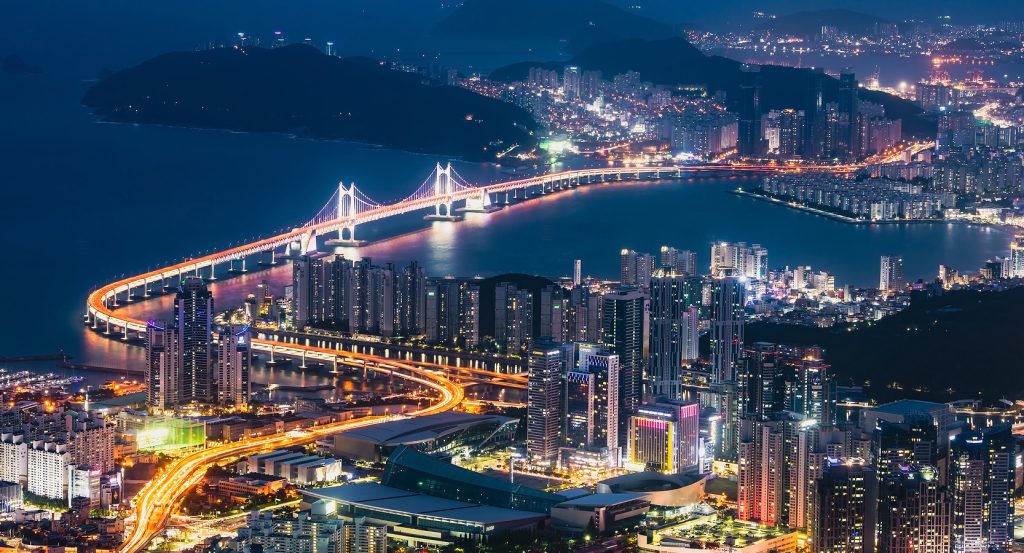
Why you should experience Gijang-gun in Busan, South Korea.
Gijang-gun is a coastal frontier where fishing villages, dramatic shorelines, and centuries of maritime tradition preserve a slower and more elemental side of Busan beyond the skyline of Haeundae.
Stretching across the northeastern edge of the metropolitan area, this expansive district occupies a landscape shaped by the constant discussion between land and sea. Fishing boats depart before sunrise from working harbors that continue to sustain local communities. Waves crash against rocky coastlines carved by generations of wind and tide. Seafood markets display catches pulled directly from nearby waters, while hillside roads reveal sweeping views of the East Sea unfolding toward the horizon. The district feels fundamentally connected to the natural forces that shaped it. Pine-covered hills descend toward the coast. Temples overlook the water from dramatic cliffs. Small fishing ports coexist alongside modern attractions that have emerged. Gijang-gun offers a perspective on Busan rarely found in the city's dense urban core, revealing a region where the rhythms of the sea remain as important today as they were generations ago.
What you should know about Gijang-gun.
Gijang-gun is best known for being home to Haedong Yonggungsa, among the few Buddhist temples in Korea built directly along the coastline.
This distinction has made the district one of the country's most recognizable spiritual and scenic destinations. Founded in 1376 during the Goryeo Dynasty, the temple occupies a dramatic position overlooking the East Sea, where waves break against the rocks below its stone terraces and prayer halls. The landmark reflects a broader characteristic of Gijang-gun itself: a deep relationship with the coastline that influences everything from local culture to economic activity. Fishing and seafood remain central to the district's identity, with Gijang long recognized throughout Korea for its seafood markets and coastal communities. At the same time, the region has become an increasingly important destination for travelers seeking natural scenery, cultural landmarks, and a quieter alternative to Busan's urban districts. Few places within the metropolitan area preserve such a strong connection between landscape, heritage, and daily life.
How to fold Gijang-gun into your trip.
Gijang-gun works as a journey through the coastal landscapes and maritime traditions that continue to shape Busan's northeastern shoreline.
Begin at Haedong Yonggungsa, where cliffside pathways, ocean views, and centuries of history immediately establish the district's defining relationship with the sea. Continue toward Jukseong Dream Cathedral, whose picturesque coastal setting has become one of the area's most photographed landmarks. From there, make your way to Gijang Market, where vendors showcase fresh seafood and regional specialties that reflect the district's longstanding fishing heritage. The progression moves naturally from spiritual landmark to coastal scenery to local culture, revealing the interconnected forces that define life along this stretch of shoreline. Along the way, explore harbors, cafés, observation points, and seaside roads that offer uninterrupted views of the East Sea. Gijang-gun remains one of the clearest expressions of Busan's maritime roots, preserving the landscapes, traditions, and coastal character that helped shape the region long before the modern city emerged.
Where your story begins.
Foresyte Travel reveals places that feel extraordinary long before you arrive.
Experience premium editorial crafted for luxury travelers.

















































































































