
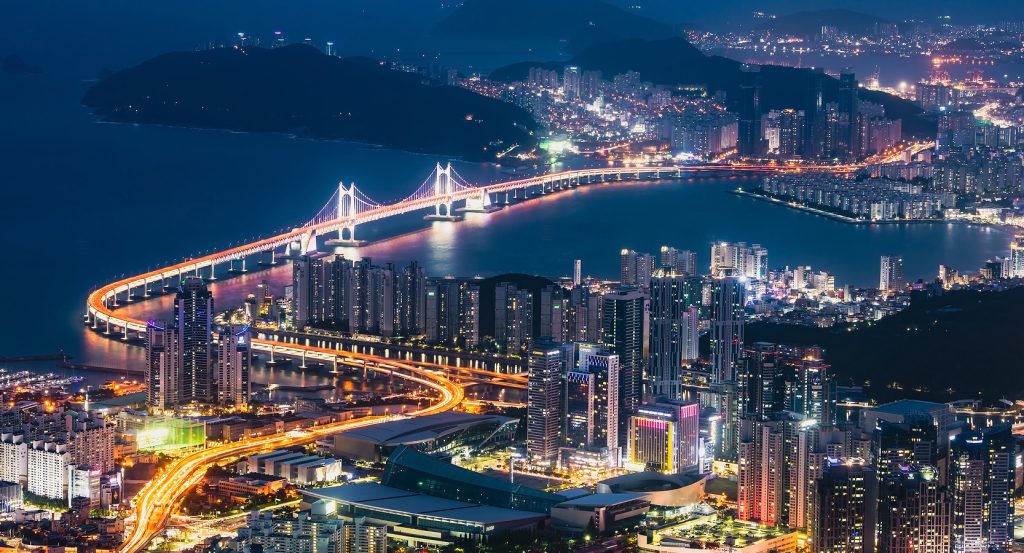
Why you should experience Dong-gu in Busan, South Korea.
Dong-gu is a historic gateway where railways, migration, and international exchange helped transform a modest harbor settlement into South Korea's largest port city alongside neighboring Jung-gu.
Positioned between Busan Station and the waterfront that connected Korea to the wider world, this district occupies some of the most consequential terrain in the city's modern development. Trains arrive throughout the day carrying travelers from across the peninsula into the heart of Busan. Ferry terminals and port facilities sit within sight of commercial streets shaped by generations of movement and exchange. Hillside neighborhoods rise above the urban core, their stairways and narrow streets revealing layers of history often overlooked by visitors rushing toward the beach districts. The district's character was forged through arrival and departure. Refugees, merchants, laborers, and international visitors all passed through these streets during defining moments in Korean history. Today, local markets, community spaces, and historic corridors continue to animate a neighborhood that remains deeply connected to Busan's origins. Few districts offer a clearer introduction to the forces that shaped the modern city.
What you should know about Dong-gu.
Dong-gu is best known for being home to Busan Station, the southern terminus of South Korea's KTX high-speed rail network and one of the country's most important transportation gateways.
The station cemented Dong-gu's role as a critical point of connection between Busan and the rest of the Korean Peninsula. Millions of passengers pass through the district each year, reinforcing its longstanding character as a place defined by movement, commerce, and accessibility. Yet the district's significance extends far beyond transportation. During the Korean War, Dong-gu became an important refuge for displaced populations seeking safety in Busan, contributing to the rapid growth and cultural diversity that would help define the city in the decades that followed. The district's streets preserve reminders of these transformative periods through memorials, historic neighborhoods, and cultural landmarks that continue to tell the story of Busan's emergence as a national and international center. Dong-gu stands as one of the city's most important historical crossroads, where transportation infrastructure and human experience intersect at an extraordinary scale.
How to fold Dong-gu into your trip.
Dong-gu works as an exploration of the transportation, history, and cultural resilience that helped shape modern Busan.
Begin at Busan Station, where the district's role as South Korea's southern transportation gateway immediately becomes apparent through its scale and constant activity. Continue toward Choryang Ibagu-gil, a hillside storytelling route that weaves together public art, historical exhibits, and panoramic views while documenting the experiences of residents who helped shape the neighborhood through decades of change. From there, make your way to Texas Street, whose international influences reflect the district's longstanding connections to trade, migration, and cultural exchange. The progression reveals the many layers of Dong-gu, moving from transportation infrastructure to community history to multicultural identity. Along the way, steep stairways, neighborhood overlooks, and local businesses provide a perspective on Busan that feels both deeply personal and historically significant. Dong-gu remains one of the city's most important points of arrival, preserving the stories, connections, and resilience that helped transform Busan into the global city it is today.
Where your story begins.
Foresyte Travel reveals places that feel extraordinary long before you arrive.
Experience premium editorial crafted for luxury travelers.

















































































































