
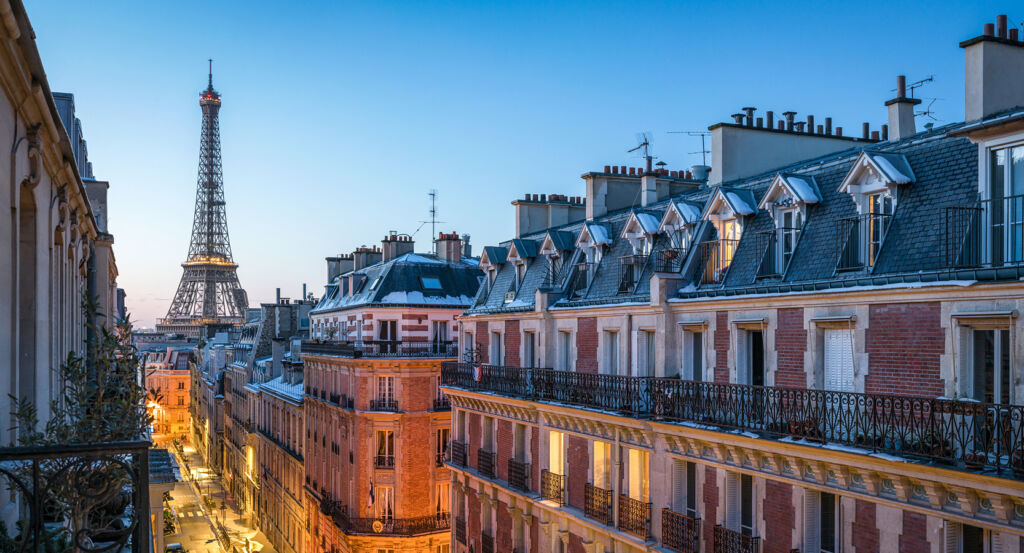
Why you should experience Hôtel de Nell in Paris, France.
Hôtel de Nell is a cultured five-star hotel where Faubourg-Montmartre's theatrical imagination, collector sensibility, nineteenth-century passage culture and contemporary design confidence converge inside a Haussmannian corner building conceived as the private home of an aesthete.
Set along Rue du Conservatoire near Rue Sainte-Cécile and just steps from Église Saint-Eugène-Sainte-Cécile, the hotel inhabits two formerly separate buildings that architect Jean-Michel Wilmotte physically unified during an extensive reconstruction completed in 2013. Behind a façade articulated by caryatids and curved windows, Wilmotte established a restrained material style of wide oak floorboards, walnut paneling, sand tones, midnight blue accents and Japanese paper lighting, punctuated by art drawn from private collections and neighboring galleries. Thirty-three individually composed rooms continue that residential language through organic-wool carpets, black-stone walk-in showers and, in selected accommodations, grand Japanese baths carved from white marble with Oregon myrtle backrests. The result is a hotel where Wilmotte's architectural precision, evolving art collections and tactile craftsmanship give Faubourg-Montmartre's culture of galleries and performance the intimacy of a collector's Parisian home.
What you should know about Hôtel de Nell.
Hôtel de Nell is best known for its 2013 transformation by Jean-Michel Wilmotte and Wilmotte & Associés, who rehabilitated and extended 1,800 square meters by joining two previously separate buildings into a single 33-room hotel with a 60-seat restaurant, bar-lobby, private vinothèque and treatment room. The reconstruction retained the buildings' structural skeleton while reorganizing circulation with a new public staircase and service lift, enlarging guestrooms and undertaking substantial basement work to increase the height beneath existing vaults. Engineering became inseparable from the interior concept in bathrooms containing Wilmotte's specially designed Japanese baths, whose white-marble mass required structural reinforcement of the floors, while oak parquet, walnut wall panels, sand-colored surfaces and midnight blue accents established a deliberately restrained material palette. Wilmotte & Industries extended the commission into bespoke furniture and lighting, making the architecture, interiors and individual objects part of a single authored program instead of treating the 2013 intervention as a conventional hotel refurbishment.
Charm & More developed the property's collector-house character around an art program assembled from personal collections, objects accumulated over time and works loaned by neighboring galleries, allowing the installation to change as pieces circulate through the hotel. Hôtel de Nell carries that curatorial premise into its 33 individually configured rooms, where Jean-Michel Wilmotte paired wide oak boards with organic-wool carpets, Japanese paper lamps and black-stone showers while preserving architectural features including caryatids, fireplaces and rounded windows within the Haussmannian envelope. Sothys extends the material emphasis into a dedicated treatment cabin finished in natural tones inspired by Paris stone, while the glass-fronted vinothèque forms a twelve-person private salon between the restaurant and library. Together, Charm & More, Jean-Michel Wilmotte, Wilmotte & Industries and Sothys turn Hôtel de Nell into a tightly authored composition of architecture, collectible objects, bespoke design and tactile materials whose character reaches from structural reconstruction to the smallest private spaces.
How to fold Hôtel de Nell into your trip.
Hôtel de Nell works as the anchor for an afternoon tracing structural experimentation, fraternal collecting and nineteenth-century commercial invention through the unusually concentrated cultural world of Faubourg-Montmartre.
Begin at Église Saint-Eugène-Sainte-Cécile, completed in 1855 by architects Louis-Auguste Boileau and Adrien-Louis Lusson as an audacious experiment in religious construction, using cast-iron columns and iron structural components to create a richly polychrome neo-Gothic interior whose slender supports allowed an unusually open volume on a constrained urban site. Continue to Musée de la Franc-Maçonnerie, housed within the Grand Orient de France, where collections spanning three centuries encompass more than 10,000 objects including seals, medals, manuscripts, ceramics and ritual material, with historically charged holdings including Voltaire's Masonic apron and a sword associated with Lafayette. Conclude at Passage Jouffroy, where François-Hippolyte Destailleur and Romain de Bourges completed the arcade in 1845 for a company headed by Félix de Jouffroy-Gonsans, creating the first Parisian covered passage built almost entirely from iron and glass and extending the commercial axis of Passage des Panoramas toward what became Passage Verdeau. The progression moves from nineteenth-century experimentation with iron in sacred architecture through the objects and symbolism of French Freemasonry into Destailleur and Romain de Bourges's engineering of metropolitan consumption, revealing the craftsmanship, collecting and structural invention surrounding Hôtel de Nell.
Where your story begins.
Foresyte Travel reveals places that feel extraordinary long before you arrive.
Experience premium editorial crafted for luxury travelers.














































































































