
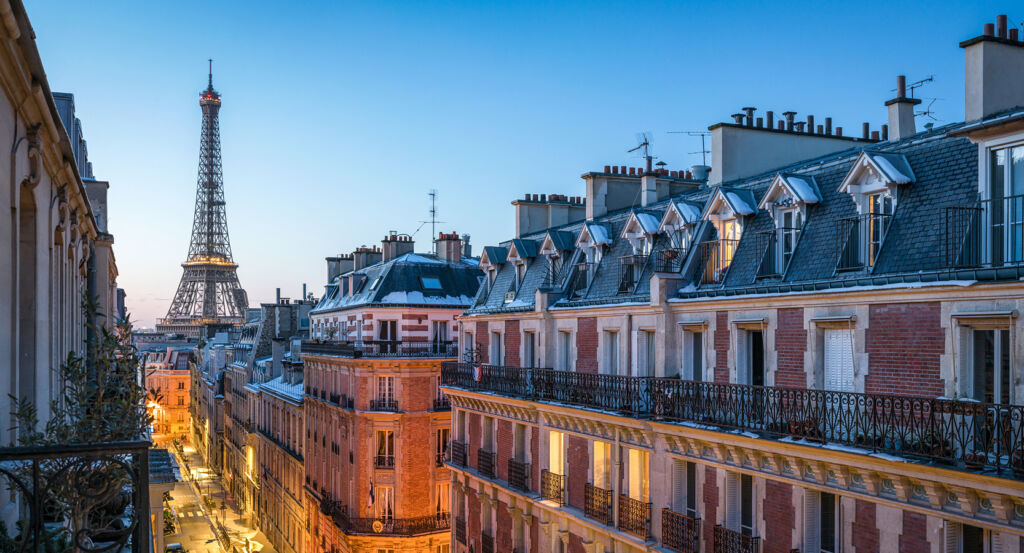
Why Faubourg-Montmartre matters.
Faubourg-Montmartre is a kinetic enclave where the Grands Boulevards meet the lower approaches to Montmartre through old suburban routes, covered passages and dense nineteenth-century blocks shaped by commerce, publishing and metropolitan entertainment.
Positioned between Grands Boulevards, Rochechouart, and Chaussée-d'Antin, the neighborhood occupies a Central Right Bank corridor where Rue du Faubourg-Montmartre climbs north from Boulevard Montmartre toward Rue Lamartine and the streets descending from the southern slope of Montmartre. Tall stone apartment houses, narrow side streets and enclosed courts create a compressed physical setting that repeatedly opens into broader boulevards and glass-roofed interior routes. Rue du Faubourg-Montmartre establishes the primary encounter through the old road from Paris toward the Abbaye de Montmartre, preserving a direct north-south axis across blocks subsequently rebuilt at far greater density. Rue de la Grange-Batelière adds a distinct spatial mechanism through territory once occupied by an extensive fief beyond the older city, with its angled streets preserving traces of property boundaries that preceded the surrounding nineteenth-century fabric. Rue Cadet and adjoining streets deepen the contrast through narrower alignments inherited from territory once occupied by gardens and cultivated ground before urban expansion filled the spaces between the boulevards and Montmartre. The result is a neighborhood where an ancient outward route became embedded inside the commercial city, preparing a history driven by suburban expansion, vanished agricultural territory and successive waves of metropolitan growth.
What defines Faubourg-Montmartre.
Faubourg-Montmartre is best known for developing along the principal road that left Paris for the Abbaye de Montmartre, turning an approach beyond the old city into one of the Right Bank's most intensively urbanized corridors. The route appears as a path on the oldest plans of Paris and was identified as the Rue et chaussée du faulxbourg de Montmartre by 1636, carrying movement north beyond the built center toward the religious settlement on the hill. Expansion occurred across territory whose earlier organization remained substantially rural: the neighboring Grange Batelière appears as Granchia Batilliaca in 1243 and formed part of a large fief extending across land west of the Montmartre road. Louis VII had granted extensive marshes between Montmartre and the Seine to the canons of Sainte-Opportune in 1153, and later cultivation gradually changed this peripheral terrain into productive land beside the capital. The Grand Égout still interrupted the Faubourg-Montmartre route near the present northern section into the eighteenth century, demonstrating how incompletely urbanized the corridor remained beyond the boulevards. Revolutionary renaming briefly turned the artery into Rue du Faubourg-Montmarat after Jean-Paul Marat's death. A ministerial decision signed by Jean-Antoine Chaptal in 1802 and a royal ordinance in 1840 subsequently established a 15-meter minimum width, marking the route's conversion from inherited suburban road into a regulated metropolitan street. Rue Lafayette cut across it after expropriations in 1859, completing another stage in the absorption of the old faubourg into nineteenth-century Paris.
Publishing supplied a separate mechanism for giving Faubourg-Montmartre national reach as newspapers and printing houses clustered around the boulevards during the nineteenth century. The press had migrated toward the Right Bank after the Restoration, and printers concentrated along the Rue Montmartre and Rue du Faubourg-Montmartre axis as proximity to central postal and commercial networks supported rapidly expanding daily circulation. Auguste Nefftzer founded Le Temps at 10 Rue du Faubourg-Montmartre in 1861, establishing a newspaper that remained there for thirteen years before moving to Boulevard des Italiens. Louis Andrieux founded Le Petit Parisien in 1876 and initially installed the evening political daily at number 11 before its 1878 transfer to Rue d'Enghien. Georges Clemenceau and Camille Pelletan placed La Justice at number 10 in 1880, connecting the same address with another influential Republican publication. Rue Cadet contributed its own press concentration through Edmond About's Le XIXe Siècle, whose editorial and printing operations occupied numbers 16 to 18 from 1872. The twentieth century extended the association through sports journalism when L'Équipe began publication at 10 Rue du Faubourg-Montmartre in 1946 after L'Auto, turning the address into a gathering point where Tour de France results were displayed for crowds.
How Faubourg-Montmartre fits.
Faubourg-Montmartre works as the anchor for an afternoon tracing nineteenth-century commercial architecture, Parisian music-hall culture and the religious building campaign that accompanied the expansion of the northern Right Bank.
Begin at Passage Verdeau, constructed in 1846 under architect Jacques Prosper Deschamps and named for developer Jean-Baptiste Ossian Verdeau as the northern continuation of the covered route formed by Passages des Panoramas and Jouffroy. A high herringbone glass roof pours daylight into the neoclassical gallery, whose connection between Rue de la Grange-Batelière and Rue du Faubourg-Montmartre extended the passage system into the expanding ninth Arrondissement; the gallery received historic protection in 1974, preserving a commercial building type that had proliferated across Paris before the department store altered metropolitan retail. Continue to Folies Bergère, where Albert Boislève converted the rear of the financially troubled Les Colonnes d'Hercule bedding store into a performance hall that opened on May 2, 1869 with 768 theater seats and another 400 places in its café area. Léon Sari expanded the establishment in 1878, the first year-end revue arrived in 1886, and Paul Derval's directorship beginning in 1919 drove another architectural phase that included a 27,000-liter reinforced-concrete pool beneath the stage in 1924; Maurice Pico then redesigned the facade in Art Deco form during the 1926 rebuilding, drawing inspiration from dancer Lila Nikolska, before Joséphine Baker's 1936 return strengthened the theater's international association with the revue. Conclude at Église Notre-Dame-de-Lorette, conceived after an 1823 architectural competition responded to the rapid growth of the Nouvelle Athènes and adjoining northern districts. Louis-Hippolyte Lebas won the commission and developed a plan based on Roman basilicas, joining an austere classical exterior to an extensive interior decorative program in which wax mural painting, gilded backgrounds and enameled lava introduced techniques receiving renewed attention during the nineteenth century; construction reached completion in 1836, and commissions distributed among numerous artists turned the church into a major laboratory for religious art under the Restoration and July Monarchy. The progression moves from Deschamps extending the commercial passage across the nineteenth-century city through Boislève, Derval and Pico turning performance architecture into increasingly ambitious performance into Lebas coordinating architecture and decorative art for an expanding northern parish, revealing three distinct responses to the extraordinary growth surrounding Faubourg-Montmartre.
Where your story begins.
Foresyte Travel reveals places that feel extraordinary long before you arrive.
Experience premium editorial crafted for luxury travelers.
Foresyte Travel may earn a commission when you book through the link on this page.














































































































