
Why Grands Boulevards matters.
Grands Boulevards is a theatrical enclave where the former defensive edge of Paris meets the commercial city through sweeping avenues, ornate facades, covered passages and streets shaped by centuries of performance and metropolitan display.
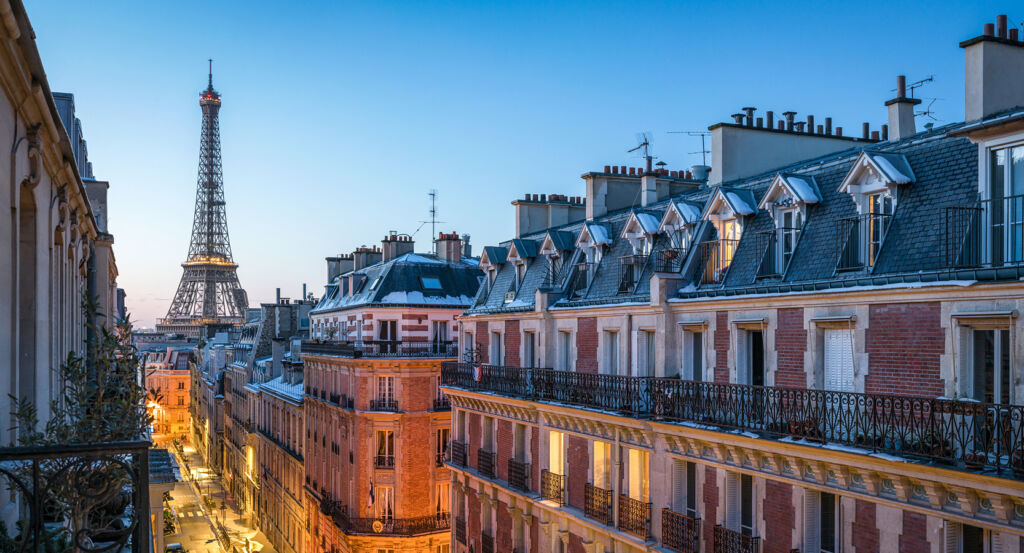
Positioned between Opéra, Faubourg-Montmartre, and Sentier, the neighborhood occupies a broad Right Bank corridor where Boulevard Montmartre, Boulevard Poissonnière and Boulevard des Italiens carry the scale of the old fortification line across the dense streets of the 2nd and 9th Arrondissements. Wide carriageways and continuous stone facades establish an expansive physical rhythm, yet short turns into Rue Drouot, Rue du Faubourg-Montmartre and the surrounding passages immediately compress the quarter into narrower commercial interiors. Boulevard Montmartre establishes the primary encounter through long sightlines, projecting balconies and richly ornamented elevations built for a street whose public life depended as much on watching the crowd as moving through it. Covered passages deepen that character by drawing commerce beneath glass roofs and through the interiors of blocks, creating a second pedestrian network behind the boulevard facades. Boulevard des Italiens adds another register through the former banking houses, cafés and entertainment addresses that accompanied the westward movement of fashionable Paris during the nineteenth century. The result is a neighborhood whose scale shifts continually between grand avenue and intimate interior, preparing a history rooted in the conversion of obsolete fortifications into one of Europe's defining corridors of metropolitan public life.
What defines Grands Boulevards.
Grands Boulevards is best known for occupying the course of defensive works that Louis XIV ordered removed as Paris expanded beyond the walls inherited from Charles V and Louis XIII. Charles V's enceinte had enclosed the northern Right Bank during the late fourteenth century, and later defenses extended the fortified line westward as the capital grew. Military victories under Louis XIV reduced the strategic purpose of these works, allowing walls to be demolished and ditches filled as the monarchy reconceived the former boundary as a public promenade. Royal letters patent of 1676 advanced the Nouveau Cours, establishing a broad planted route between the dense city and its northern faubourgs. Completion continued into the eighteenth century, turning defensive ground into a linear public space whose openness contrasted sharply with the narrow streets inside old Paris. Property development intensified along the western stretches as aristocratic residences and gardens occupied territory around the future Boulevard des Italiens. The promenade subsequently attracted cafés, outdoor amusements and theaters, drawing recreation onto ground once engineered to keep armies outside the capital. This conversion carried a larger urban consequence: the edge of Paris became a destination in its own right, and the word boulevard moved from the language of fortification toward the social geography of the modern city.
Nineteenth-century commercial culture supplied a separate mechanism for turning the boulevards into an international image of Parisian modernity. Café Tortoni became a center of fashionable society on Boulevard des Italiens, joining restaurants, shops and financial institutions in a corridor increasingly associated with wealth and display. Traffic reached extraordinary intensity as the century advanced, with an 1881 count placing 20,000 vehicles per day on Boulevard des Italiens. Artists responded to the performance of movement itself. Camille Pissarro rented a room at the Grand Hôtel de Russie at 1 Rue Drouot in 1897 and painted repeated views across Boulevard Montmartre and Boulevard des Italiens, translating crowds, carriages and shifting light into a sustained series of urban paintings. Cinema then gave the corridor another technological role when Auguste and Louis Lumière presented their celebrated paid screening at the Grand Café on Boulevard des Capucines in December 1895. Purpose-built cinemas followed during the next decade, extending a culture already organized around novelty, entertainment and public spectatorship into the age of moving images. The boulevards had consequently moved from royal promenade through fashionable social stage into a testing ground for new forms of mass metropolitan culture.
How Grands Boulevards fits.
Grands Boulevards works as the anchor for an afternoon tracing the covered-passage revolution, the emergence of three-dimensional popular journalism and the rise of Parisian music hall through three institutions embedded within the entertainment geography surrounding Boulevard Montmartre.
Begin at Passage des Panoramas, where American entrepreneur James William Thayer developed two panorama rotundas on Boulevard Montmartre in 1799 and opened a protected passage to draw pedestrians from the Palais-Royal toward the new attraction. Panoramic paintings surrounded spectators with continuous views inside the towers, giving the passage its name, yet the sheltered commercial route proved equally consequential: shops filled the interior, Théâtre des Variétés joined the complex in 1807, and the surviving galleries became an early model for the covered shopping passages that multiplied across nineteenth-century Paris. Continue to Musée Grévin, created after Le Gaulois founder Arthur Meyer conceived a three-dimensional counterpart to newspaper coverage at a time when photography remained uncommon in the press. Meyer recruited caricaturist, sculptor and theatrical designer Alfred Grévin as artistic director, the museum opened on June 5, 1882, and financier Gabriel Thomas joined its leadership in 1883; Émile Reynaud introduced his Théâtre Optique there in 1892, projecting hand-colored animated works including Pauvre Pierrot years before cinema became commercially established on the nearby boulevards. Conclude at Folies Bergère, where Albert Boislève converted part of a former bedding emporium into a hybrid theater and café-concert that opened on May 2, 1869 with 768 theater seats and further café seating. The house became closely associated with music hall, Loïe Fuller appeared in Jules Chéret's 1893 lithographic advertising, and a sixteen-month reconstruction completed in 1928 expanded the auditorium to 1,740 seats; Pico simultaneously redesigned the facade in Art Deco form around a gilded relief inspired by dancer Lila Nikolska, carrying nineteenth-century popular entertainment into a new architectural age. The progression moves from Thayer enclosing optical performance inside a commercial passage through Meyer, Grévin and Reynaud joining journalism to waxwork and projected animation into Boislève and Pico carrying café-concert culture toward modern music hall, revealing how successive entertainment technologies turned the streets surrounding Grands Boulevards into laboratories of metropolitan spectatorship.
Where your story begins.
Foresyte Travel reveals places that feel extraordinary long before you arrive.
Experience premium editorial crafted for luxury travelers.
Foresyte Travel may earn a commission when you book through the link on this page.














































































































