
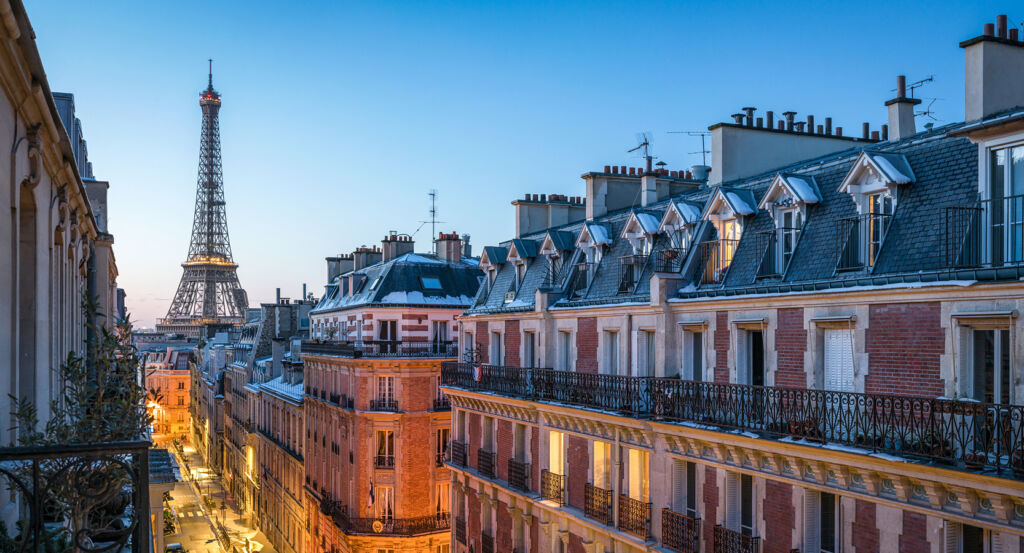
Why Sainte-Opportune matters.
Sainte-Opportune is a compact enclave where the medieval Right Bank meets Central Paris through narrow commercial streets, old pilgrimage routes and an urban grain formed beside the former market world of Les Halles.
Positioned between Les Halles, Saint-Merri, and the Seine, the neighborhood occupies a central pocket where Rue Saint-Denis, Rue des Halles and Rue des Lombards converge around streets whose alignments reach deep into medieval Paris. Narrow frontages, irregular intersections and tightly packed buildings preserve a compressed physical scale even where nineteenth-century interventions opened broader routes toward Châtelet. Rue Saint-Denis establishes the primary encounter through the ancient north-south road that carried royal processions and long-distance movement between the city center and northern France. Rue des Lombards deepens the physical character through a narrower east-west corridor whose commercial history developed among money changers, merchants and densely subdivided properties near Les Halles. Place Sainte-Opportune supplies a small pause within that network, occupying ground associated with a religious institution that disappeared during the Revolutionary era but left its name attached to the surrounding streets. The result is a neighborhood where vanished churches, medieval commerce and later reconstruction remain encoded in an unusually dense street pattern, preparing a history centered on one of the Right Bank's oldest religious communities.
What defines Sainte-Opportune.
Sainte-Opportune is best known for growing around a medieval church and convent whose origins were linked to relics brought to Paris during the Scandinavian incursions that destabilized northern France in the ninth century. Opportuna had been abbess of Montreuil near Almenêches in Normandy during the eighth century, and her cult expanded after her death as communities dedicated to her developed beyond the original monastery. Norman attacks drove clerics carrying her relics toward Paris, where a chapel dedicated to Notre-Dame-des-Bois became associated with the saint and subsequently took her name. The surrounding settlement developed near the northern approaches to the Île de la Cité, placing Sainte-Opportune close to the commercial territory that expanded into the Right Bank during the Central Middle Ages. Louis VII granted the chapter jurisdictional privileges during the twelfth century, strengthening an ecclesiastical precinct embedded within an increasingly dense mercantile district. The church was rebuilt and enlarged across later centuries as the quarter surrounding Les Halles intensified, with chapels, houses and chapter property occupying the adjoining streets. Its position near Rue Saint-Denis also placed the institution beside the ceremonial route used by French monarchs entering Paris from the north. Revolutionary suppression ended the chapter, and the church was sold as national property before demolition in 1792. Place Sainte-Opportune and adjoining street names preserve the religious geography after the physical complex vanished, leaving the former ecclesiastical precinct legible through the organization and nomenclature of the surrounding city.
The nineteenth century supplied a separate mechanism for changing Sainte-Opportune as Paris rebuilt the circulation system connecting Les Halles, Châtelet and the expanding boulevard network. The medieval district had accumulated extremely narrow streets between the market and the Seine, producing a dense web that became a major target of Second Empire reconstruction. Boulevard de Sébastopol opened through the surrounding blocks during the 1850s as part of the north-south axis driven through Central Paris under Napoleon III and Georges-Eugène Haussmann. Rue des Halles followed as a broad connection between the central markets and Place du Châtelet, requiring extensive demolition across older parcels and severing several inherited street alignments. Théodore Ballu's Fontaine du Palmier was moved and reconstructed during the enlargement of Place du Châtelet, extending the remaking of public space immediately south of the quarter. Victor Baltard's iron market pavilions simultaneously changed the scale and operation of Les Halles, concentrating wholesale commerce inside a coordinated architectural complex from the 1850s onward. Sainte-Opportune survived these interventions as a small residual pocket between new arteries and older streets, giving the neighborhood its present collision between medieval alignments and the engineered circulation of nineteenth-century Paris.
How Sainte-Opportune fits.
Sainte-Opportune works as the anchor for a daytime exploration connecting a Flamboyant Gothic parish church shaped by generations of Parisian builders, a Renaissance fountain created for a royal procession and a civic tower whose successive rebuilding concentrated municipal authority beside the Seine.
Begin at Église Saint-Merri, whose surviving building rose principally between 1500 and 1565 on a site associated with the burial of the eighth-century hermit Médéric, later Saint Merri, and with an earlier sanctuary serving the surrounding Right Bank community. Construction carried the church from late Gothic architecture into Renaissance decoration, and eighteenth-century work brought the Slodtz brothers into its sculptural program before later interventions added paintings by Théodore Chassériau, producing an interior whose artistic chronology spans several major phases of Parisian religious art. Continue to Fontaine des Innocents, commissioned for Henri II's ceremonial entry into Paris in 1549 and created through the collaboration of architect Pierre Lescot and sculptor Jean Goujon. The original structure stood against buildings beside the route of the procession, with Goujon's nymph reliefs joining classical figure sculpture to Lescot's architectural composition; removal of the adjoining cemetery in the eighteenth century prompted reconstruction as a freestanding fountain, and the work was moved again during the nineteenth-century remaking of Les Halles before settling in Square des Innocents. Conclude at Tour Saint-Jacques, the surviving bell tower of the former Église Saint-Jacques-de-la-Boucherie, reconstructed between 1509 and 1523 as the prosperous butchers' district financed an elaborate Flamboyant Gothic structure on the pilgrimage route toward Santiago de Compostela. The church disappeared after its sale during the Revolution, but the tower survived independently, entered municipal ownership in 1836 and acquired a public garden after surrounding buildings were cleared, preserving a single vertical fragment from a religious and mercantile complex that once dominated this part of the Right Bank. The progression moves from a medieval cult developing into a major parish church through Lescot and Goujon transforming royal ceremony into Renaissance public art into a guild-supported pilgrimage church surviving through its isolated tower, revealing the religious, commercial and civic forces that shaped the streets surrounding Sainte-Opportune.
Where your story begins.
Foresyte Travel reveals places that feel extraordinary long before you arrive.
Experience premium editorial crafted for luxury travelers.
Foresyte Travel may earn a commission when you book through the link on this page.














































































































