
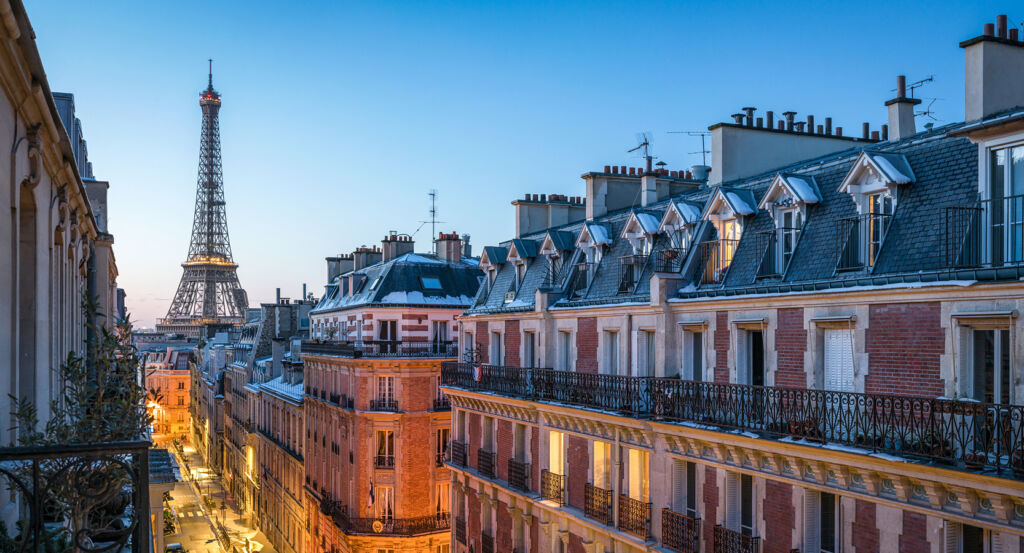
Why you should experience Hôtel Botaniste in Paris, France.
Hôtel Botaniste is a pastoral four-star hotel where Auteuil's garden culture, villa-lined intimacy, architectural experimentation and enduring fascination with cultivated nature converge within two secluded houses conceived around the pleasures of a Parisian family home.
Set along Rue Molitor near Rue Boileau and just steps from the leafy streets of southern Auteuil, the 42-room hotel divides its accommodations between Maison Molitor and Maison Boileau, with private gardens creating the connective landscape between them. Floral wallpapers, framed herbaria, linen, velvet and botanical room names carry the garden premise indoors, while balconies and terraces allow several accommodations to maintain a physical relationship with the planting outside. Maison Molitor functions as the principal house while quieter Maison Boileau sits beyond the central garden, giving the property an unusual sequence of interiors, greenery and residential-scale spaces. The result is a hotel where two houses, intimate gardens and a deliberately botanical decorative language give Auteuil's cultivated seclusion the character of a private retreat hidden inside Paris.
What you should know about Hôtel Botaniste.
Hôtel Botaniste is best known for organizing 42 rooms between Maison Molitor and Maison Boileau, two distinct houses connected through private gardens and conceived collectively around the atmosphere of a family residence. The accommodation program develops its botanical character through room categories named Mélisse, Aubépine, Jasmin, Passiflore and Hibiscus, with floral wallpapers, herbarium displays, linen and velvet carrying plant references from naming into material design. Maison Boileau's Aubépine rooms measure 15 to 18.5 square meters and include private balconies facing the garden, while Maison Molitor's Passiflore rooms range from 15.9 to 24 square meters with private balconies and the top-floor Grande Hibiscus forms the property's largest accommodation. The garden also functions as part of Hôtel Botaniste's hospitality program, linking the two buildings while supporting outdoor breakfast picnics, a terrace and the house's honesty-bar culture within the same planted setting.
Maison Molitor establishes the more animated side of Hôtel Botaniste through Jasmin, Passiflore and Grande Hibiscus accommodations, carrying the botanical naming system from compact rooms through the property's largest top-floor category. Maison Boileau develops the quieter counterpart through Mélisse and Aubépine rooms, with the latter opening onto private garden-facing balconies and the former ranging from 13.6 to 15 square meters. Hôtel Botaniste reinforces continuity between both houses through recurring linen, velvet, floral imagery and framed herbaria, making plant collecting and domestic textiles a consistent visual style across otherwise differentiated accommodations. Together, Maison Molitor, Maison Boileau and the Mélisse, Aubépine, Jasmin, Passiflore and Hibiscus room families turn Hôtel Botaniste's 42-key configuration into a coherent botanical composition whose character progresses from nomenclature through textiles into the gardens themselves.
How to fold Hôtel Botaniste into your trip.
Hôtel Botaniste works as the anchor for an afternoon tracing Auteuil's progression from experimental domestic architecture into Art Nouveau invention and finally the horticultural culture that makes the hotel's botanical character feel native to the neighborhood.
Begin at Maison La Roche, designed by Le Corbusier and Pierre Jeanneret between 1923 and 1925 for banker and modern-art collector Raoul La Roche, where Purist paintings, reinforced concrete, early architectural polychromy and Le Corbusier's first fully developed promenade architecturale turned a private collection into an experiment in spatial movement. Continue to Castel Béranger, the apartment building Hector Guimard completed in 1898 after encountering Victor Horta's work in Brussels, combining cast iron, ceramics, ironwork and botanical forms in the project that won recognition in Paris's 1898 façade competition and propelled its young architect to international attention. Conclude at Jardin des Serres d'Auteuil, where Jean-Camille Formigé's horticultural complex was completed in 1898 on a site with botanical roots reaching Louis XV's 1761 garden, and where historic glasshouses, Sèvres vases and nearly 5,000 plant species now coexist with Marc Mimram's 2019 greenhouses surrounding the 5,000-seat Court Simonne-Mathieu. The progression moves from Le Corbusier's rebellious rethinking of domestic space through Guimard's botanical Art Nouveau into Formigé's living architecture of glass and plants, revealing the unusually fertile relationship between houses, design and horticulture that gives Hôtel Botaniste its sense of place.
Where your story begins.
Foresyte Travel reveals places that feel extraordinary long before you arrive.
Experience premium editorial crafted for luxury travelers.














































































































