
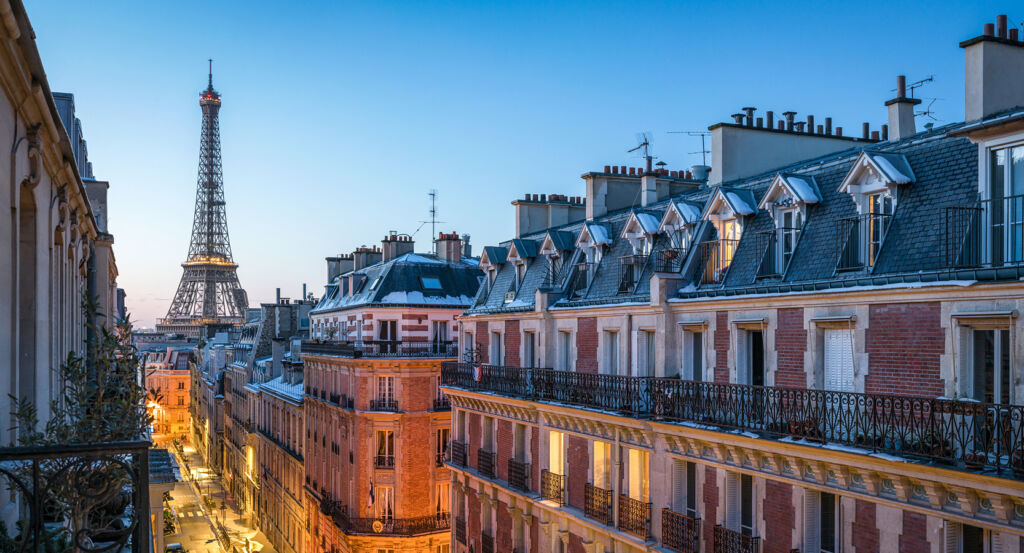
Why Auteuil matters.
Auteuil is a cultivated enclave where the western edge of Paris meets the Bois de Boulogne through former village streets, secluded villas and successive generations of architecture shaped by writers, artists and experimental designers.
Positioned between Passy, Porte Dauphine, and Boulogne-Billancourt, the neighborhood occupies a western pocket where Rue d'Auteuil, Rue La Fontaine and Rue Boileau retain the scale and irregular alignments of a settlement that remained independent from Paris until 1860. Low houses, planted private lanes, enclosed gardens and denser apartment buildings create repeated changes in scale, preserving traces of the country retreats that once attracted Parisians beyond the city. Rue d'Auteuil establishes the primary encounter through the former village center, where commercial frontage and older side streets continue an east-west route toward the Seine and Bois de Boulogne. Streets branching toward Villa Montmorency and Hameau Boileau deepen that character through gates, vegetation and detached houses that preserve an unusually residential counterpoint to the grand avenues of the surrounding 16th Arrondissement. Farther south, twentieth-century architecture introduces another layer through buildings that turned Auteuil into a testing ground for new approaches to domestic space, structure and facade design. The result is a neighborhood where village inheritance, literary retreat and architectural experimentation occupy the same western Paris terrain, preparing a history that began long before Auteuil entered the capital in 1860.
What defines Auteuil.
Auteuil is best known for developing from a rural village into a celebrated intellectual retreat whose relative isolation from Central Paris attracted successive circles of writers, philosophers and political thinkers. The settlement belonged to the seigneury of the Abbey of Sainte-Geneviève for centuries, with vineyards, agricultural land and country properties extending between the Seine and the forest west of Paris. Nicolas Boileau acquired a country house in Auteuil during the seventeenth century and gathered figures associated with the literary culture of Louis XIV's reign, establishing a tradition of intellectual sociability beyond the dense capital. A later circle formed around Anne-Catherine de Ligniville Helvétius, whose residence at 59 Rue d'Auteuil became one of the celebrated salons of the late eighteenth century. Benjamin Franklin joined its company during his years in France, alongside Condorcet, Cabanis, Malesherbes and Talleyrand, connecting the former village with Enlightenment philosophy, diplomacy and the political culture surrounding the American and French revolutions. Literary occupation continued during the nineteenth century when Edmond and Jules de Goncourt settled in Auteuil and received writers and artists in the gathering place they called their grenier. Their work together, followed by Edmond's establishment of the Académie Goncourt through his will, extended Auteuil's association with literary exchange into an institution that became central to French publishing culture. The sequence gave a western agricultural settlement an intellectual reputation sustained across several generations before and after incorporation into Paris.
The territorial reorganization of 1860 supplied a separate mechanism for remaking Auteuil as part of the expanding capital. Before annexation, the commune stretched beyond the boundaries of the present neighborhood and retained the appearance of a country settlement characterized by shaded roads, detached houses and extensive gardens. Napoleon III's enlargement of Paris divided the commune, attaching its principal village to the new 16th Arrondissement and assigning territory west of the fortifications to Boulogne. New streets and denser residential construction followed as western Paris attracted households seeking greater space beyond the older center. Villa Montmorency emerged from this nineteenth-century residential expansion as an enclosed district of detached country houses, and an 1863 Paris guide already singled it out among Auteuil's prominent residential developments. Another social chapter began in 1866 when Abbé Louis Roussel founded the Maison des Orphelins Apprentis d'Auteuil to provide vocational education for disadvantaged boys, establishing the institution that developed into Apprentis d'Auteuil. The former village entered modern Paris through simultaneous physical expansion and institutional growth, yet its surviving lanes and garden compounds retained a degree of separation from the denser city surrounding them.
How Auteuil fits.
Auteuil works as the anchor for an architectural exploration tracing the district from Hector Guimard's breakthrough experiments through Le Corbusier and Pierre Jeanneret's Purist houses into the glass residential block where Le Corbusier joined domestic life with his painting studio.
Begin at Castel Béranger, where Hector Guimard transformed a commission begun in 1894 into the project that established his position within Parisian Art Nouveau. His initial rationalist design drew from Eugène-Emmanuel Viollet-le-Duc, but a journey to Brussels in 1895 brought Guimard into contact with Victor Horta and Paul Hankar and redirected the building toward curving ironwork, varied brick and stone, ceramics, stained glass and individually designed interior components. Completed in 1898, Castel Béranger won the first Paris facade competition and gave Guimard a highly visible platform for the architectural approach that soon extended into his Métro entrances. Continue to Maison La Roche, designed with the adjoining Maison Jeanneret by Le Corbusier and Pierre Jeanneret between 1923 and 1925 for two radically different domestic programs. Albert Jeanneret's house accommodated his family, but banker and collector Raoul La Roche required both a residence and a gallery for Cubist and Purist works by figures including Picasso, Juan Gris and Fernand Léger; the resulting composition introduced pilotis and an interior ramp through which Le Corbusier first developed his architectural promenade, alongside early experiments in polychromy that grew from his painting with Amédée Ozenfant. Conclude at Immeuble Molitor, designed by Le Corbusier and Pierre Jeanneret from 1931 to 1934 on the boundary between Paris and Boulogne-Billancourt. Reinforced concrete freed the facades for extensive glazing in clear and Nevada glass, and Le Corbusier reserved the seventh and eighth floors for a 240-square-meter duplex combining his home with a painting studio and roof terrace; he moved there in 1934 and remained until his death in 1965. The building later joined sixteen other Le Corbusier sites on UNESCO's World Heritage List in 2016, carrying Auteuil's long history of secluded domestic architecture into an internationally consequential experiment in modern housing. The progression moves from Guimard absorbing Belgian Art Nouveau into a comprehensive Parisian design language through Le Corbusier and Jeanneret reorganizing a collector's house around art and movement into their use of reinforced concrete and glass for a radically different apartment block, revealing how Auteuil became fertile ground for successive challenges to conventional domestic architecture.
Where your story begins.
Foresyte Travel reveals places that feel extraordinary long before you arrive.
Enjoy editorial crafted for luxury travelers.
Foresyte may earn a commission when you book.














































































































