
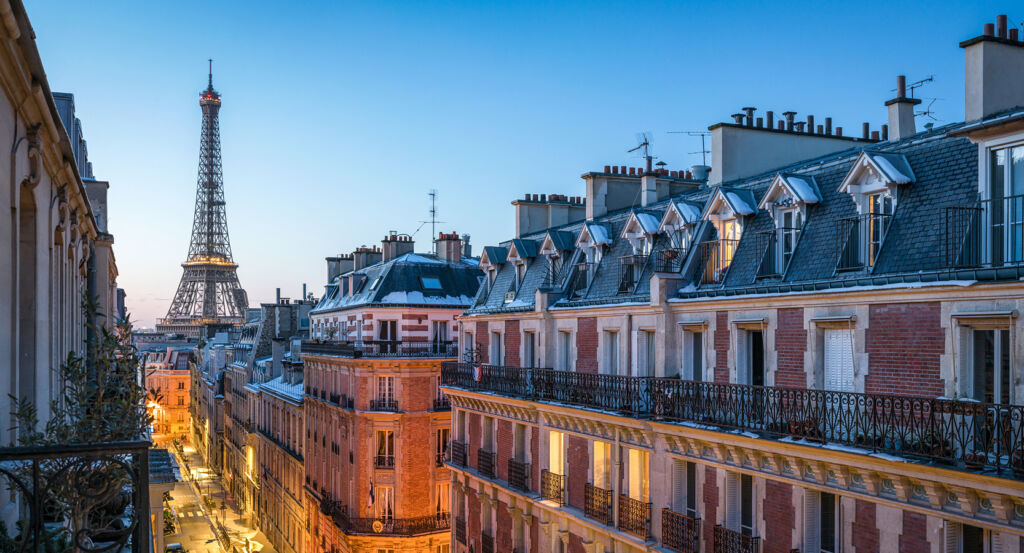
Why 16th Arrondissement matters.
16th Arrondissement is an expansive enclave where the western edge of Paris meets the Seine through former village streets, hillside avenues, garden districts and broad residential quarters extending from Chaillot to Auteuil.
Positioned between the Arc de Triomphe, Boulogne-Billancourt, and the Bois de Boulogne, the neighborhood occupies an elongated western territory where the slopes above the Seine descend through Chaillot and Passy before opening into the lower ground of Auteuil. Broad avenues lined with freestanding residences and substantial apartment buildings alternate with older village streets, secluded villas and steep passages, giving the Arrondissement a physical range uncommon within a single Parisian district. Passy establishes the primary encounter through winding streets whose changing elevations preserve the contours of a settlement that developed independently from Paris on hills overlooking the river. Auteuil introduces a second spatial mechanism through quieter roads, private lanes and garden-oriented housing whose lower density carries the western city toward the Bois de Boulogne. Chaillot adds a more formal metropolitan scale through long avenues, elevated public spaces and commanding Seine crossings that pull the Arrondissement back toward Central Paris. The result is a district whose breadth depends on the coexistence of former villages, planned residential expansion and metropolitan architecture, preparing a history shaped by the incorporation and remaking of several distinct western territories.
What you should know 16th Arrondissement.
16th Arrondissement is best known for bringing the former communes of Passy and Auteuil together with Chaillot during the territorial expansion that carried Paris to the Thiers fortifications in 1860. Passy had existed outside Paris as a hillside village of cultivators, winegrowers and quarry workers, with extensive underground extraction accompanying vineyards and houses above. Its slopes gradually attracted country residences and private estates under the Ancien Régime, introducing an affluent residential strand long before incorporation into the capital. Auteuil developed farther south as another independent settlement, separated from the denser city by agricultural ground and retaining its own municipal institutions until annexation. Chaillot followed a different course: the former village had entered Paris centuries earlier, giving the northern part of the future Arrondissement a closer connection to the expanding capital. The 1860 enlargement absorbed Passy and Auteuil into Paris and joined their territories with Chaillot inside the newly constituted Arrondissement. A new spiral numbering system accompanied the expansion, producing the present 16th designation after an earlier proposal would have assigned the number 13 to the affluent western districts. The resulting Arrondissement united territories with different topographies, building traditions and relationships to Paris, establishing the unusually varied urban geography still visible between Étoile, the Seine and the Bois de Boulogne.
Universal Expositions supplied a separate mechanism for turning the northern Seine frontage into one of Paris's principal ceremonial landscapes. The hill of Chaillot became the site of Gabriel Davioud and Jules Bourdais's Palais du Trocadéro for the 1878 Exposition Universelle, with Adolphe Alphand directing gardens that combined winding paths, cascades, rockwork and extensive planting around the exhibition palace. Paris had opened Place du Trocadéro in 1869 in anticipation of development across Chaillot, and the exhibition gave that emerging district a major architectural focus overlooking the Champ-de-Mars. Another exposition in 1900 extended the area's role in international display, including a subterranean mining exhibition conceived by Louis de Launay beneath the hill. The 1937 Exposition Internationale replaced the nineteenth-century palace with the Palais de Chaillot and reworked the central garden axis around the Fontaine de Varsovie, whose twenty inclined water cannons project across the great basin. Successive exhibitions turned terrain above the Seine into a sequence of terraces, museums, gardens and public approaches calibrated to the river and Champ-de-Mars, embedding international exhibition culture into the northern edge of the Arrondissement.
How 16th Arrondissement fits.
16th Arrondissement works as the anchor for a daytime exploration connecting Honoré de Balzac's secluded writing residence, Hector Guimard's breakthrough apartment building and Le Corbusier's early architectural experiment for a collector of modern art.
Begin at Maison de Balzac, where Honoré de Balzac occupied part of a hillside house in Passy from 1840 to 1847 under the name Monsieur de Breugnol, using a residence with entrances at different elevations as both refuge and workplace during a decisive period in the construction of La Comédie humaine. Archaeological investigation in 2002 uncovered late-medieval troglodytic habitation within its cellars, the only examples known in Paris, extending the site's history far behind the writer; Balzac completed the first sixteen volumes of the Furne edition of La Comédie humaine during his Passy years before leaving for Rue Fortunée. Continue to Castel Béranger, the apartment building Hector Guimard constructed between 1894 and 1898 as his first major work, initially developing the project through the rationalist principles of Eugène-Emmanuel Viollet-le-Duc before his 1895 encounter with Victor Horta in Brussels redirected its decorative language toward Art Nouveau. Stone, brick, metalwork and curving ornament spread Guimard's design across facade, balconies and entrance, turning an apartment commission into an architectural manifesto that established his position in Paris before his later work for the Métro. Conclude at Maison La Roche, designed by Le Corbusier and Pierre Jeanneret between 1923 and 1925 as one half of a paired composition serving two sharply different domestic programs. Banker and collector Raoul La Roche required a residence capable of displaying his Cubist and Purist collection, much of it assembled through Le Corbusier and Amédée Ozenfant, leading the architects to separate private apartments from a gallery and organize movement through changing volumes; reinforced concrete enabled an early realization of principles Le Corbusier later codified in 1927 as the five points of a new architecture. The progression moves from Balzac converting an unusual hillside dwelling into the workplace of an immense literary project through Guimard redirecting Parisian apartment architecture toward Art Nouveau into Le Corbusier and Jeanneret reorganizing the private house around modern art and spatial movement, tracing three generations of creative experimentation embedded within the residential fabric of the 16th Arrondissement.
Where your story begins.
Foresyte Travel reveals places that feel extraordinary long before you arrive.
Enjoy editorial crafted for luxury travelers.
Foresyte may earn a commission when you book.














































































































