
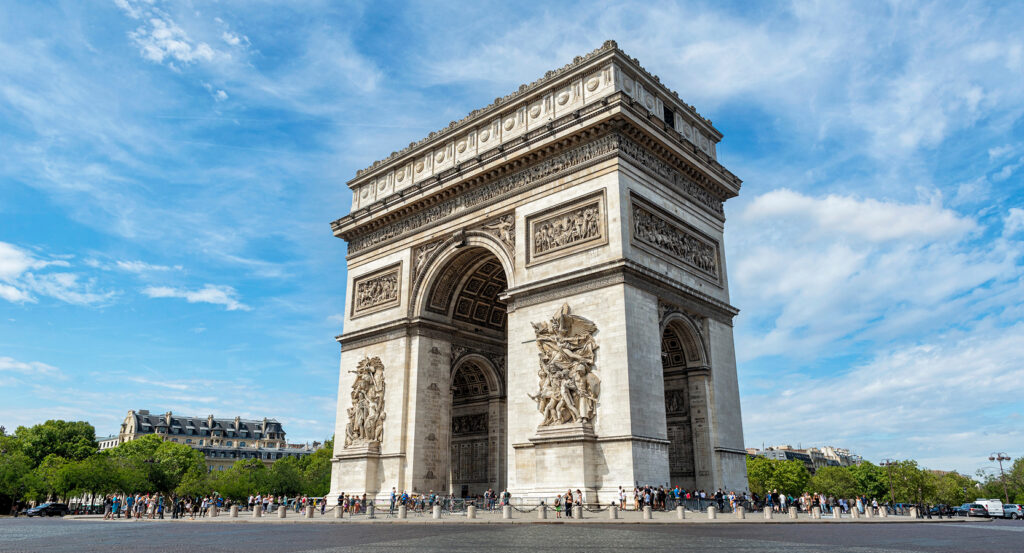
Why Arc de Triomphe matters.
Arc de Triomphe is a commanding commemorative monument where Chaillot's grand avenues meet Napoleonic ambition, revolutionary military memory and a national ceremonial site built at the western culmination of the Champs-Élysées.
Set within Place Charles de Gaulle near Avenue des Champs-Élysées and just steps from Avenue Kléber, the monument occupies the center of a vast circular junction where twelve radiating avenues, continuous Haussmann-era facades and long axial views create one of western Paris's most expansive urban compositions. Its four immense piers rise above the traffic ring with a single central vault opening views between the Champs-Élysées and Avenue de la Grande Armée. Avenue Foch and Avenue Kléber extend the composition toward western Paris as the surrounding avenues divide the perimeter into sharply defined wedges of nineteenth-century building fabric. François Rude's sculptural group and the other colossal reliefs animate the lower elevations before the restrained attic and balustrade establish a heavier upper profile against the open sky. The result is a grand urban hinge where architecture, sculpture and twelve radiating avenues transform a military memorial into the organizing center of an entire Parisian district.
What defines Arc de Triomphe.
Arc de Triomphe is best known for transforming Napoleon I's 1806 tribute to the Grande Armée into a national monument whose thirty-year construction absorbed successive political regimes and competing interpretations of French military history. Napoleon ordered the arch after Austerlitz through an imperial decree signed on February 18, 1806, and Jean-François-Thérèse Chalgrin developed the initial scheme with Jean-Arnaud Raymond for the western end of the Champs-Élysées. Their single-opening design drew on the Arch of Titus, the Arch of Constantine and François Blondel's Porte Saint-Denis, giving imperial Paris a structure rooted in Roman triumphal architecture. The foundation stone was placed eight meters below ground on Napoleon's birthday, August 15, 1806, yet the monument remained unfinished when the Empire collapsed in 1814. Construction resumed under Charles X with a dedication to the Army of the Pyrenees before the July Revolution changed the political purpose again. Louis-Philippe appointed Guillaume-Abel Blouet in 1832 to complete an arch now devoted to the armies of both the Revolution and Empire. Interior Minister Adolphe Thiers simultaneously commissioned an extensive sculptural program from artists including François Rude, Jean-Pierre Cortot and Antoine Étex. Military commemoration spread across the structure through battle names and hundreds of officers inscribed on the piers, with omissions provoking further additions after completion. The arch was inaugurated on July 29, 1836 after three decades of construction, leaving a Napoleonic commission physically completed under a constitutional monarchy and dedicated to a broader span of French military history.
The four colossal sculptural groups created between 1833 and 1836 converted the piers into distinct episodes of revolution, empire, resistance and peace. François Rude developed Le Départ des volontaires de 1792 around a winged Génie de la Liberté calling volunteers toward battle, using an allegorical composition to commemorate the mobilization ordered by the Legislative Assembly against the European coalition. Jean-Pierre Cortot answered that revolutionary subject on the Champs-Élysées elevation with Le Triomphe de Napoléon, centering the composition on the emperor during the imperial ascendancy of 1810. Antoine Étex supplied La Résistance de 1814 and La Paix de 1815 for the western elevation, extending the sculptural cycle through the collapse of the Empire and cessation of war. Additional reliefs above the groups developed episodes including Austerlitz, Jemappes and the funeral of General Marceau, embedding individual military events within the larger architectural program. The attic carries major battle names as inscriptions across a structure measuring close to fifty meters high, giving written commemoration an architectural scale distinct from the figurative sculpture below. Rude's departure group subsequently became closely associated with La Marseillaise, even though its subject concerns the volunteers of 1792 and its official title remains Le Départ des volontaires. Arc de Triomphe binds several political eras into one sculptural ensemble, allowing Revolution, Napoleonic victory, invasion and peace to occupy separate faces of the same monument.
How Arc de Triomphe fits.
Arc de Triomphe works as the anchor for a daytime exploration through the western 8th Arrondissement using three nearby sites that move from a Second Empire collector's mansion through an eighteenth-century pleasure garden reconstructed for Haussmannian Paris into a twentieth-century house built to preserve an exceptional collection of ancien régime decorative art.
Begin at Musée Jacquemart-André, created from the collecting partnership of Édouard André and Nélie Jacquemart inside the hôtel particulier Henri Parent built between 1869 and 1876 on the newly established Boulevard Haussmann. André, heir to a banking fortune and former officer in Napoleon III's Imperial Guard, commissioned Jacquemart to paint his portrait in 1872 and married her in 1881; subsequent journeys through Italy and the Near East expanded a collection installed within Parent's classical rooms and dramatic double-revolution staircase. André died in 1894, and Jacquemart continued acquiring art before leaving the residence and collections to the Institut de France. Raymond Poincaré inaugurated the museum on December 8, 1913, preserving the couple's domestic arrangement within one of the grand private houses generated by Haussmann's reconstruction. Continue to Parc Monceau, whose origins reach Philippe d'Orléans, duc de Chartres, and his 1769 acquisition of the Mousseau property. Louis Carrogis Carmontelle transformed the grounds from 1773 through an Anglo-Chinese garden populated with architectural follies, and Claude-Nicolas Ledoux added the circular Barrière de Chartres in 1787 when the Farmers-General wall cut through the estate. Jean-Charles Alphand reconstructed the reduced property as a public English-style park during the Second Empire, with Gabriel Davioud and Jean-Pierre Barillet-Deschamps participating in the 1860s intervention as surrounding land entered the Pereire brothers' residential development. The surviving pyramid, rotunda and fragments of Carmontelle's garden preserve earlier phases inside Alphand's later landscape. Conclude at Musée Nissim de Camondo, where Moïse de Camondo demolished his inherited Second Empire residence and commissioned René Sergent to build a new house between 1911 and 1914 for his collection of eighteenth-century French decorative art. Sergent drew on the Petit Trianon while incorporating modern domestic infrastructure, and Achille Duchêne developed the garden beside Parc Monceau. Camondo assembled works by cabinetmakers including Jean-François Oeben alongside Sèvres porcelain, Savonnerie carpets, silver and furniture connected with the courts of Louis XV and Louis XVI. His son Nissim died in aerial combat in 1917, prompting Moïse to bequeath the house and collection in his memory; the museum opened in 1936 after Moïse's death. The progression moves from André, Jacquemart and Parent's Second Empire collecting palace through Carmontelle, Ledoux and Alphand's successive reconstruction of Parc Monceau into Sergent and Camondo's early twentieth-century recreation of an eighteenth-century residence, developing three chapters in the patronage and urban transformation surrounding the western Champs-Élysées district.
Where your story begins.
Foresyte Travel reveals places that feel extraordinary long before you arrive.
Experience premium editorial crafted for luxury travelers.
Foresyte Travel may earn a commission when you book through the link on this page.














































































































