
Why you should experience Elysées Opéra Hôtel in Paris, France.
Elysées Opéra Hôtel is a composed three-star hotel where Europe's Haussmannian order, theatrical inheritance, railway-era momentum and quietly residential streets converge inside a compact house newly sharpened for contemporary Paris.
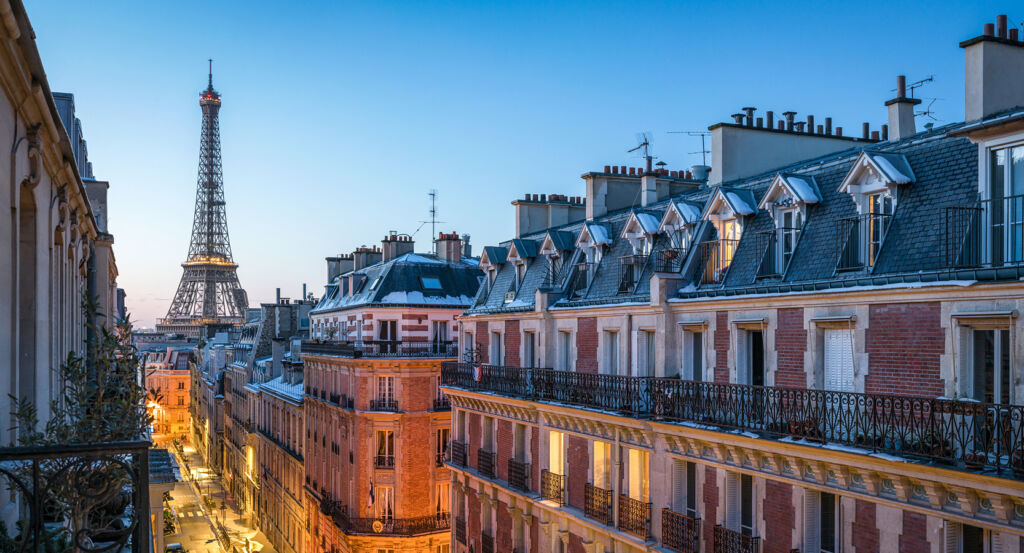
Set along Rue de Turin between Place de Clichy and Gare Saint-Lazare, the 39-room hotel occupies a Haussmannian building whose wrought-iron balconies and vertically ordered stone façade preserve the architectural language established as this part of the eighth Arrondissement expanded during the nineteenth century. A complete 2023 renovation recast all six accommodation floors, pairing oak-toned flooring and pale walls with saturated blue, patterned textiles and streamlined furnishings while maintaining the tall windows and balcony relationships inherited from the building. The property sits within the Europe quarter, an unusual district whose streets were systematically named for European cities as the surrounding railway infrastructure accelerated the area's development. The result is a hotel where a freshly edited interior inhabits a nineteenth-century urban structure still defined by the architecture, railway history and cosmopolitan naming scheme that created Europe.
What you should know about Elysées Opéra Hôtel.
Elysées Opéra Hôtel is best known for completing a comprehensive renovation of all 39 guestrooms in 2023, reworking six floors inside its Haussmannian building at 17 Rue de Turin while retaining the tall French windows, wrought-iron balconies and ordered stone frontage that establish the property's nineteenth-century architectural character. The current accommodation collection ranges from 11-square-meter Single rooms with 100-by-200-centimeter beds through Classic and Superior configurations to Premium rooms, with soundproofing and redesigned bedding forming part of the renovation across the inventory. Rue de Turin belongs to the Europe quarter's distinctive network of streets named for continental cities, a scheme initiated during the nineteenth-century development of the former Tivoli lands and expanded as the Saint-Lazare railway transformed the surrounding district into one of Paris's principal transportation and commercial territories. Elysées Opéra Hôtel consequently occupies a building whose 2023 reinvention sits inside a much older urban composition, connecting contemporary hospitality with the Haussmannian architecture and railway-driven expansion that produced this particular fragment of the eighth Arrondissement.
Place de l'Europe provides the organizing idea behind that urban composition, with the surrounding network assigning names including Londres, Amsterdam, Moscou, Madrid, Rome and Turin to streets radiating through a district conceived around an explicitly continental identity. Rue de Turin carries the Italian component of that scheme directly past Elysées Opéra Hôtel, embedding the property's address within a nineteenth-century act of metropolitan placemaking whose style remains legible across the neighborhood. Gare Saint-Lazare accelerated the area's development as successive railway enlargements concentrated travelers, hotels, commerce and entertainment around Europe, giving the street system an economic purpose that extended well beyond its cartographic novelty. Together, Place de l'Europe, Rue de Turin and Gare Saint-Lazare explain the deeper character of Elysées Opéra Hôtel, a small contemporary hotel inhabiting one of Paris's most unusually coherent nineteenth-century experiments in architecture, transportation and cosmopolitan identity.
How to fold Elysées Opéra Hôtel into your trip.
Elysées Opéra Hôtel works as the anchor for an afternoon tracing the private artistic salons, theatrical experimentation and architectural performance that flourished between Europe and Nouvelle Athènes during nineteenth-century Paris.
Begin at Musée de la Vie Romantique, where Dutch-born painter Ary Scheffer settled in 1830, built two north-facing studios and hosted Friday gatherings attended by Eugène Delacroix, George Sand, Frédéric Chopin, Franz Liszt, Rossini and Charles Dickens before the property became a City of Paris museum in 1983. Continue to Théâtre de l'Œuvre, whose history reaches the experimental theater founded by actor-director Aurélien Lugné-Poe in 1893, a Symbolist enterprise associated with artists including Édouard Vuillard and Pierre Bonnard and with the notorious 1896 premiere of Alfred Jarry's Ubu Roi. Conclude at Palais Garnier, where Charles Garnier won an anonymous architectural competition in 1861, spent fourteen years realizing Napoleon III's new opera house and created the 1,979-seat theater inaugurated in 1875 beneath Marc Chagall's 1964 ceiling composition. The progression moves from Scheffer's intimate Romantic salon through Lugné-Poe's rebellious theatrical laboratory into Garnier's immense synthesis of architecture, painting and performance, revealing the unusually concentrated creative culture surrounding Elysées Opéra Hôtel.
Where your story begins.
Foresyte Travel reveals places that feel extraordinary long before you arrive.
Experience premium editorial crafted for luxury travelers.














































































































