
Why Nouvelle Athènes matters.
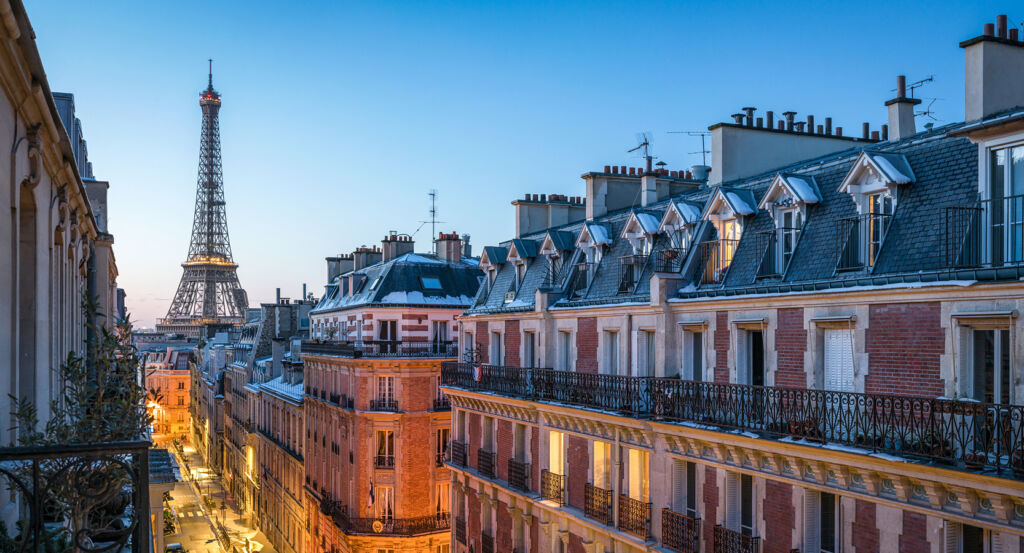
Nouvelle Athènes is an elegant enclave where the lower slopes of Montmartre meet Romantic Paris through neoclassical facades, secluded residential courts and streets purpose-built for the artists, performers and writers who transformed the nineteenth-century Right Bank.
Positioned between Pigalle, Chaussée-d'Antin, and Saint-Georges, the neighborhood occupies a rising pocket of the 9th Arrondissement where Rue Blanche, Rue des Martyrs and Rue Saint-Lazare frame streets climbing across terrain that remained thinly developed before the nineteenth century. Neoclassical houses, compact hôtels particuliers, garden courts and restrained five-story facades preserve the residential scale established as speculative development advanced across former agricultural ground. Rue de la Tour-des-Dames establishes the primary encounter through an exceptional concentration of private houses commissioned by celebrated stage performers, giving one short street the architectural character of a theatrical colony. Rue de La Rochefoucauld and the streets ascending toward Pigalle deepen the physical character through changing gradients, recessed entrances and properties whose workshops and gardens sit behind relatively quiet street fronts. Place Saint-Georges adds a more formal spatial composition, its curved building line and radiating streets revealing the coordinated planning that accompanied the district's rapid construction. The result is a neighborhood where topography, residential architecture and artistic ambition remain tightly interwoven, preparing an account of the speculative development that created one of nineteenth-century Paris's most concentrated cultural quarters.
What defines Nouvelle Athènes.
Nouvelle Athènes is best known for emerging from the speculative subdivision of land on the slopes of the Saint-Georges quarter beginning in 1819 and 1820, when financier Jean de la Peyrière and architect Léopold-Auguste Constantin began developing territory beyond the densely built center of Paris. Saint-Georges entered its own major phase of subdivision in 1823 and 1824, extending streets and residential construction across terrain attractive to an increasingly prosperous population seeking new houses on the Right Bank. Journalist Adolphe Dureau de la Malle supplied the development with its enduring cultural name on October 18, 1823, when he used Nouvelle Athènes in the Journal des Débats amid French fascination with ancient Greece and contemporary support for Greek independence from Ottoman rule. Alexandre Delessert and Louis Nicolas Hubert Lavocat extended this urban expansion in 1825 by securing royal authorization to open Rue Chaptal between Rue Blanche and Rue Pigalle, then circulated a plan advertising property for construction. The architecture emerging across the district drew heavily upon neoclassicism, with private residences adopting Greek and Italian references suited to the name attached to the quarter. Performers François-Joseph Talma, Mademoiselle Mars and Mademoiselle Duchesnois established an early theatrical presence, followed by painters Théodore Géricault, Eugène Delacroix, Horace Vernet, Paul Delaroche and Théodore Chassériau. Musicians Frédéric Chopin, Hector Berlioz, Charles Gounod and Georges Bizet joined writers George Sand, Théophile Gautier, Victor Hugo, Charles Baudelaire and Alexandre Dumas across the surrounding streets. Their concentration converted a real-estate venture into a principal center of Parisian Romantic culture, with domestic architecture, private salons and artistic production developing inside the same newly constructed quarter.
A later generation carried Nouvelle Athènes into another artistic phase as cafés around Place Pigalle became gathering places for painters developing new approaches during the final decades of the nineteenth century. The Café de la Nouvelle Athènes became particularly associated with Edgar Degas and artists connected with Impressionism after opening on Place Pigalle during the 1870s. Édouard Manet, Pierre-Auguste Renoir and Camille Pissarro belonged to the wider circle connected with the establishment, shifting a name born from Restoration-era residential development into the café culture of a younger artistic generation. Degas drew upon this setting for L'Absinthe, painted in 1875 and 1876 with actress Ellen Andrée and artist Marcellin Desboutin seated before drinks at a café table. The work entered the collection of Captain Henry Hill before appearing in the 1893 London exhibition that provoked intense debate around Degas's depiction of modern metropolitan isolation. The neighborhood had consequently moved through successive artistic concentrations across the century, first through residences and private creative circles and later through public cafés where painters used contemporary Paris itself as subject matter.
How Nouvelle Athènes fits.
Nouvelle Athènes works as the anchor for an afternoon tracing Restoration religious architecture, a Symbolist painter's deliberately preserved working environment and the residential culture that brought major figures of Romantic music and literature into a shared private court.
Begin at Église Notre-Dame-de-Lorette, commissioned after an architectural competition launched in 1823 for a new church serving the rapidly expanding district and awarded to Louis-Hippolyte Lebas. Lebas developed a basilican plan drawing upon Roman precedents, and the building reached completion in 1836 before its extensive interior decoration continued through later campaigns; paintings executed principally in wax, gilded surfaces and enameled lava introduced contemporary techniques into a program involving numerous artists, making the church a major Restoration-era experiment in uniting architecture and painted decoration. Continue to Musée Gustave Moreau, occupying the house acquired in 1852 by architect Louis Moreau for his son Gustave and entered by the family the following year. Gustave Moreau commissioned Albert Lafon in 1895 to remake the upper levels as immense studios intended to preserve and display his work, then spent his final years arranging paintings and drawings for the museum envisioned in his 1897 will; the resulting house joins intimate family rooms with towering studio galleries and Moreau's celebrated spiral staircase, preserving the unusual conversion of a private artist's residence into a museum conceived by the artist himself. Conclude at Square d'Orléans, the secluded residential court at 80 Rue Taitbout whose buildings developed into their present configuration under successive English owners during the nineteenth century. George Sand settled at number 5 and Frédéric Chopin at number 9 in 1842, joining residents who included dancer Marie Taglioni, pianist Friedrich Kalkbrenner, sculptor Jean-Pierre Dantan and singer Pauline Viardot; Sand and Chopin's neighboring apartments became part of an unusually concentrated social world where music, literature and private gatherings joined residential life inside an English-inspired court removed from the surrounding streets. The progression moves from Lebas giving the new quarter a major Restoration church through Moreau converting his family residence into a permanent artistic repository into Sand, Chopin and their neighbors concentrating Romantic creative life within a shared residential court, revealing how architecture became an active setting for the religious, artistic and musical culture of Nouvelle Athènes.
Where your story begins.
Foresyte Travel reveals places that feel extraordinary long before you arrive.
Experience premium editorial crafted for luxury travelers.
Foresyte Travel may earn a commission when you book through the link on this page.














































































































