
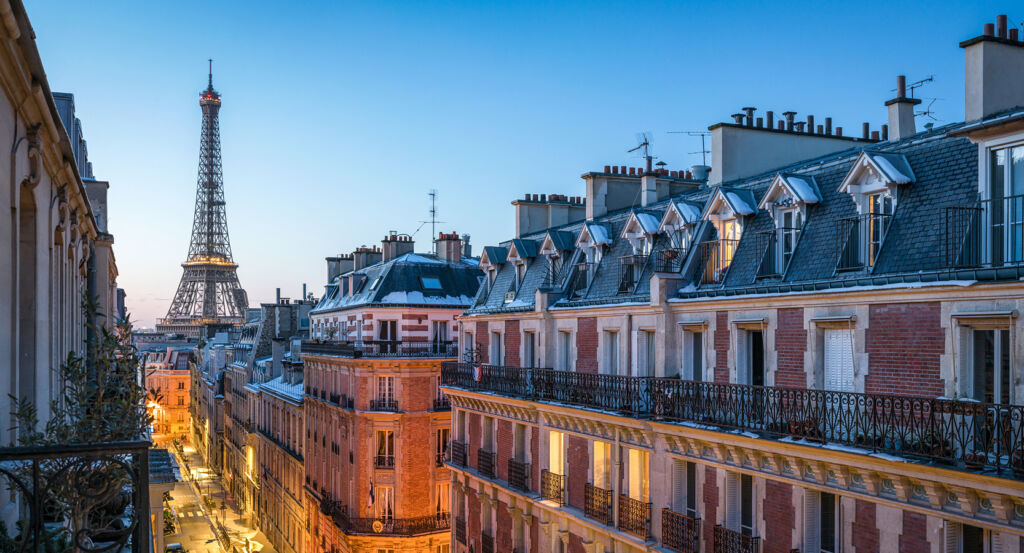
Why 9th Arrondissement matters.
9th Arrondissement is an architecturally rich enclave where the Grands Boulevards meet the lower slopes of Montmartre through neoclassical streets, commercial boulevards, theaters and residential quarters created during successive waves of nineteenth-century expansion.
Positioned between Montmartre, the 8th Arrondissement, and the Central Right Bank, the neighborhood occupies rising terrain where Boulevard Haussmann, Rue La Fayette, Rue des Martyrs and Rue du Faubourg Montmartre connect the dense boulevard city below with the steeper streets approaching Pigalle. Broad commercial axes across its southern half give way to smaller squares, private lanes and sloping residential streets farther north, producing unusually sharp changes in scale across a compact section of Paris. Rue des Martyrs establishes the primary encounter through a long ascending route that predates much of the surrounding construction and carries the street pattern directly toward Montmartre. Streets around Notre-Dame-de-Lorette and Saint-Georges deepen the physical character through neoclassical facades, former artists' houses and planned residential developments built across terrain previously occupied by orchards and market gardens. Boulevard Haussmann supplies a second urban register through the grand commercial architecture that concentrated fashion and metropolitan consumption along the Arrondissement's southern edge. The result is a neighborhood where older routes, Romantic-era expansion and the commercial ambitions of nineteenth-century Paris remain unusually close together, preparing a history shaped by the city's decisive movement north from the Grands Boulevards.
What you should know 9th Arrondissement.
9th Arrondissement is best known for encompassing the Nouvelle Athènes, the planned quarter that transformed agricultural slopes below Montmartre into one of nineteenth-century Paris's principal concentrations of artists, writers and musicians. Jean de la Peyrière and architect Léopold-Auguste Constantin initiated subdivision in 1819 and 1820, opening a period of speculative development across orchards and cultivated ground north of the older city. Saint-Georges underwent subdivision in 1823 and 1824, and Alexandre Delessert and Louis Nicolas Hubert Lavocat received royal authorization to open Rue Chaptal between Rue Blanche and Rue Pigalle in 1825. Journalist Adolphe Dureau de la Malle had already attached the name Nouvelle Athènes to development on the Saint-Georges slopes in the Journal des Débats on October 18, 1823, connecting the new neoclassical quarter with contemporary French enthusiasm for Greek independence. Painters Théodore Géricault, Eugène Delacroix, Horace Vernet and Paul Delaroche established themselves across the surrounding streets as the district developed. George Sand moved to Rue Jean-Baptiste Pigalle in 1839, Frédéric Chopin joined her there in 1841, and both moved to Square d'Orléans the following year. Musicians Hector Berlioz, Charles Gounod and Georges Bizet joined writers including Théophile Gautier, Alexandre Dumas, Victor Hugo and Charles Baudelaire across the wider quarter, creating an exceptional concentration of Romantic-era cultural figures within the expanding Right Bank.
Department stores supplied a separate mechanism for reshaping the Arrondissement as western Paris became a center of mass retail during the later nineteenth century. Jules and Augustine Jaluzot opened Printemps in 1865 beside the newly driven Boulevard Haussmann, choosing territory still undergoing reconstruction near Saint-Lazare. Fire destroyed much of the store in 1881, prompting architect Paul Sédille to rebuild it with an exposed iron-and-glass structural system and electric lighting that placed new engineering directly at the service of retail. Théophile Bader and Alphonse Kahn began Galeries Lafayette with a 70-square-meter shop at Rue La Fayette and Chaussée d'Antin in 1893, then acquired adjoining properties as the enterprise expanded. Architect Georges Chedanne completed major work in 1907 before Ferdinand Chanut directed the 1912 enlargement around a 43-meter dome whose stained glass came from Jacques Gruber and whose ironwork involved Louis Majorelle. Galeries Lafayette extended the relationship between commerce and applied art through La Maîtrise workshops under Maurice Dufrêne in 1922, with Jean and Jacques Adnet among the early collaborators. Jules Védrines added an aviation episode to the building's history on January 19, 1919 when he landed a Caudron G.3 on its rooftop and collected a 25,000-franc prize, demonstrating how the Arrondissement's commercial institutions had become stages for technology and public performance as well as retail.
How 9th Arrondissement fits.
9th Arrondissement works as the anchor for a daytime exploration connecting pioneering iron-and-glass commercial architecture, a music hall repeatedly rebuilt around new forms of popular performance and the Second Empire opera house that joined architecture, sculpture, painting and stage engineering on an unprecedented scale.
Begin at Passage Jouffroy, opened in 1847 as a continuation of the covered route running north from Passage des Panoramas and constructed across former gardens belonging to the Marquis d'Aguado. Promoter Félix de Jouffroy-Gonsans developed the 140-meter passage with architects François-Hippolyte Destailleur and Romain de Bourges, whose structure ranked among the early Parisian applications of cast iron, iron and extensive glazing to a commercial arcade; its site had also contained the Restoration-era Boîte aux Artistes, a residence occupied by numerous artists during the 1820s. Continue to Folies Bergère, where Albert Boislève converted the rear of a former bedding store into a theater that opened on May 2, 1869 with 768 auditorium seats and another 400 seats in its café area. Léon Sari later incorporated the failed store into a winter garden, the Isola brothers established the revue as a central component of the theater after 1902, and Paul Derval began a directorship lasting from 1919 until 1966; a 27,000-liter reinforced-concrete pool appeared beneath the stage in 1924, followed by a 16-month rebuilding campaign that increased capacity from 920 to 1,740 and gave the facade its Art Deco treatment by Pico. Conclude at Palais Garnier, born from the international competition for a new imperial opera house in 1860 and won the following year by 35-year-old Charles Garnier against 170 other submissions. Construction began after steam pumps drained groundwater for five months in 1862, reached the stage and machinery phase in 1866 and survived interruption during the Franco-Prussian War before the completed theater opened on January 5, 1875; Garnier coordinated architecture with extensive sculptural and painted decoration, creating a building conceived for the technical requirements and ceremonial culture of French grand opera. The progression moves from Destailleur and Romain de Bourges enclosing commerce beneath nineteenth-century iron and glass through Folies Bergère engineering increasingly elaborate forms of popular performance into Garnier coordinating architecture, fine art and theatrical technology at metropolitan scale, revealing the successive forms of public entertainment that reshaped the 9th Arrondissement.
Where your story begins.
Foresyte Travel reveals places that feel extraordinary long before you arrive.
Experience premium editorial crafted for luxury travelers.
Foresyte Travel may earn a commission when you book through the link on this page.














































































































